
Reading

25 Years In, AVAM’s Kinetic Sculpture Race is Classic Baltimore

Previous Story
Article Image

BmoreArt’s Picks: September 23-29

Next Story
Article Image

BmoreArt News: Wide Angle Youth Media, ‘Fan [...]

Art can be a cerebral experience that transcends space and time for creators as well as observers. But there is an inescapable physicality when it comes to sculptures. No matter how conceptual an idea may be, a sculptor must consider length, depth, and height when rendering an object into a three dimensional form. And how does a sculpture interact with space? 

When Pablo Picasso was working on a public sculpture for the Daley Plaza, he built a maquette and studied the way light and shadows passed through it. That’s just one example of the many variables that sculptors reckon with. But what happens when movement is added to the equation?

In 1969, California artist Hobart Brown toyed with this idea when upgrading his son’s tricycle into a “pentacycle.” He didn’t re-invent the wheel by adding two extra ones, but his silly tinkering became the vehicle for something revolutionary. Not only was his artistic neighbor Jack Mays inspired to make a similar moveable sculpture, but he challenged Brown to a race. The race garnered more participants as well as media attention. Soon it became an annual event in Ferndale, California.

Three decades passed since the pentacycle’s debut race, but that didn’t mean things were slowing down. In 1999, staff members from the newly established American Visionary Art Museum in Baltimore caught wind of Brown’s adventures through a segment on Good Morning America. Theresa Segreti, the Director of Design (and All the Fun Stuff), described Brown as a “cowboy hippie. He looked like the Monopoly Man. He wore a little top hat, he had a big mustache, but he wore overalls. He was this little crazy guy who invented this race.”

Segreti, who has since retired, recalls those early years at AVAM. “It was really in the front of all of our minds to come up with projects that would be galvanizing for the community,” she says. A kinetic sculpture race seemed like the perfect thing. “The race was just wacky and it celebrated things we were interested in. It celebrated creativity. It was art meets engineering.” 

Segreti reached out to Brown on a whim to pick his brain and he was receptive. He had helped influence races all over the world, but there was something that piqued his curiosity about Baltimore. “He was really interested in what would happen if the race was in an urban setting.”

Brown visited Baltimore a few times to consult with the AVAM team. “He was very generous with his information,” Segreti remarks. But there were a lot of logistics to consider. “Him telling you how to make it happen and then making it happen were two incredibly different things.” 
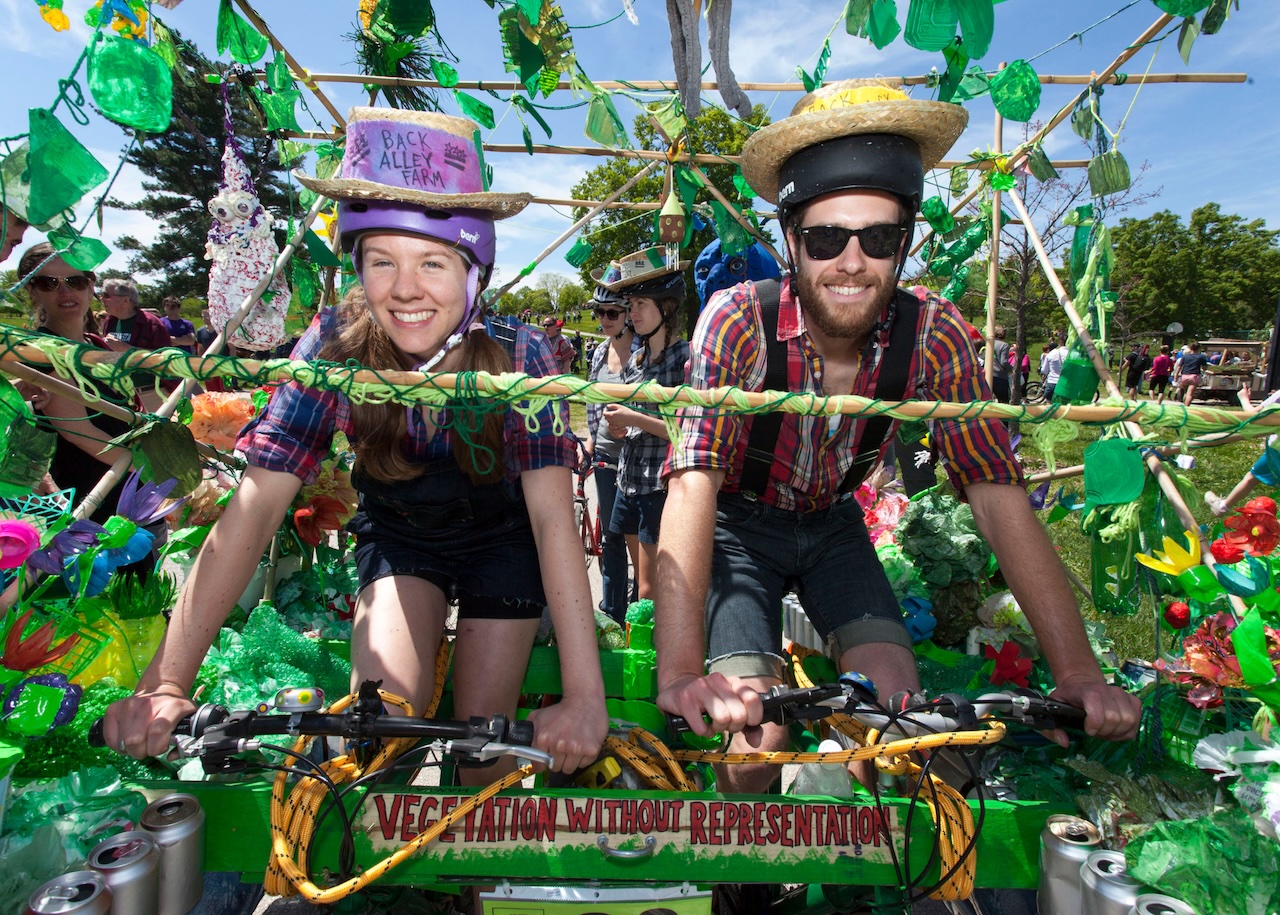
AVAM Kinetic Race photo by Maria Sanchez
Kinetic 2013 by Eric Zhang, courtesy of AVAM
AVAM Kinetic Race photo by Maria Sanchez
I had to convince Baltimore City that we were going to make this happen. You have to create an all-terrain vehicle that is art and that is human-powered. It was something that you had to see in order to understand it.
Theresa Segreti

One could see parallels between Newton’s Laws of Motion to AVAM’s efforts on starting their own kinetic sculpture race. On NASA’s website, Newton’s first law states that “every object will remain at rest or in uniform motion in a straight line unless compelled to change its state by the action of an external force.” 

The AVAM team wanted this idea to accelerate, but first they had to overcome inertia. “I had to convince Baltimore City that we were going to make this happen,” Segreti says. “You have to create an all-terrain vehicle that is art and that is human-powered. It was something that you had to see in order to understand it.” 

With a tray of cookies and a positive attitude, Segreti would show up to city meetings, determined to get the greenlight for the race. It was a challenge to persuade the police department, the fire department, and the Mayor’s Office due potential traffic and safety concerns. But someone from the Baltimore Office of Promotion and the Arts was intrigued. They suggested that AVAM’s Kinetic Sculpture Race could be a part of their Waterfront Festival. 

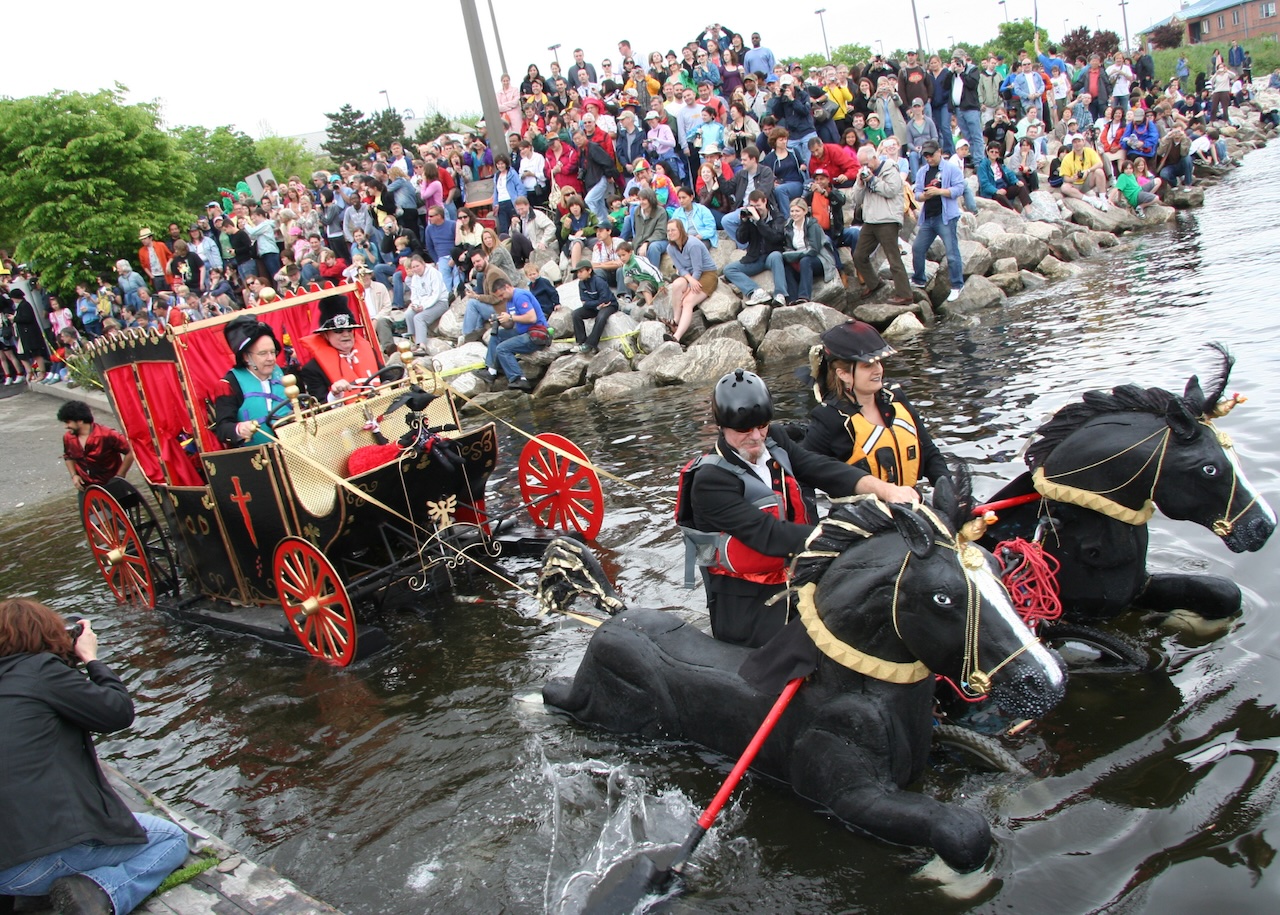
There were only six vehicles taking part in the first race. “That first year, they looked like trash on wheels,” Segreti laughs. The all-terrain race had to travel on pavement, through mud and across water, so they launched the kinetic sculptures into the Inner Harbor. Simultaneously, there was a yacht race happening as part of the Waterfront Festival.

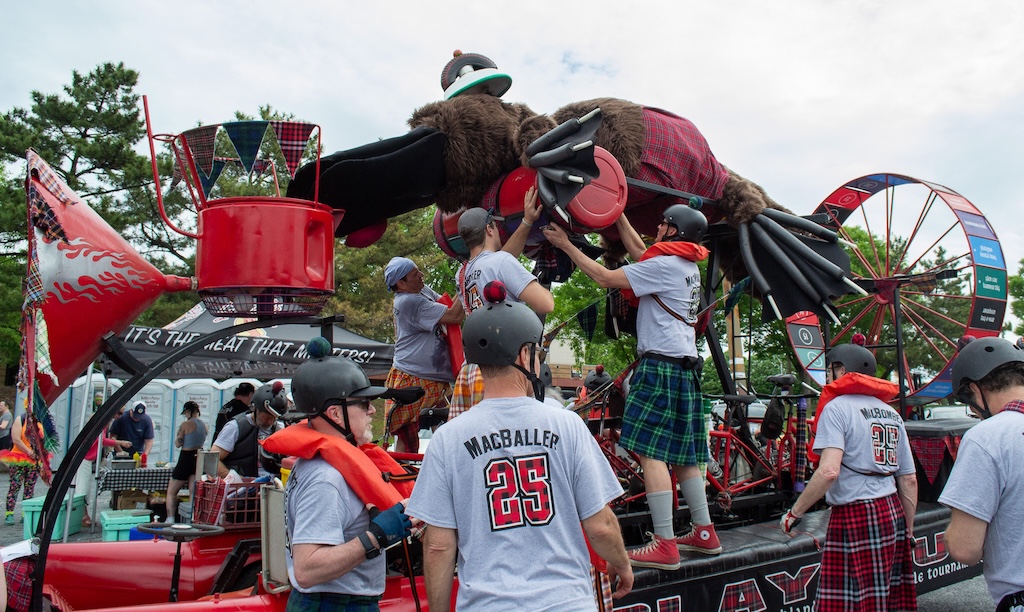
AVAM Kinetic Race photo by Maria Sanchez
Kinetic 2009 by Tom Jones, courtesy of AVAM
In 2025, we were proud to return for the second straight year as the presenting sponsor of the Kinetic Sculpture Race Powered by PNC. This now widely beloved event champions community, imagination, and invention, which is the spirit of Baltimore.
Laura Gamble

“Everybody was standing around waiting for these identical, beautiful boats to make it to the finish line, but then they saw our crazy teams of trash pushed by people,” Segreti says. “Will it float or won’t it float? Are people going to die in the Inner Harbor? It became really interesting.”

The first race was a success, but AVAM soon realized that in order to make it an annual event, they would have to figure out ways to fund and organize it themselves. They were already wearing many hats, but now it was time to roll up their sleeves. This was going to need some elbow grease, because according to Newton’s second law of motion, “the acceleration of an object depends on the mass of the object and the amount of force applied.” There was inevitable friction, but with some push and pull, they persevered. 

“In order to appease the city I tried to put as many of the routes in parks so that we would get off the street, but you couldn’t avoid going park to park without going through city traffic, so we did need a police escort to get us through traffic,” Segreti says. 

As the Kinetic Sculpture Race found its way, figuratively and literally, it won hearts and supporters in Baltimore, including its presenting sponsor. “As part of PNC’s philanthropic investment in arts and culture in Baltimore City, we are a longtime supporter of AVAM,” says PNC Regional President for Greater Maryland Laura Gamble. “In 2025, we were proud to return for the second straight year as the presenting sponsor of the Kinetic Sculpture Race Powered by PNC. This now widely beloved event champions community, imagination, and invention, which is the spirit of Baltimore.”

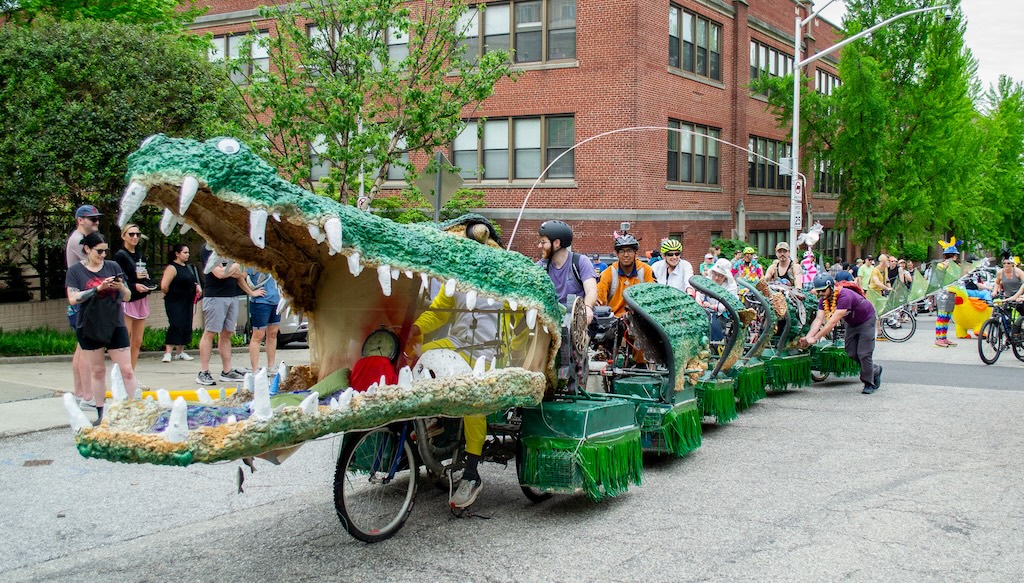
AVAM Kinetic Race photo by Maria Sanchez
Kinetic 2010 by Johanna Goderre Jones, courtesy of AVAM
AVAM Kinetic Race photo by Maria Sanchez
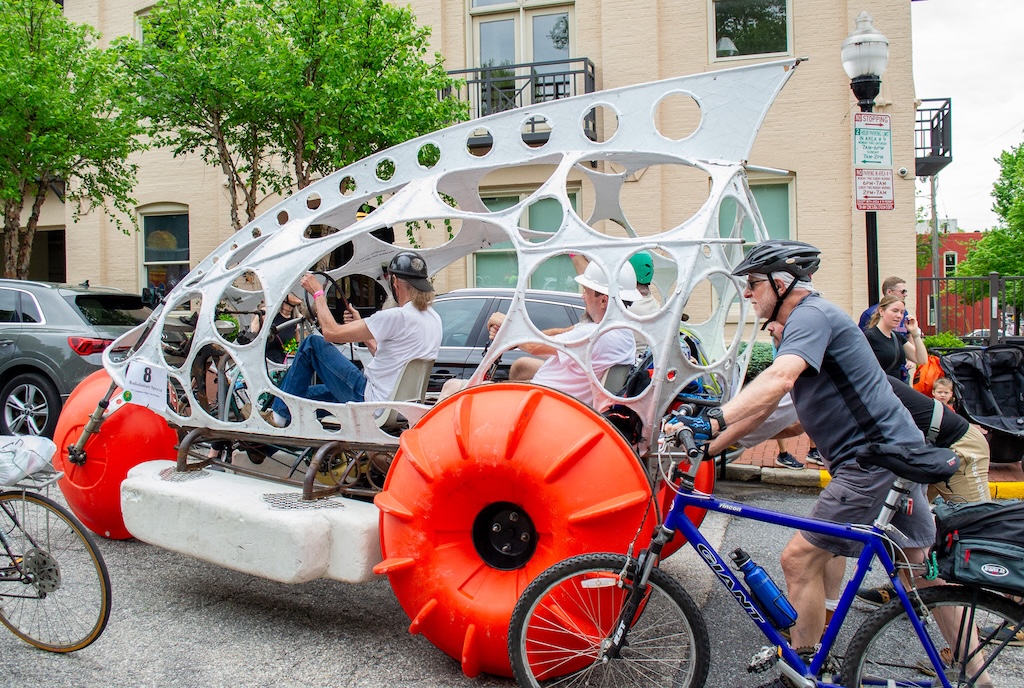
He went to a junkyard with his friend Jason Bennett and salvaged a Suzuki Samurai and an old pontoon boat. Then they went to Walmart and picked up eight bicycles. They put all of the pieces together...
Marian McLaughlin

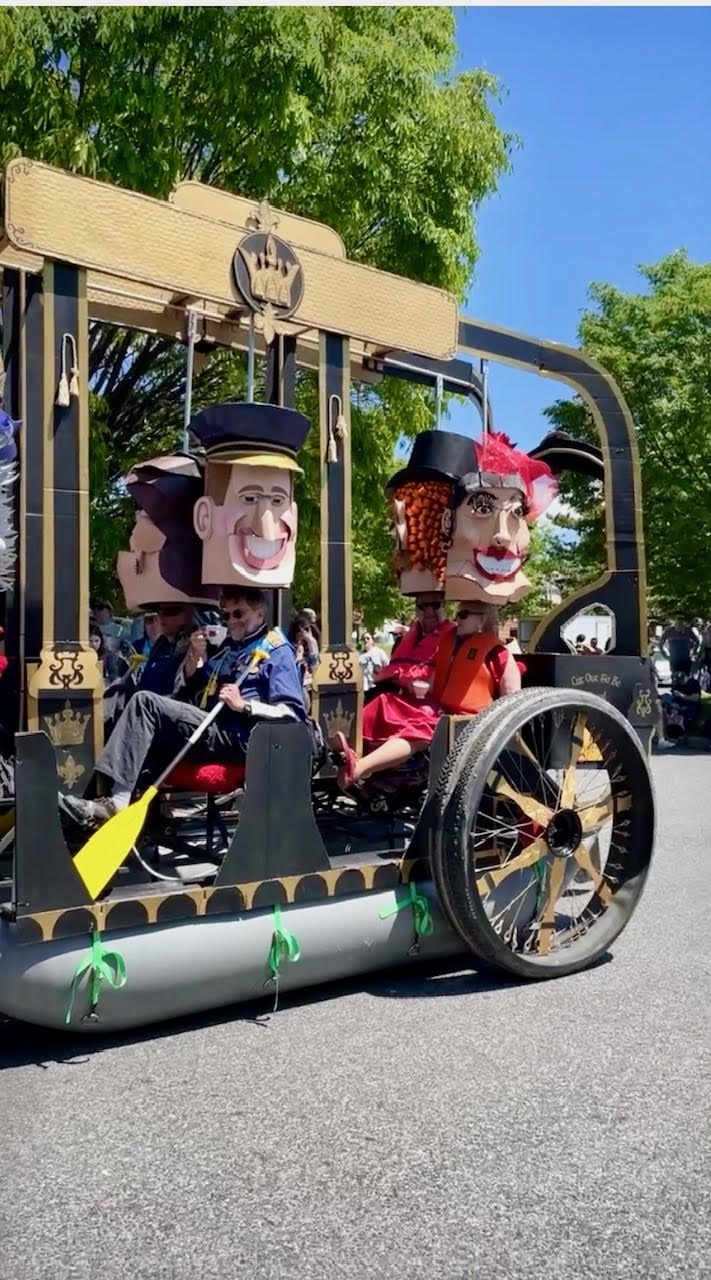
The 15 mile course kicks off at AVAM and participants (also known as “kinetinauts”) cruise down Federal Hill. A huge portion of the route skirts around the harbor and a water entry at Canton Waterfront Park serves as the midway point. From there, racers head north for an obstacle course in Patterson Park, challenged by sand, mud, and hills. The afternoon portion cuts through Butcher’s Hill and Little Italy, and the last leg of the race circuits back through Federal Hill.

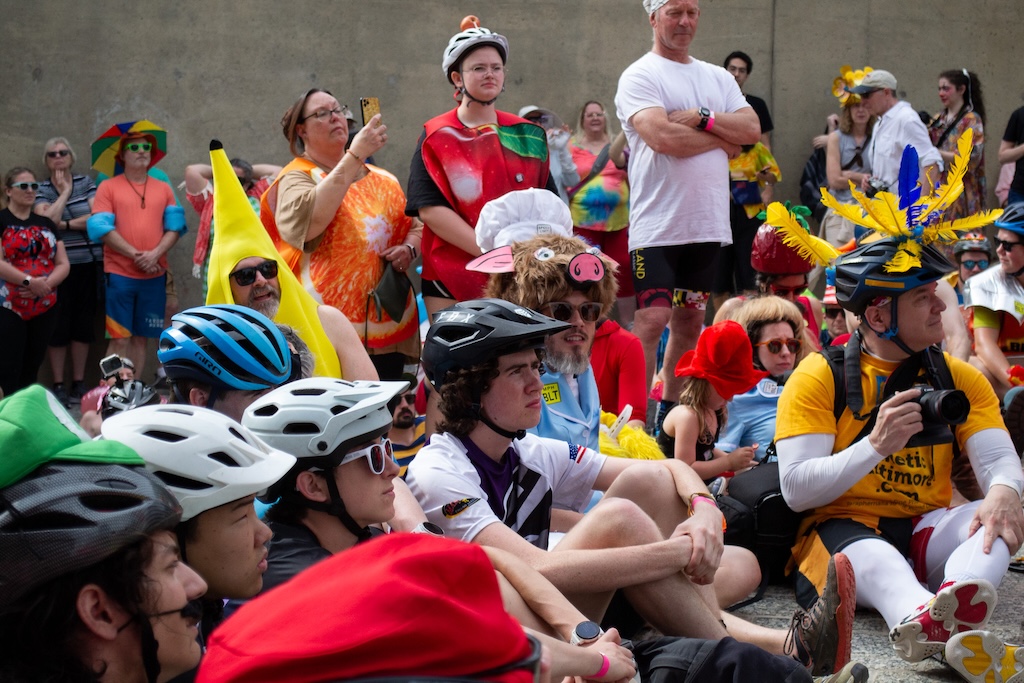
Metal artist David Hess has a lot of experience with traveling through the race course. After designing AVAM’s central staircase, he was recruited to join the first race and has been a Kinetinaut ever since. The following year, his five year-old son had learned to ride a bike and wanted to be a part of his team. “Hobart Brown’s big philosophy was giving kids a sense of what adults having fun looks like,” Hess says. They became an inter-generational team when Hess’ dad joined. “It’s been a huge thing, my son has been in it many years now, he’s thirty years old. My dad has only missed one year, he just turned 88.”

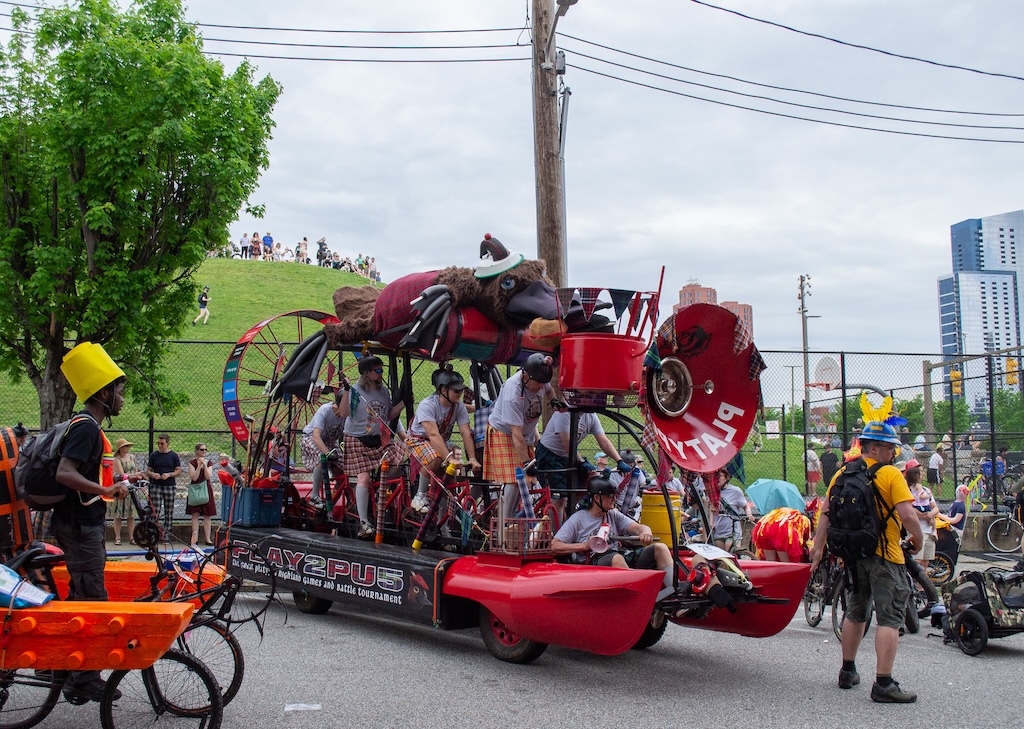
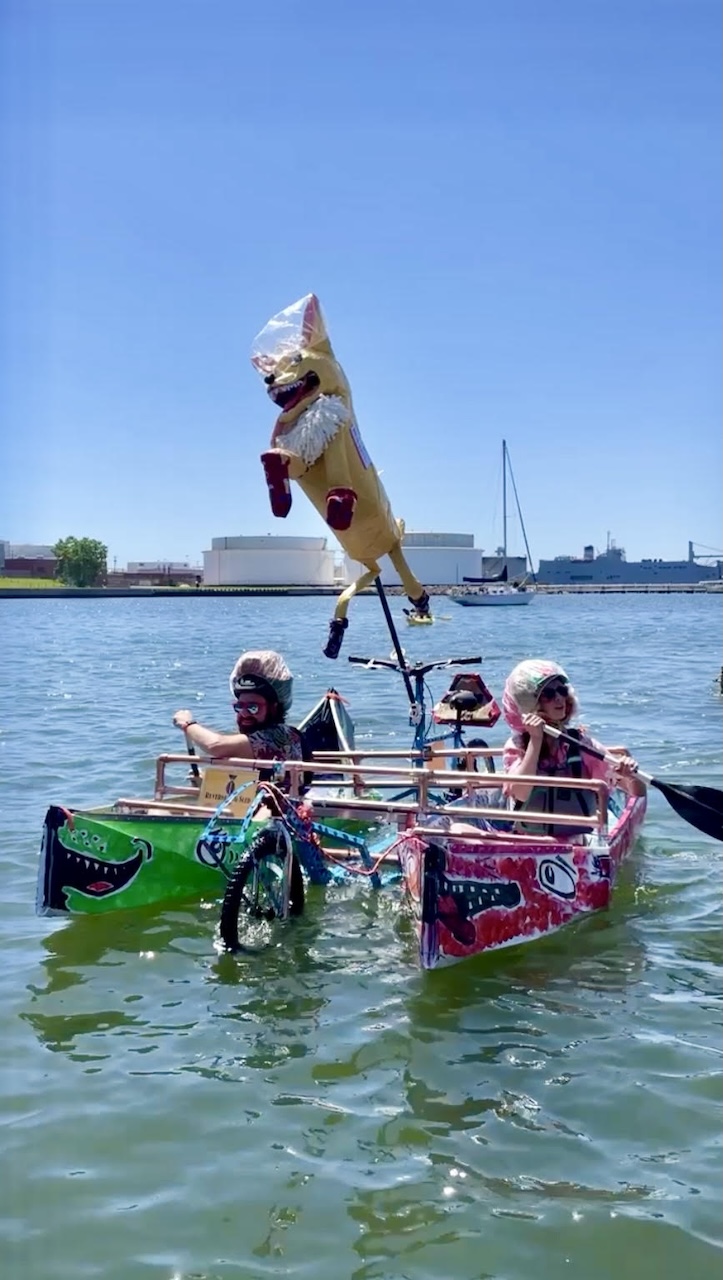
In those early years, Hess and his family experienced lots of cause and effect scenarios, like the one time when their bike wheels folded over due to lateral load issues. Kinetinauts call this phenomenon “tacoing” due to the shape the tire takes when it experiences too much sideways force. When Hess’ son was seven, they almost capsized in the harbor. But these challenges pushed him to get more serious, so he went to a junkyard with his friend Jason Bennett and salvaged a Suzuki Samurai and an old pontoon boat. Then they went to Walmart and picked up eight bicycles. They put all of the pieces together and created a vehicle called the PLATYPUS, an acronym for Personal Longrange All-Terrain Yacht Proven Un-Safe. 

Hess and his crew have been operating the PLATYPUS for close to twenty years now, altering it every year based on the theme of the race. For the “Out of this World” theme in 2015, Hess and his team dressed like astronauts and attached a 25” retractable rocket sculpture to the top of the PLATYPUS. And when they turned their vehicle into a spaceship in 2018, they called it an Unidentified Flying Platypus.

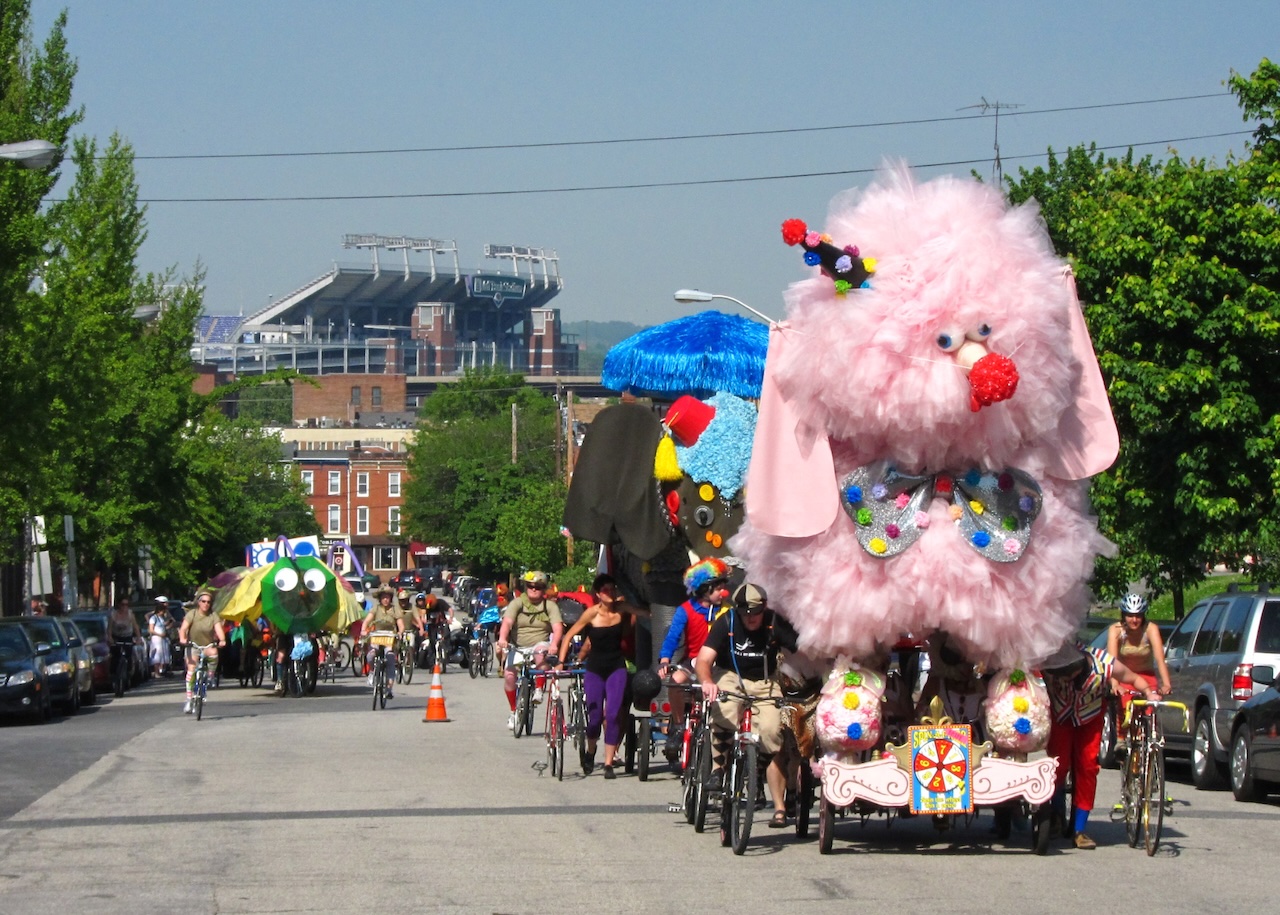
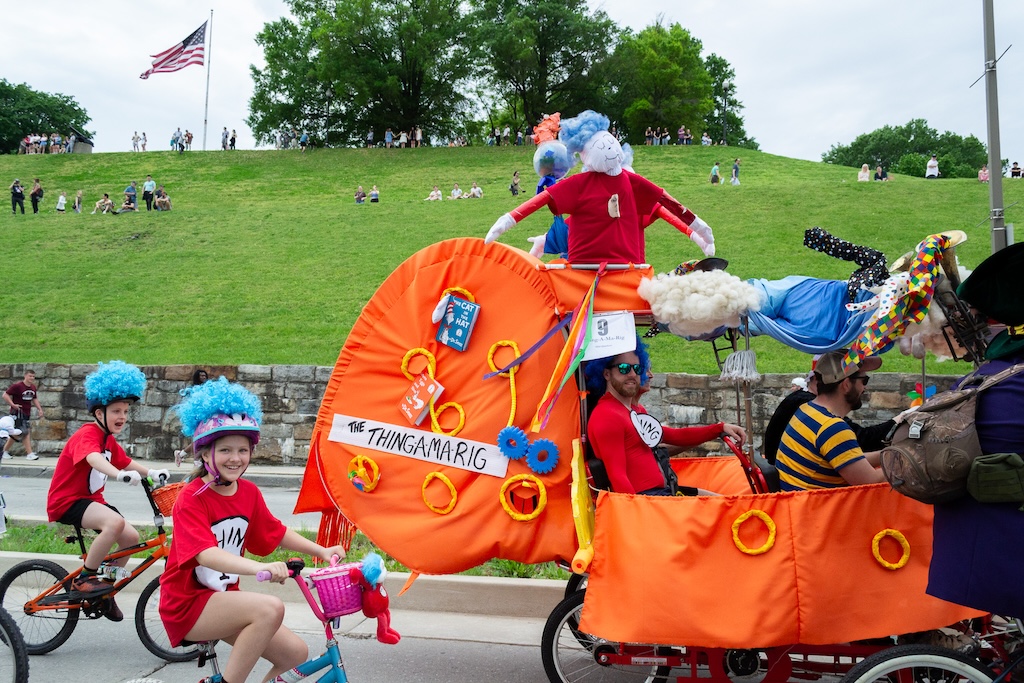
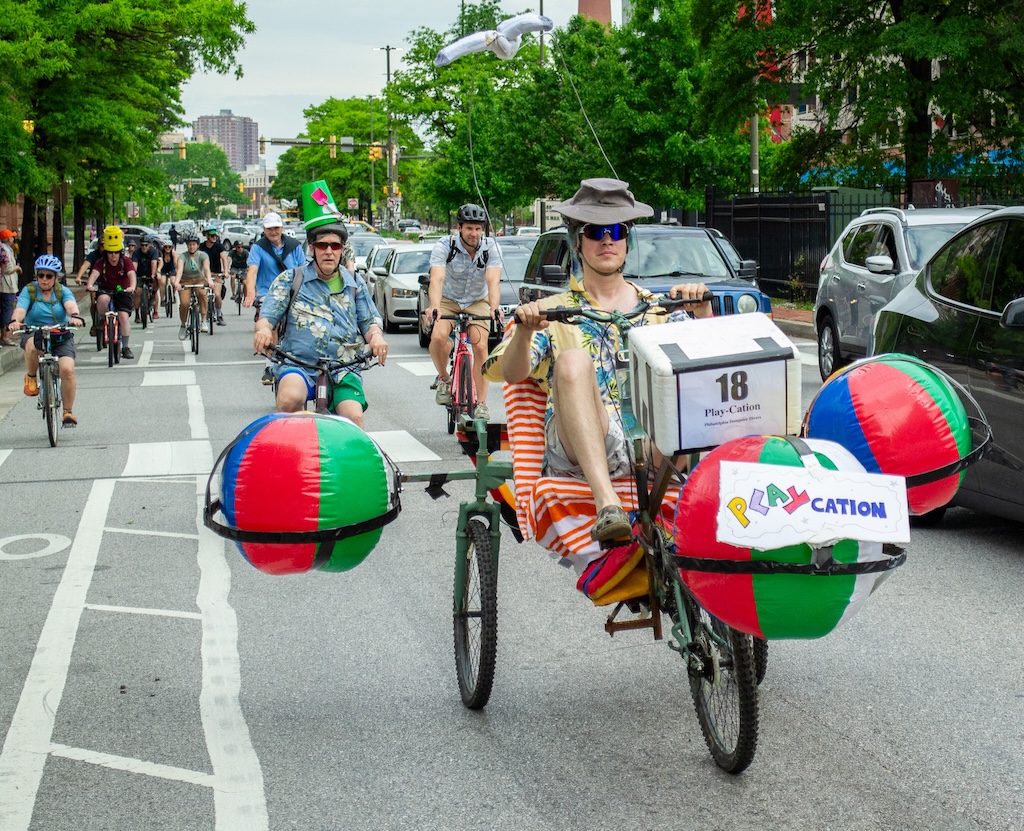
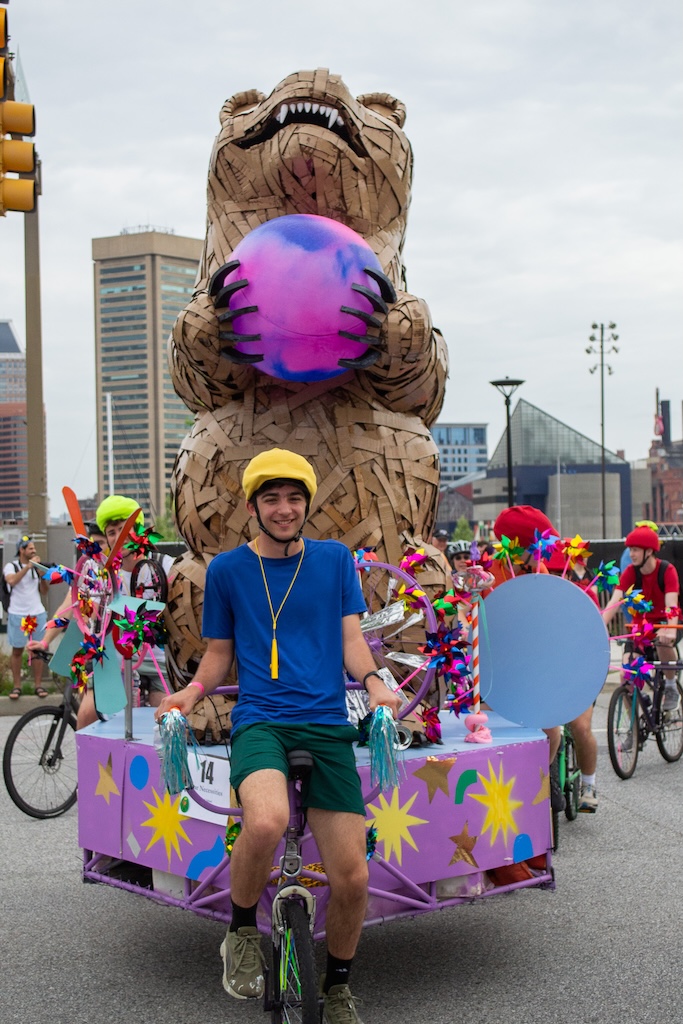
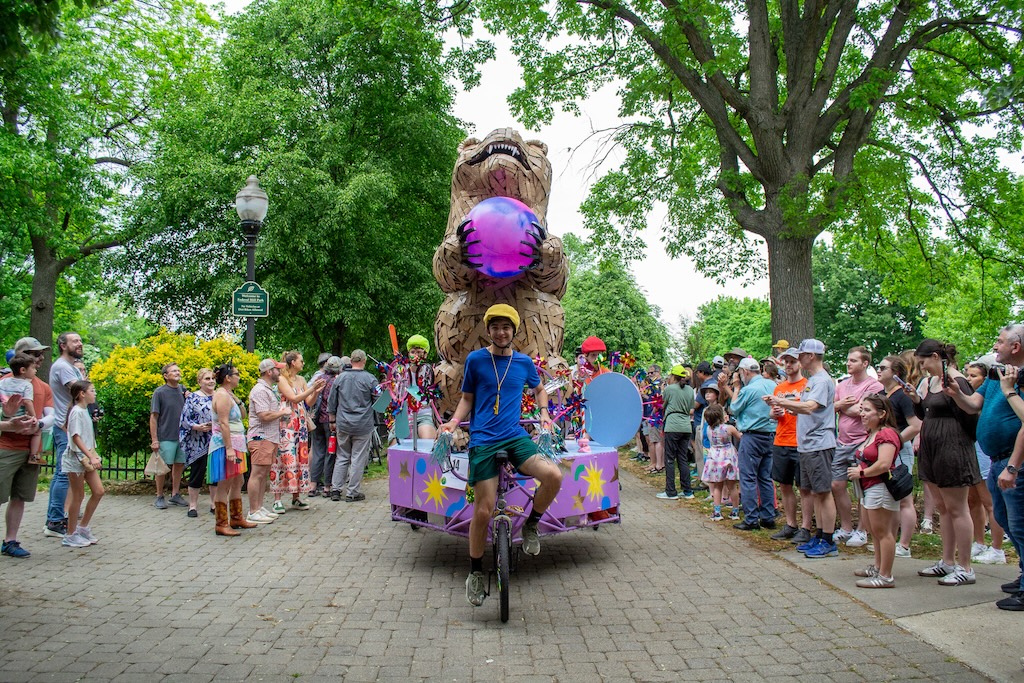
The PLATYPUS is a well-documented vehicle in the Kinetic Sculpture Race archive. There’s also Fifi, a 15’ pink poodle made by Segreti. One year there was a kraken made out of upcycled water bottles and a cardboard bear dressed up as the Statue of Liberty. When it comes to making an entry, the possibilities are infinite. Perhaps this is what makes the whole thing such an ongoing attraction. Although there is an extensive rule guide and plenty of parameters to work with, there is also a lot of room for exploration. “It underscores the importance of play, but also that intuitive know-how, to figure things out,” says Rebecca Hoffberger, AVAM’s Founder and former Director. “It’s done in such a safe environment, it’s not cut-throat competition, it’s the joy of a community coming together and putting on this moveable feast for the eyes.”

The race itself wasn’t really a race, because the vehicles went so slow. This was more about celebrating failures.
Theresa Segreti

“The race itself wasn’t really a race, because the vehicles went so slow,” Segreti adds. “This was more about celebrating failures because you never really feel accomplishment until you go through a whole Ferris wheel of failures.” Segreti’s emphasis on trial and error is reflected in the race’s humorous awards, like the “Golden Dinosaur” for breakdowns and the “Next to Last” award to build anticipation towards the end of the race. 

In what she called Kinetic Moments, Segreti shares a heart-felt story about a team of highschoolers that won the Golden Dinosaur award one year. After some personal hardships, they had joined a new school during the spring, an odd timing as most of their classmates were prepping for exams. As an alternative activity, their science teacher created an independent study program where they had to build a vehicle for the Kinetic Sculpture Race.  “He cobbled together whatever he could. He gave them a discarded patio chair, 250 pounds of PVC pipe, milk jugs, coat hangers, wheels from a fertilizer spreader, some duct tape,” Segreti lists.  Unfortunately, the wheels duct taped on and they fell off right as they arrived at the race.

Little did the students know that this major hiccup meant they had already won the ‘Golden Dinosaur’ award. Brown happened to be in town for the race, and he advised Segreti to give the kids a pep talk. Segreti told them that if they could carry it, then they’d still be qualified to race. They accepted the challenge. 

By the late afternoon, all the vehicles had crossed the finish line except theirs, but word was getting out that they were still en route. It started to get dark, but the crowd stayed until the students crossed the finish line. “I can still remember the look on those kids’ faces of what a victory that was. It was a moment of what this is really all about,” Segreti says.

“Success and failure are relative,” Segreti continues. “It’s all about heart. It’s about building something yourself. You may not have the expertise to do it, but it’s about having this accomplishment, and that’s how it really got off the ground. People understood and said, ‘I wonder what I could build if those kids could do it with a patio chair?’”

Ellen Owens, who took over the helm of AVAM as Executive Director in June of 2025, adds, “The whole event is based on human ingenuity, grit, and joy. It’s a celebration of what makes Baltimore the special place we know it to be; people of every walk of life bringing together their individual talents—creating, supporting, and inspiring one another on a long, imperfect journey to the finish line!”

Newton’s third law of motion says that “for every action, there is an equal and opposite reaction.” For the Kinetic Sculpture Race, creation is the action and inspiration is the reaction. “25 years later, it’s still going strong,” Segreti adds. “It’s still a super creative vehicle for people who may or may not be artistic. It’s a great outlet for people who are into engineering. It’s this beautiful level playing field for everybody.”

“The Kinetic Sculpture Race demonstrates that Baltimore is a visionary city,” describes Owens. “This annual people-powered parade of homemade creativity-on-wheels is exactly what AVAM is all about—art that’s accessible, fun, and reflects the artistic spirit that lives within each of us.”  


AVAM Kinetic Race photo by Maria Sanchez
Photo by E. Brady Robinson
Related Stories
Ikhide's "Tales From Future Past" is on View through November 22 at CPM

CPM Gallery recently announced that the run of Richard Ayodeji Ikhide's solo exhibition "Tales from Future Past" would be extended to November 22 by appointment. At the opening on September 27, the British-Nigerian artist was interviewed by luminary art historian, curator, and educator Lowery Sims.

In "Pandarayuhan: Home is a Memory" Divinagracia Explores Immigration and Identity at Creative Alliance

"One of my biggest intentions with this show was to really spotlight Filipino presence in Baltimore and specifically immigrant lives and journeys.”

Baltimore art news updates from independent & regional media

This week's news includes: Amy Sherald shines brightly in Baltimore, Hilton Carter makes his house a home, Inviting Light returns with a Wickerham & Lomax, John Akomfrah moving image + sound installation opens at the BMA, mayorial portraits unveiled at City Hall, Maryland Film Fest is here, and more

Swagger and Style at the BmoreArt Release Party for Issue 20

On Saturday, November 1, BmoreArt hosted 400+ guests at the Icons Ball & Benefit at the Lord Baltimore Hotel.