Reading

Being with Objects and the Arts of Memory: Animate Objects from MICA’s Low-Res Studio Art MFA

Previous Story
Article Image

Nancy Proctor Named New Executive Director of the [...]

Next Story
Article Image

Strong, Bright, Useful & True: This is What [...]

I smile as I watch a child repose on a series of overlapping furry rugs and wrap their torso in a snaking, blue soft sculpture made from discarded tights. Directly across the gallery, another sculpture crafted from dyed burlap and netting is suspended from an industrial wood palette hanging from the ceiling, plush limbs dangling. Below the burlap body, a barely recognizable baseball sits, deconstructed and suggesting new potentials beyond its past lives.

Above, the sound of speakers embedded within ceramic vessels proudly echoes the ancestral tales of Black women. Nearby, a computer complains that it feels the weight of its many files. Vermillion coral—sculpted and painted as relic, lung, and aorta—reveals the entanglement of human and invertebrate bodies. A monumental fluorescent canvas invites us to step inside its cinematic, painterly surface.

Melissa Sutherland Moss
Tamara Payne
Benji Stiles
Blair Simmons

These are the critters and objects brought to being by artists Annika Marthinuss, Melissa Sutherland Moss, Benji Stiles, Tamara Payne, Blair Simmons, Ariel Oakley, and Katie Murphy, respectively, for the Maryland Institute College of Art’s MFA in Studio Art Low-Residency program. The 2025 iteration of thesis exhibitions just closed, but these lifeforms will live on in the form of a companion exhibition featuring similar work titled VESSELS: A Slow Quiet Moving Memory at the artist-led collaborative performance and exhibition space Sleepwalker Collective until July 25th.

At MICA’s Riggs & Ledy Galleries, these artworks represented, enlivened, and conjured more-than-human entities in ways that encourage us to see how objects can embody and recall that which lies beyond our perception. Feminist and ecocritical theorist Donna Haraway explains that “the practice of the arts of memory enfold all terran critters.” In Staying with the Trouble (2016), she meditates on an orchid whose formal structure memorializes the bee who once pollinated it. Like that orchid, in this multifaceted thesis exhibition, a pillow cries, a computer speaks, a canvas reimagines, a vessel voices, a traffic cone breaks down, a pool of blood gives us the side-eye, and burlap relives a violent industrial history.

Katie Murphy
Katie Murphy

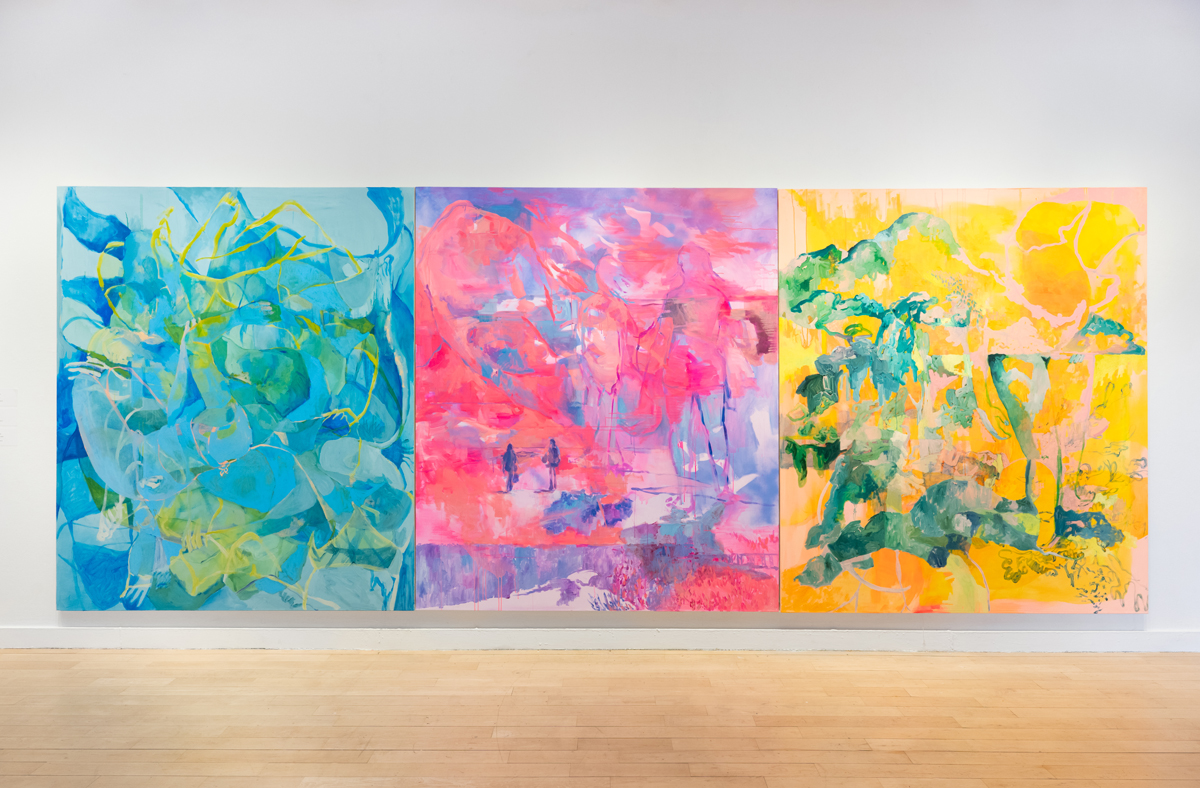
In 2024, painter Katie Murphy spent a quiet birthday with her sisters on the beach in Grand Isle, Louisiana. They photographed and filmed their movements—walking, wading, watching birds. Back in her studio, Murphy digitally collaged these images into layered, disoriented compositions. She pinned these visual references onto large canvases (84 x 72 inches), painting on the ground in close physical proximity to the stretched substrates. Murphy resists expectations of both familiarity and her chosen medium in a process that is bodily and imaginative, allowing memory to shift into something unrecognizable and ethereal.

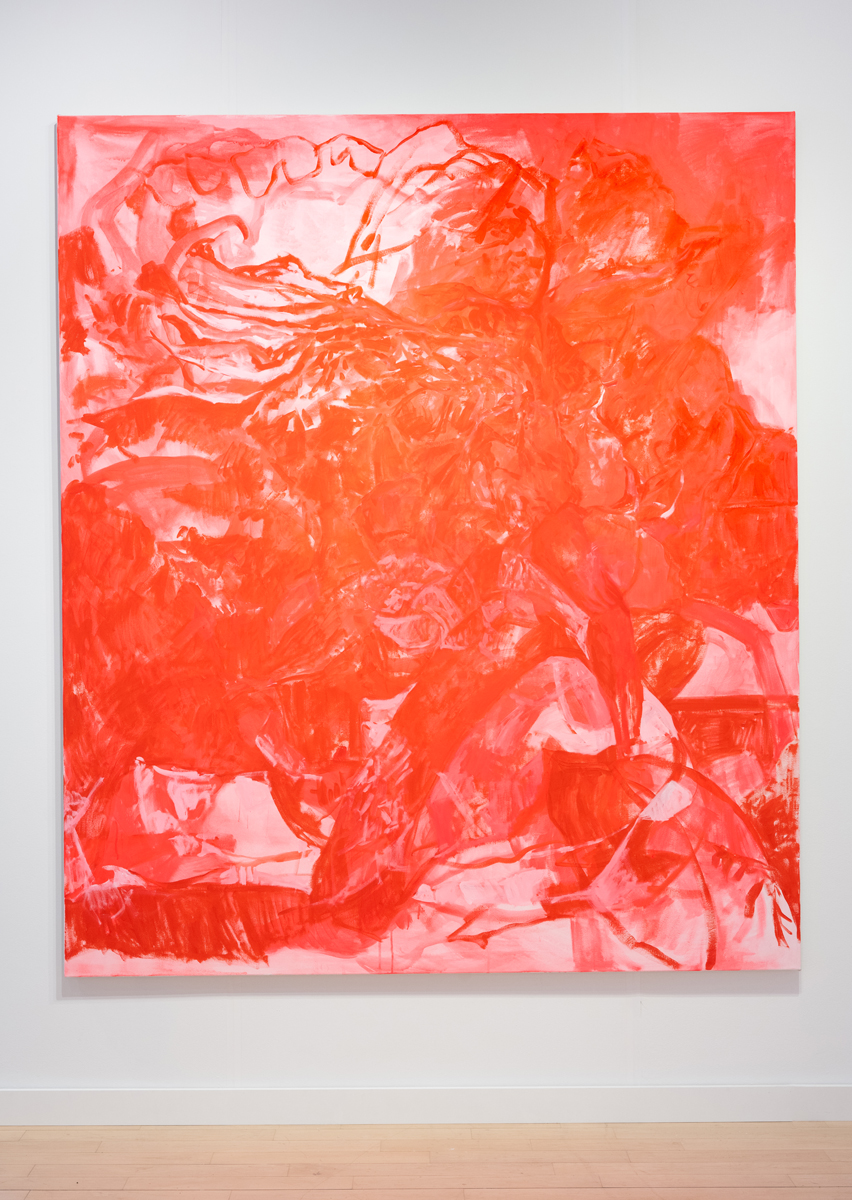
Three of her resulting canvases—”Some Inward Maze” (2025), “Light and Languor” (2024), and “A Plunge at Daylight” (2024)— hang just above the baseboards in a triptych-like arrangement, forming a continuous visual line like a film strip, yet evading legibility. The artist flipped “Some Inward Maze” upside down post-painting, leaving the central figure spiraling in a sea of brushstrokes. This work is a nod to Ana Mendieta’s Siluetas and Murphy’s own failed attempt to impress her body into cold, packed sand. “Light and Langour” features her sisters walking away, disrupted by birds and dunes that dissolve spatial coherence. “A Plunge at Daylight” layers pink acrylic, orange flashe, and green oils to achieve a vibrant material and conceptual tension. The final canvas, “Flaming and Apparent” (2024), is a red monochromatic self-portrait of Murphy as a pulsing and bulbous form—marking her awakening to the monumental within the mundane.

Tamara Payne
Tamara Payne
Tamara Payne

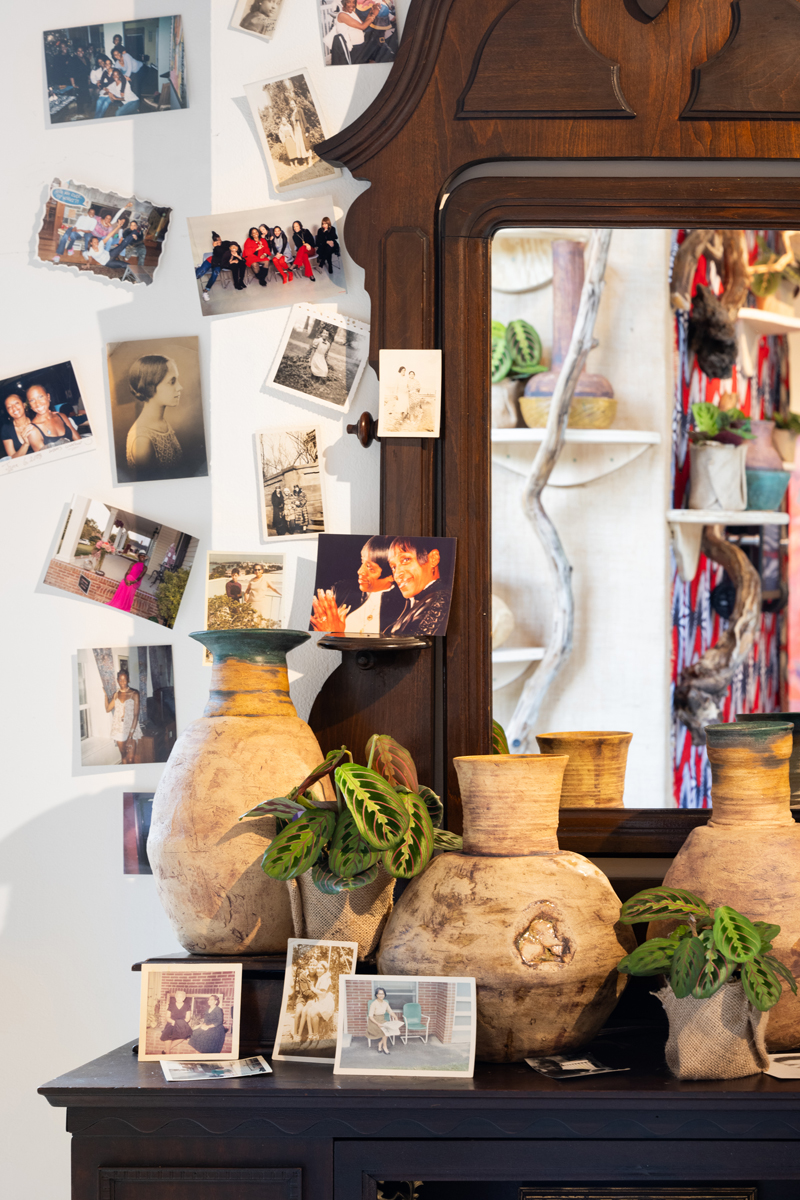
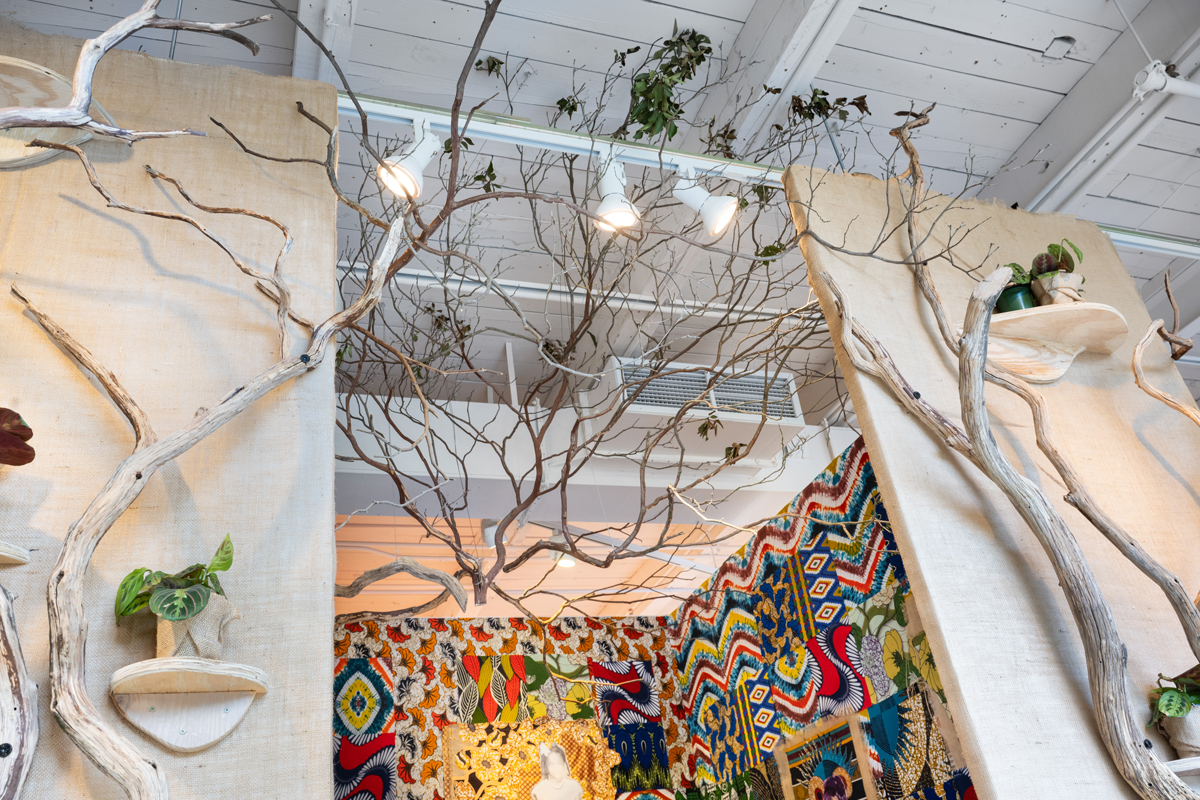
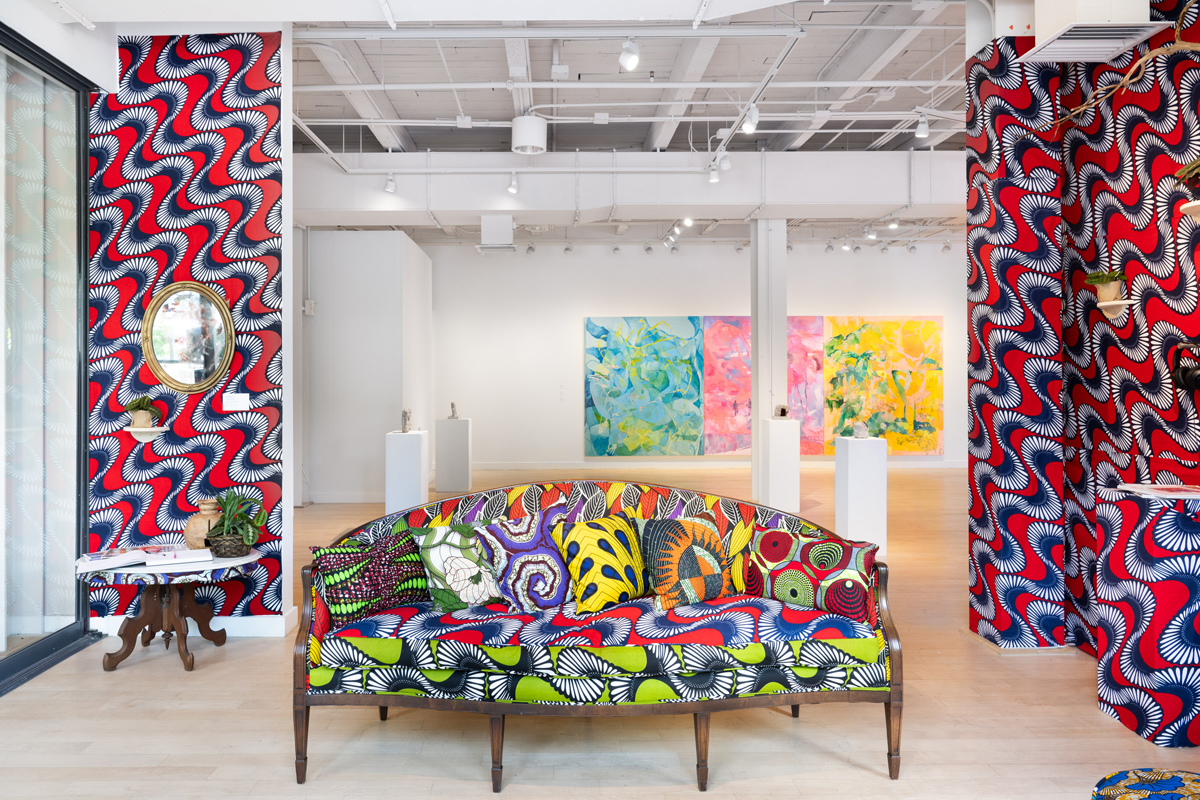
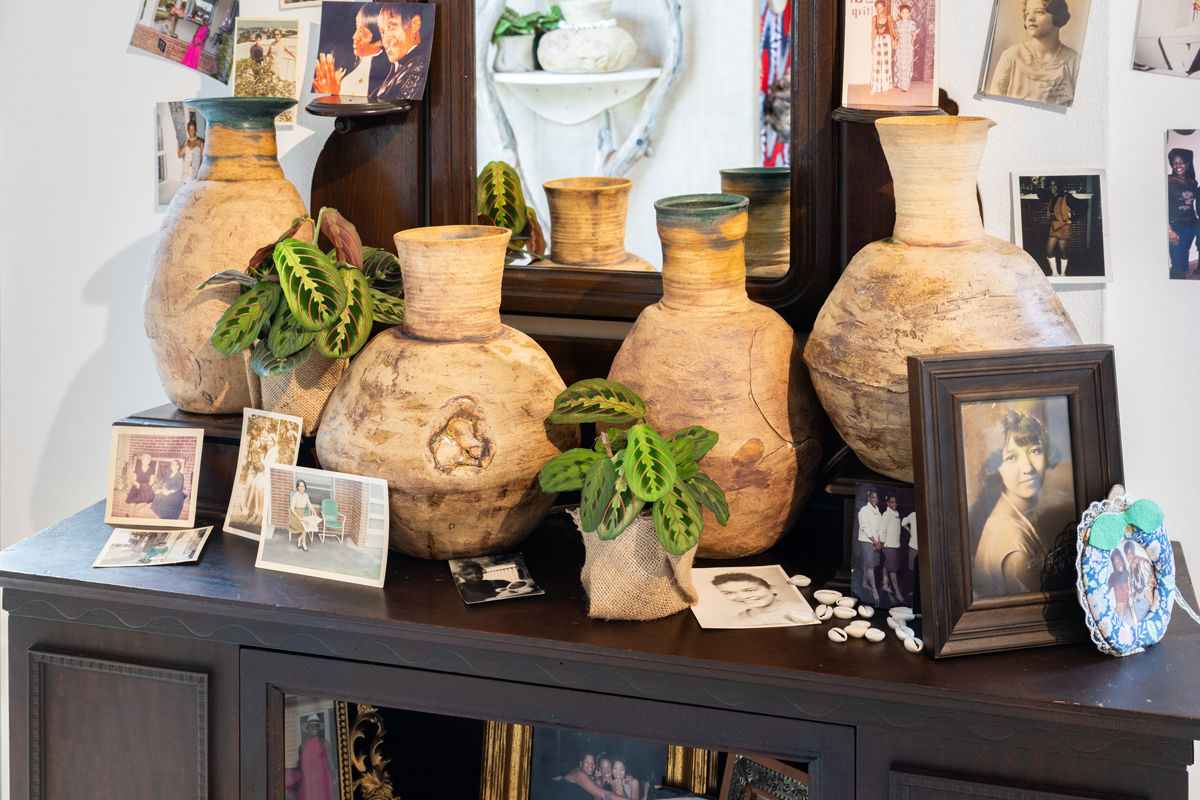
Tamara Payne’s “We Echo the Voices of Our Ancestors” (2025) is a room-scale mixed-media installation that also evokes monumental yet personal memory. Mud cloth, Ankara fabric, salvaged tree branches, prayer plants, reupholstered antique furniture, ceramic vessels, archival photographs, and audio-visual recordings construct a living room for gathering—a sacred, ecological space of remembrance and resistance. Reminiscent of Sarah Jane Cervenak’s notion of “Black gathering” as a poetics of togetherness amidst ungivable life, the work operates as both ancestral shrine and critical archive of Black women’s traumatic and triumphant testimonies. Under the symbolic Baobab tree, Payne has crafted a Black feminist ecology that brings people, stories, and multiple species together to raise awareness about, and resist, the totalizing misrepresentation, misunderstanding, devaluation, and extraction of labor from Black women.

Building on her 2024 project “Dear Black Girl” and responding to the loss of her mother, Payne honors the Black women she calls her “tribe,” amplifying them as her kin and home. Yet this is much more than mere representation. Each material breathes with historical and poetic meaning: mud cloth from Mali, gifted Ankara fabrics, ceramic bodies, braided hair, bark, and leaves. An embroidered frame in the space proclaims: “We are the vessels that hold water to nourish many flowers.”

Ariel Oakley
Ariel Oakley

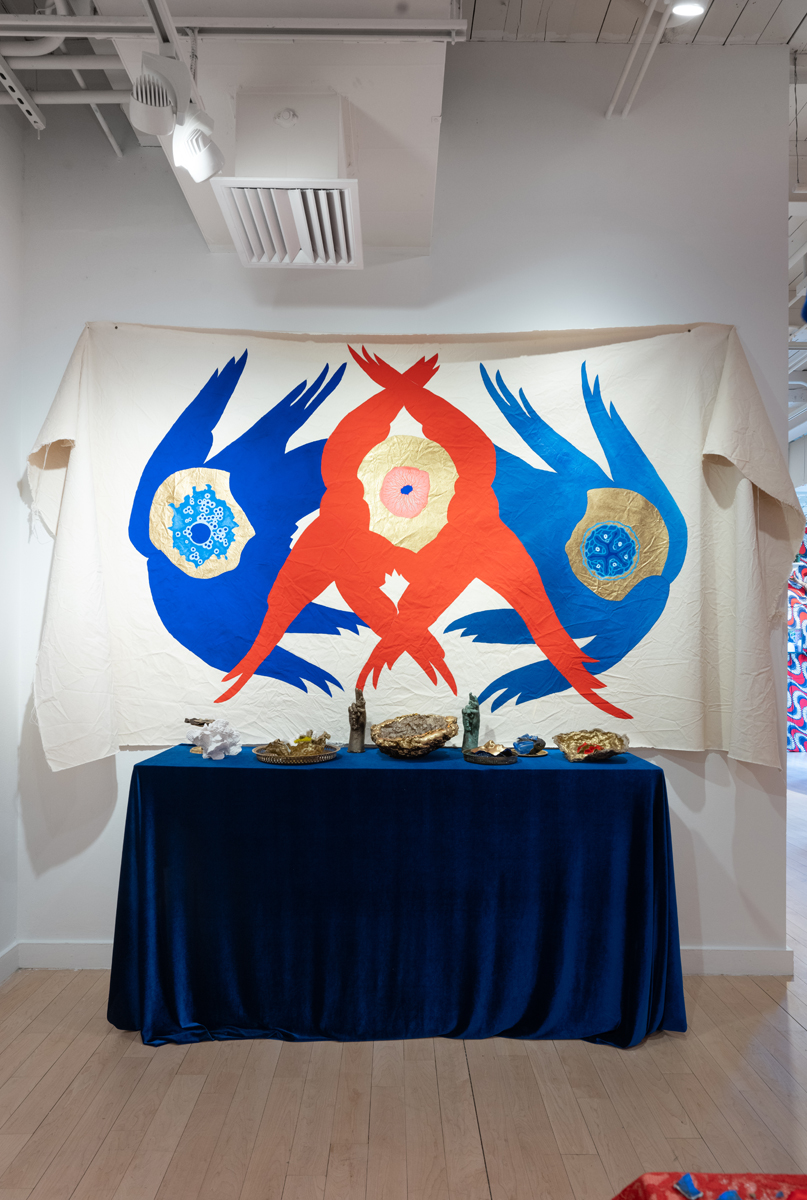
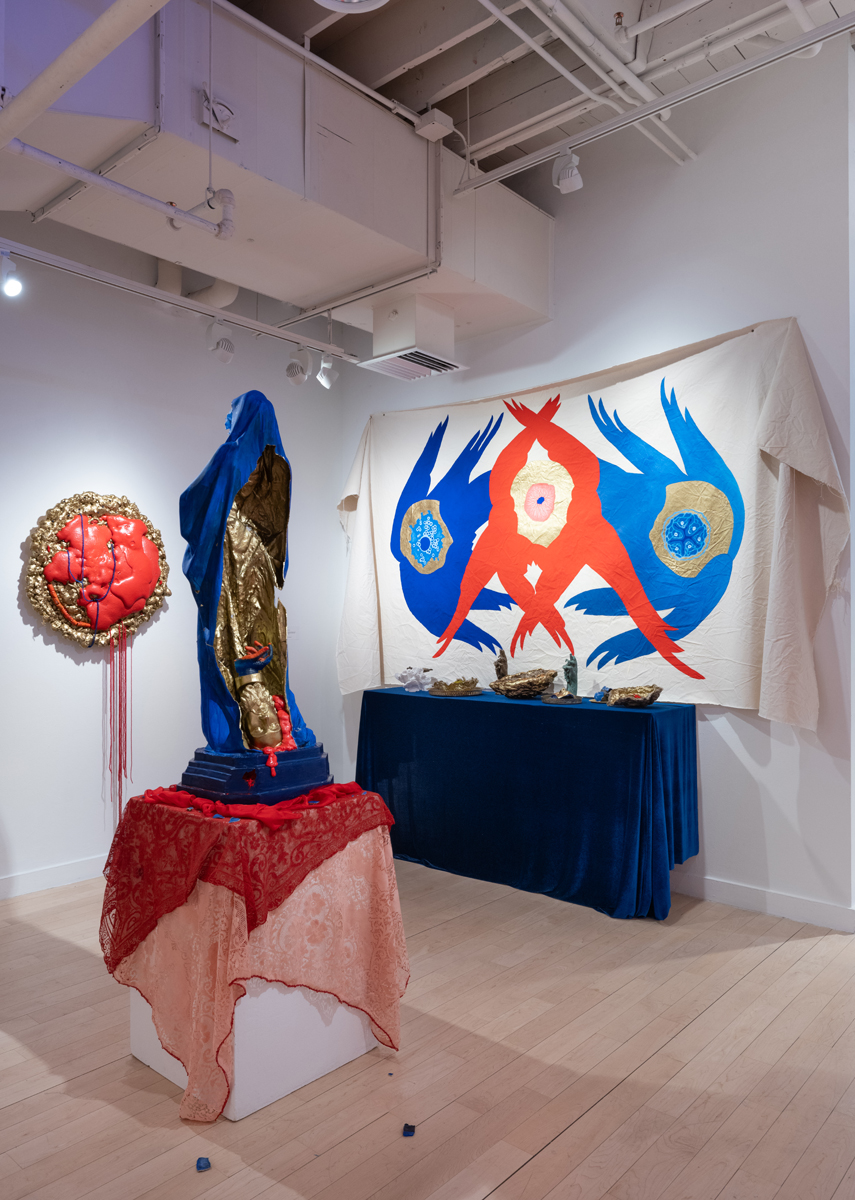
Around the corner, painter and sculptor Ariel Oakley similarly questions hierarchies of value and evokes the more-than-human. As a surgical nurse at Keck Hospital, Oakley has held lungs and touched the interiors of bodies. She seeks to understand the sacred spirit of organs after death by merging seemingly opposing visuals: contemporary CT scans and medieval European relics and frescoes. In “Mater Spiritus (Breath Mother)” (2025), a gold halo crowns a figure resembling the Virgin Mary, whose torso is an anatomical rendering of the cardiovascular system. Though not raised Catholic, Oakley uses religious iconography to blur the boundary between the sacred and scientific. As art historian Taylor McCall notes, medieval anatomical diagrams, like modern ones, were imaginative—expressing subjective perspectives on the body. Oakley’s interdisciplinary interplay is a form of science-art worlding, where scientific and artistic knowledge combine to reshape how we see and inhabit the world.

Oakley’s “Mater Spiritus” and “Angelus” (2025) depict chimeric figures with anatomical, plant, and invertebrate elements such as antennae and coral. In the sculpture “Mater Vacui Aeris” (2025), the Virgin Mary’s head is replaced with coral, which lives in symbiosis with algae—exchanging oxygen and carbon dioxide to support each other’s survival. Oakley invokes it to imagine breath as a shared, spiritual force for all earthly inhabitants, reminding us that we are entangled participants in a collective ecological body.

Blair Simmons
Blair Simmons
Blair Simmons

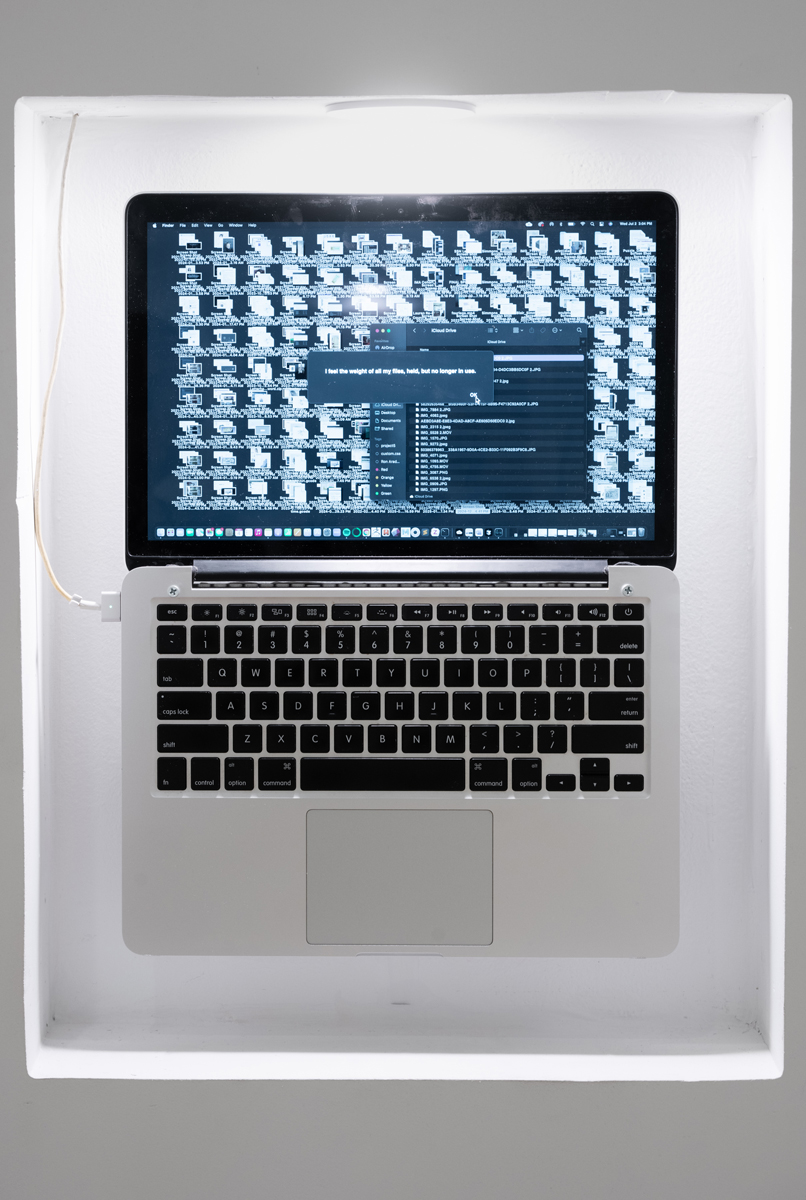
Sculptor and coder Blair Simmons finds kinship with the more-than-human world by humorously probing the limits and failures of machine memory. In “…/documents/files/memories/digitalhoard,” Simmons displays her college MacBook Pro on the wall, activating its personality through an HTML program that enables it to ask viewers for help deleting files. She explains, “I want my computer to forget like I do.” Yet the task is too great, its files too numerous.

While this MacBook Pro feels animate and burdened, across the gallery, an embalmed laptop in “Portrait of Phil Caridi From Ages 30 to 39” could be mistaken for a stelae or architectural fragment. Similarly, “Portrait of Matt Piazza from Ages 24-26” appears fossilized. A sliver of metal peaks through the geologic material, curving into the familiar form of an iPhone. Part of Simmons’ series Archive of Digital Portraits Cast in Concrete, this work and the eight others in the gallery subvert the viewer’s expectations. Intentionally resembling museum artifacts, her sculptures combine obsolete personal electronic devices, “unwiped data”, and cast concrete. By mimicking the aesthetic of the fossil or artifact, Simmons offers institutional and social critique. Her work asks: what do we use, store, remember, value, and discard—and where does it go?

Take the “Portrait of Matt Piazza.” At first, it appears to be a rock. How could a rock be a portrait? Simmons challenges a Western logic of animacy—rooted in Aristotle—that defines rocks as non-living. If a portrait traditionally depicts a living human, Simmons equates a human with concrete, disorienting that species hierarchy. Then we see the iPhone—once Piazza’s, now entombed. An extension of himself in the form of machine memory, it is also a product of global extraction and labor, particularly in the Global South. Simmons’ preserved fragments expose cycles of consumption and waste, urging us to think with the technological and geological worlds we so often overlook.

Annika Marthinuss

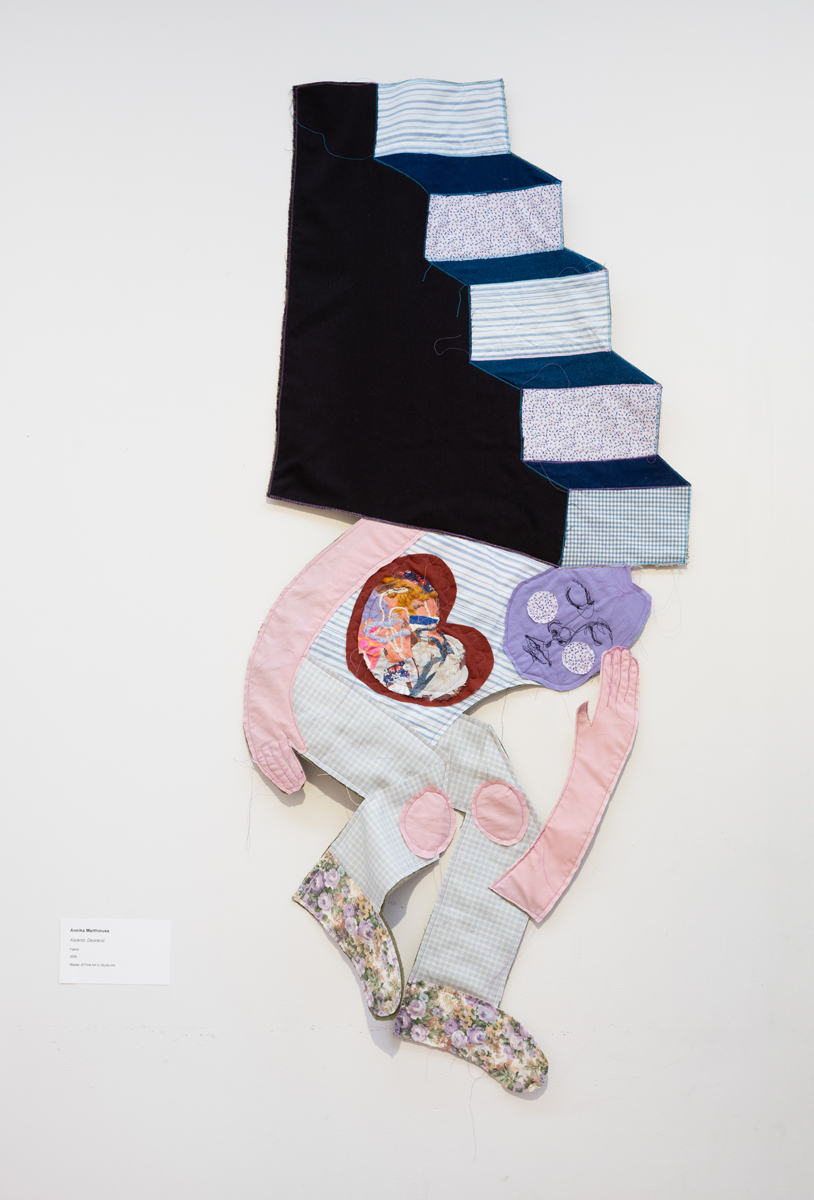
If Simmons’ work employs the hardness of concrete, Annika Marthinuss’ nearby exploration of soft materials’ potentials provides the counterpoint. Through fluffy and cozy fabrics, yarn, nylon, spandex, and cotton, Marthinuss asks us to stretch our imaginations, expanding our understanding of what art could and should be. On the couch at the center of her gallery she has embroidered the phrase “Comfortable Discomfort.” She encourages visitors to the space to disregard their inhibitions and assumptions about how we engage with art. “You are invited to touch the fluff,” “You are invited to rearrange the fabric pieces up and down between the two pieces” and “You
are invited to sit on the sofa” her labels explain throughout the bright space. These labels actively disrupt the typical ableist and rigid guidelines for engagement in museum and gallery spaces. Labels have also been critical in the artist’s own journey to find and understand herself. In June 2023 she was labeled “autistic” and in 2024 “chronically ill” and “disabled”.

A sculpted yarn and found plastic “Brain” is displayed on a pedestal in front of the cardboard and yarn painting “Moments,” both unconventional self-portraits that abstractly conjure the artist’s neurodivergence, childhood experiences of alienation, and ability to find community and connection after her diagnosis. Processing her physical chronic illness, dizzy spells, and inability to navigate space in a normative way, Marthinuss also channeled her feelings of frustration and pain into her soft-sculptural, sewn, and painted work. Holding the artist’s complex emotional landscape and autobiographical experiences, the sewn and stitched installation has been imbued with her bodily memories. As tears cascade down the visage of one of her pillow sculptures, another folds itself into a ball with gently shuttered eyelids. They demand our attention, sensitivity, and—most importantly—touch.

Melissa Sutherland Moss

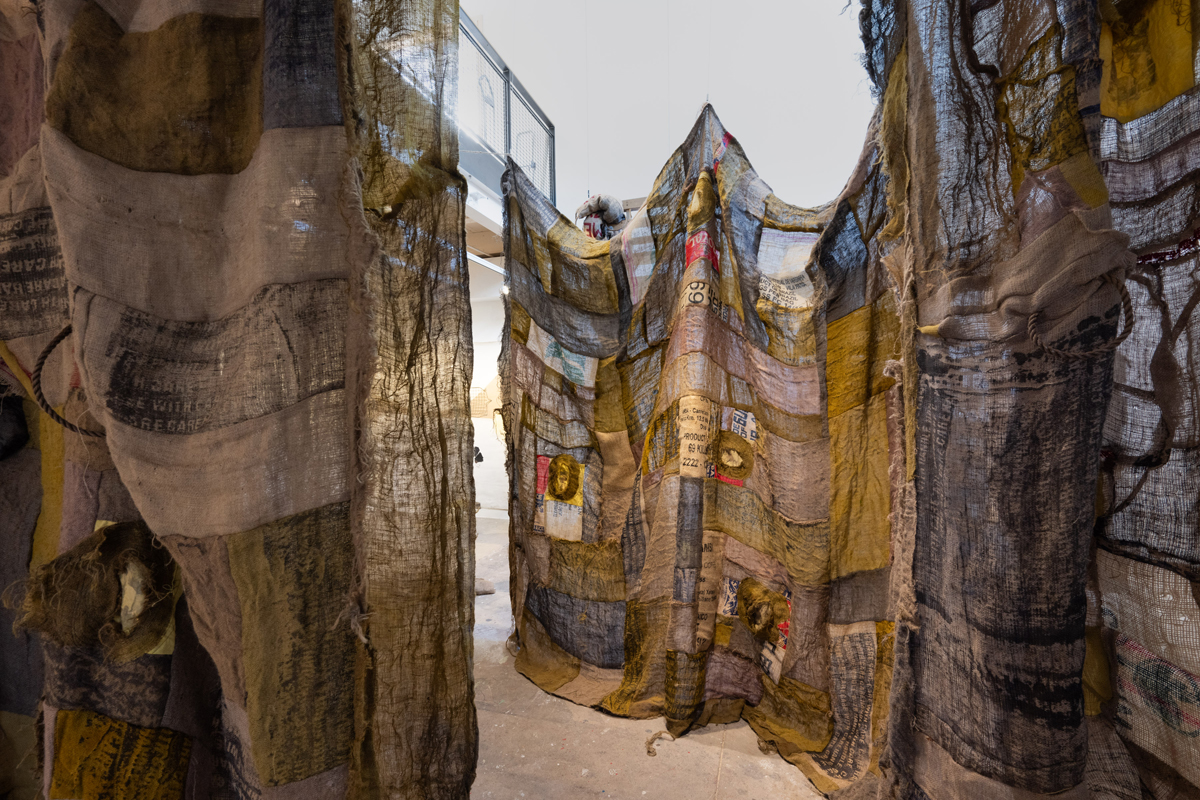
Like Marthinuss, mixed-media and performance artist Melissa Sutherland Moss invites her viewers to move through and enact her installation. Before entering “Still Standing” (2025), they are instructed to select a typewritten ticket with a word such as rage or accumulation to hold throughout the experience. A video of the artist bearing a burlap soft sculpture beside train tracks reveals that this project traces her ancestors’ forced migration as Jamaican laborers who built the railroad to Puerto Limón, Costa Rica in the late 19th century. Through hand-dyed burlap, video, archival photos, found objects, and sculpture, Sutherland Moss explores industrial labor, consumption, and environmental harm. Like Ghanaian artist Ibrahim Mahama, who uses jute to expose capitalist trauma, she works with what curator Kwasi Ohene-Ayeh calls “traumatic materialism.”

Yet her focus is personal. She hand-dyes burlap with turmeric, coffee, and iron, then stitches it into body-like forms she carries or embraces during performances. These materials—burlap, shipping crates, rusty wheels, chains—bear what she calls “sedimentation”: layers of trauma and memory. Photographs of her grandmother and cousins repeat in portals across the burlap tapestry. Fading with each printing these images mirror family silence and the failures of memory. One looping video features glitching footage of the artist performing, layered over archival images of Afro-descendant railroad laborers in Costa Rica. Each burlap sack references a global site—Rwanda, Brazil, New York—while proclaiming, please handle me with care. The work gives material form to the pain and resilience of Afro-Atlantic history and the earth itself.

Melissa Sutherland Moss
Benji Stiles

Painter and sculptor Benji Stiles similarly activates found and discarded objects. His practice involves slowly wandering through Houston, Texas and Baltimore, Maryland to pick up the detritus of these urban landscapes he calls home. By attending to the materials, signs and symbols that are often overlooked and deconstructing, painting, repositioning and hanging them, Stiles creates a poetic yet precarious portrait of city life.

In the center of his gallery space, the installation “State of Disunion” (2023) features the lone star flag painted yellow and affixed to a weathered wooden table standing perilously atop white concrete bags. Stiles veils the typical symbolism of the flag of Texas with the industrial yellow hue. No longer able to signify the 19th century history of the Texas Revolution, when white settlers fought to establish the Republic of Texas against Mexico, it instead recalls asphalt paint. While Stiles subverts the typical symbolism of the flag, his label explains that he found this wooden table in the wreckage of Hurricane Harvey in 2017. The weathered piece of table recalls the devastation that the cyclone wrought upon Texas and Louisiana. It holds that history in its cracked wooden particles. In utilizing this table to prop up his yellow flag, Stiles has also imbued it with a new purpose. Throughout his gallery space Stiles plays with positionality and association, inviting us to consider and reconsider how each of his objects—baseballs, strings, papers, concrete bags, piano keys, electrical cords, and foam—might signify differently. Though these objects may hold the memories of the lives they once lived and the roles they once played, Stiles shows us that if we pause for a moment, we might see their capacity for change.

These seven artists—Katie Murphy, Tamara Payne, Ariel Oakley, Blair Simmons, Annika Marthinuss, Melissa Sutherland Moss and Benji Stiles—share a deep investment in material storytelling, embodied and machinic memory and disrupting dominant systems of value and representation. Across varied mediums and practices, they offer a collective expansion of what art can hold. In their new habitat at Sleepwalker Collective, viewers will have another chance to think with these objects this month, and perhaps be transformed.

Vessels: A slow quiet moving memory

A Pop-Up Group Exhibition and Publication Launch

Sleepwalker Collective
324 E 23rd St
Baltimore MD

Public viewing: July 19 and 20, 1-5pm
By appointment: July 21-25
Reception: July 24 and 7:30pm

Sleepwalker Collective is an artist-led collaborative initiative dedicated to producing immersive, interactive, and experimental artworks. Our mission is to uplift Baltimore’s diverse artistic community by providing creative opportunities, resources, and platforms that extend beyond the traditional confines of formal art institutions. Sleepwalker is driven by the efforts of two founding members, Baltimore-based artists Najee HF and Agustin Rosa, along with a rotating team of artistic collaborators.

Emily Shoyer is a doctoral candidate in art history at Bryn Mawr College and formerly curatorial fellow at the ICA/Boston and curator at the Museum of Sex.

Related Stories
Ikhide's "Tales From Future Past" is on View through November 22 at CPM

CPM Gallery recently announced that the run of Richard Ayodeji Ikhide's solo exhibition "Tales from Future Past" would be extended to November 22 by appointment. At the opening on September 27, the British-Nigerian artist was interviewed by luminary art historian, curator, and educator Lowery Sims.

In "Pandarayuhan: Home is a Memory" Divinagracia Explores Immigration and Identity at Creative Alliance

"One of my biggest intentions with this show was to really spotlight Filipino presence in Baltimore and specifically immigrant lives and journeys.”

Baltimore art news updates from independent & regional media

This week's news includes: Amy Sherald shines brightly in Baltimore, Hilton Carter makes his house a home, Inviting Light returns with a Wickerham & Lomax, John Akomfrah moving image + sound installation opens at the BMA, mayorial portraits unveiled at City Hall, Maryland Film Fest is here, and more

Swagger and Style at the BmoreArt Release Party for Issue 20

On Saturday, November 1, BmoreArt hosted 400+ guests at the Icons Ball & Benefit at the Lord Baltimore Hotel.