Reading

Book Review: Amos Badertscher Images and Stories

Previous Story
Article Image

BmoreArt’s Picks: May 13-19

Next Story
Article Image

BmoreArt News: Christopher Myers + George Ciscle, [...]

Amos Badertscher passed away in 2023, shortly before his first hometown retrospective opened at UMBC’s Albin O. Kuhn Library Gallery. It was sad timing, but fitting for a photographer whose work and writing anticipated earthly rewards and documented tragedies with the same unblinking lust.

Badertscher also deliberately spent most of his decades-spanning career as one of Baltimore’s greatest under-known artists—eschewing the spotlights of galleries on his way back and forth from back alleys to his home darkroom. To this day, you are more likely to hear his name muttered in the context of gossip amongst a dive bar’s elder happy-hour crowd than discussed in an art institutional context.

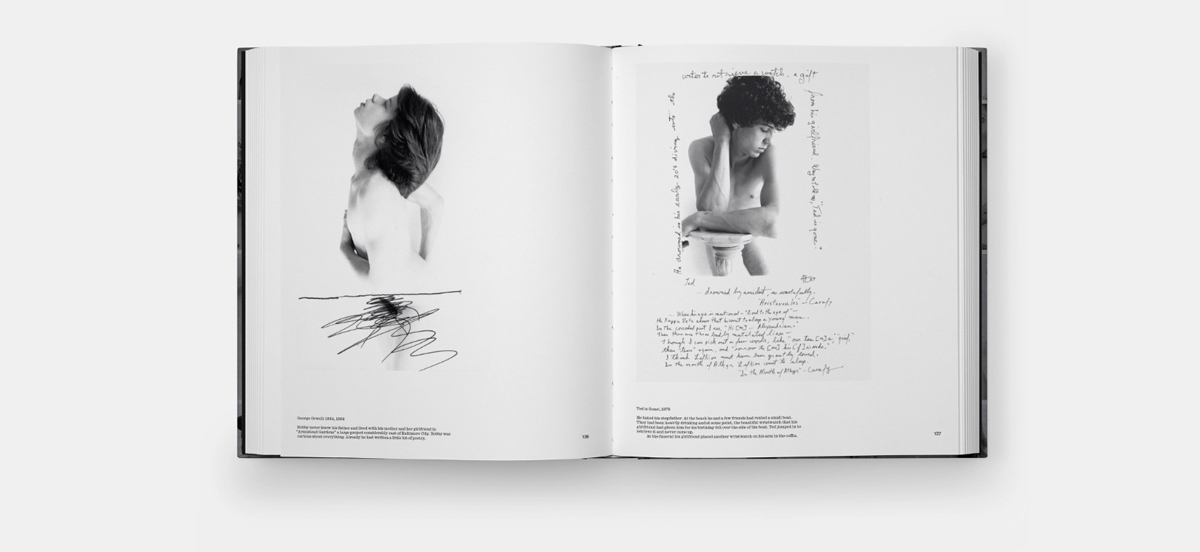
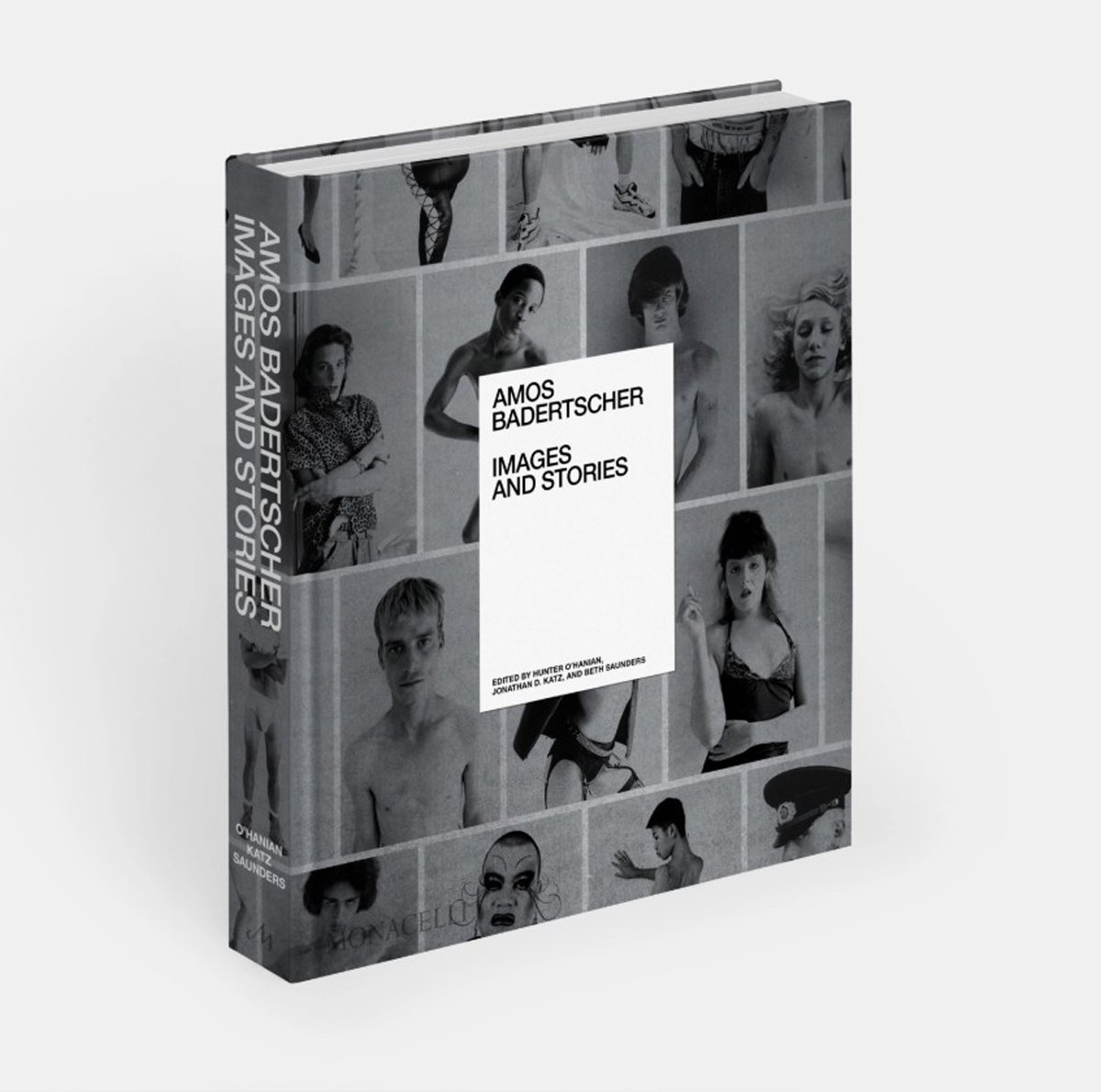
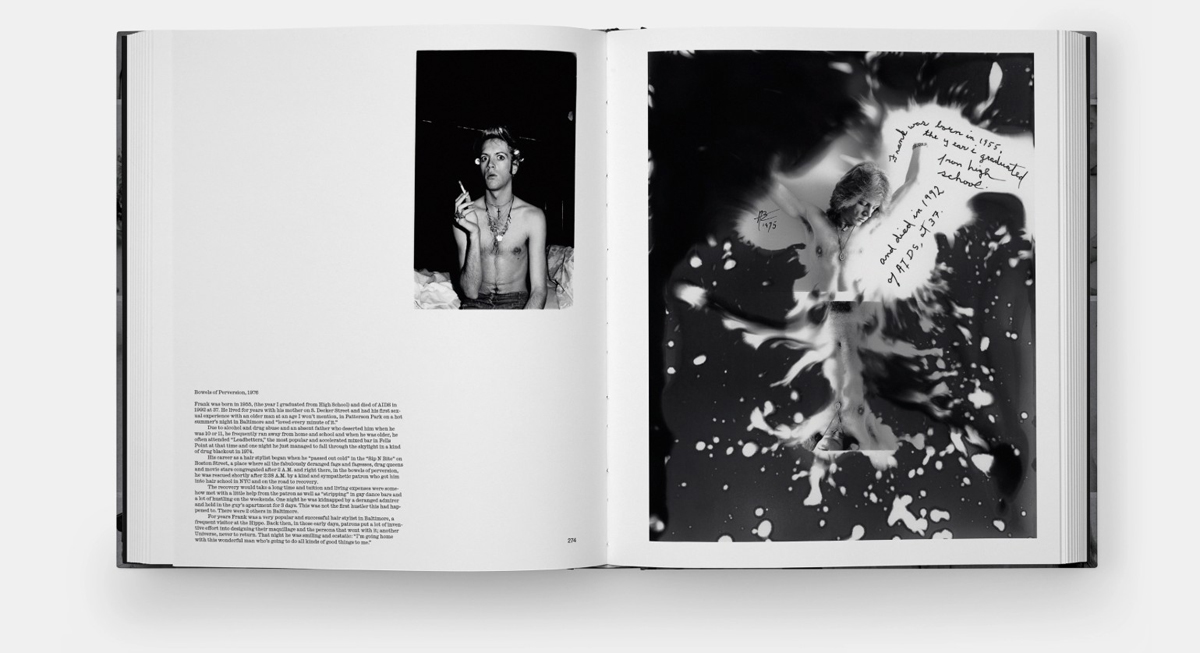
That’s about to change. This month, the esteemed international art publisher Phaidon ships Amos Badertscher: Images and Stories, a long-overdue 334 page monograph containing a treasure trove of Badertscher’s intimate photos and recollections from the late 1950s through early 2000s. Many of those are scans of images Badertscher revisited and reprinted decades after originally shooting them—marking them up with his confessional annotations in the margins—relating years of sexual desires, transactional relationships, and matter-of-fact documentation of the seedy underbelly of a Baltimore that’s been long-ago waxed smooth.

Many of those are scans of images Badertscher revisited and reprinted decades after originally shooting them—marking them up with his confessional annotations in the margins—relating years of sexual desires, transactional relationships, and matter-of-fact documentation of the seedy underbelly of a Baltimore that’s been long-ago waxed smooth.
Michael Anthony Farley

For the past few months, I have had the privilege of perusing a preview PDF of the publication, often mulling over a poignant text on a long train ride or flight with my laptop on my tray table. In retrospect, that was probably not a good idea. On the last such occasion, I heard an audible gasp from a woman en route to the bathroom as she passed and caught a glimpse of my screen. While revisiting Jonathan D. Katz’s provocative, insightful essay about the rigidity of sexual identities on page 18, I had inadvertently exposed half of coach class to Badertscher’s 1988 photo “A Shocking Case of Trans-Lateral Positing #1” on page 19. It’s a gorgeous composition, depicting a young man folded into an impossible lotus-petal position. It’s also a pretty graphic invitation to gaze into the sitter’s asshole.

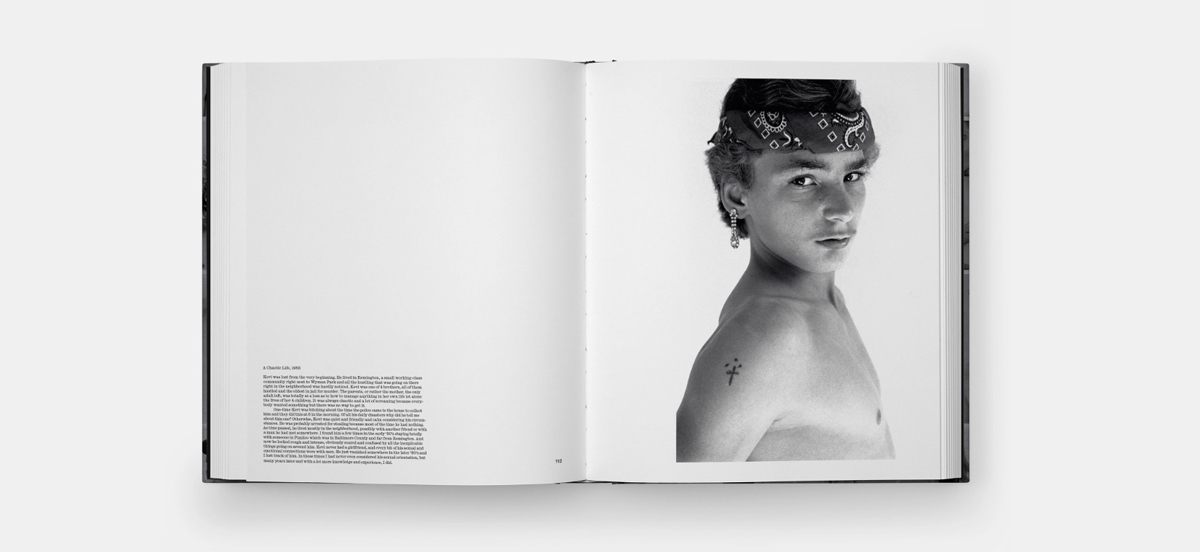
Don’t let the relatively tame images (lifted from the publisher’s website) in this review fool you: this might be the single most NSFW tome to ever hit the storied presses of Phaidon.

A good deal of Badertscher’s œuvre is dedicated to male sex workers or models the artist picked up cruising or hitchhiking in varying states of undress and compromising positions. In other photos, heroin needles dangle from junkies’ arms, big floppy penises dangle from between trans sitters’ thighs, and pearls dangle from the artist himself in a self portrait—one of my favorite images—for which he wears nothing else, save compression socks and high heels.

But beyond the shocking depictions of vice and degeneracy, many of Badertscher’s less scandalous photos serve as a bittersweet time capsule of a Baltimore that no longer exists. There’s a streetscape from 1956 featuring a White Coffee Pot diner, since long-shuttered. There are portraits of “Dreamlander” Edith Massey alongside recollections of visits to her messy home and the night she swatted a police officer with her handbag to protect a sex worker. There are joyful or defiant portraits of clothed ravers and punks and goths and drag queens. Many of their stories end in tragedy—overdoses, AIDS, suicides—but in Pictures and Stories they’ve been immortalized at their most glamorous.

Don’t let the relatively tame images (lifted from the publisher’s website) in this review fool you: this might be the single most NSFW tome to ever hit the storied presses of Phaidon.
Michael Anthony Farley

The editors—Albin O. Kuhn Library Gallery curator Beth Saunders, consulting curator for the retrospective and Founding Director of the Leslie-Lohman Museum of Gay and Lesbian Art Hunter O’Hanian, and University of Pennsylvania professor and curator Jonathan D. Katz—have each contributed compelling texts. There are also great essays by UMBC professor James Smalls, Director of the Winston Tabb Special Collections Research Center at Johns Hopkins University Joseph Plaster, author Rafael Alvarez (who also contributed to our book City of Artists), and Leverhulme Early Career Fellow at the University of York Theo Gordon.

Reading their work, I ticked-off the range of loaded topics one could extract from Badertscher: the complicated ethics of the gaze and sex work; identity concerns around queerness, gender, race, and class; or nostalgia for a wilder, more populated Baltimore. (Who knew Baltimore had its own version of Stonewall over a decade before New York? I did not!) But what struck me as most unique about this art historical document is how refreshingly not academic its introductory essays can often read—something about Badertscher’s work encourages us to veer from our best-laid inroads towards theory and meander into the personal. Arguments for Badertscher’s rightful place in the canon of queer image making are often peppered with anecdotes about the authors’ own experiences with the artist and/or his legacy.

After flipping through countless portraits and stories Badertscher crafts with such pathos, wondering about what became of the ones who simply “disappeared” from his life, I was unexpectedly excited to come across a 1997 photograph of Shawnna Alexander—a drag queen who used to hold court at a now-defunct gay dive bar my ex managed years ago. Thanks to James Smalls’ essay, I am relieved to find out she’s still alive and performing! In an odd twist of coincidence, I had bought that same boyfriend Duke University Press’ 1999 book Amos Badertscher: Baltimore Portraits as a birthday gift one year, without ever knowing he had photographed someone in our social circle.

In Badertscher's work, the mirror is much more about reproduction, empasiszing how his camera creates the conditions of appearance.
Theo Gordon

But Images and Stories is a different beast than the dogeared copy of Baltimore Portraits that long lived happily on our coffee table. In this expanded collection, I was pleasantly surprised to see how Badertscher’s work evolved over the trajectory of his career—likely as a result of self-reflection based on his decision to revisit and annotate his own archive years after shooting some of the images, adding another layer of nostalgia to their charm.

In Badertscher’s later works, he often incorporated mirrors, so that viewers would see the sitter seeing themselves—or, more conceptually interesting, himself. This performance for the camera, to me, reads like an admission and self-aware acknowledgement of the uncomfortable power dynamics discussed by Theo Gordon in his essay. Badertscher almost assumes the character of the “dirty old man” with a knowing wink, posing with his sexual conquests like a hunter with a trophy. Whether or not money was changing hands, I like to think many of Badertscher’s models were enthusiastic about their role in the tableau.

In the artist’s own writing, too, the agency of individual sitters is often discussed. The hyper-specific nature of Badertscher’s relationships with each person he photographed also resists their utility as tools for some sort of broad ethnographic study of Baltimoreans, try as we might.  I wonder if that’s partly why only the most academic of writers could resist the urge to insert first-person perspectives and anecdotes. It’s impossible to view Badertscher’s own writing and photography without wanting to be part of the story. In his introduction, O’Hanian notes, seemingly with a tinge of regret, “Badertscher stopped photographing boys around the time the chapter of my life began in which I very likely could’ve been one of them.”

The desire that even his most admittedly pornographic images evoke is often less akin to sharing Badertscher’s lustful gaze and more that we desire to be seen as Badertscher saw, desired, and remembered his subjects.

His shameless, often leering voyeuristic gaze cast an aura of glamour indiscriminately across inebriated drag queens, ostracized punks, desperate drug addicts, sex workers—all became worthy of archive, of being wanted, of being recalled in the decades following a chance encounter. I see Badertscher’s lens less like a violent “penetrative” object, and more like a stripper pole upon which a variety of characters took the chance to perform.

Months after I first read it, I find myself thinking back to one of Badertscher’s notes on page 72, accompanying a nude portrait of a scrawny young man smoking a cigarette under the Remington Bridge:

“Chubs liked being photographed not only because he was getting paid in cash, but it was also the first time anyone was paying him any attention and these photographs were his only legacy”

Amos Badertscher Images and Stories is available for pre-order on the Phaidon website. 

Related Stories
Ikhide's "Tales From Future Past" is on View through November 22 at CPM

CPM Gallery recently announced that the run of Richard Ayodeji Ikhide's solo exhibition "Tales from Future Past" would be extended to November 22 by appointment. At the opening on September 27, the British-Nigerian artist was interviewed by luminary art historian, curator, and educator Lowery Sims.

The Definitive Design Textbook's Seventh Edition Diversifies the Canon

The idea of a master narrative and the Eurocentric bias of earlier editions of this text have been pressured, and forced to make room for multiplicity and inclusivity. The history of graphic design appears here fresher, livelier, and more relevant.

The best weekly art openings, events, and calls for entry happening in Baltimore and surrounding areas.

This Week: Soft Gym celebration at the new YNot Lot, screening of "Without Arrows" at The Walters, artist talk with Jaz Erenberg at Loyola University of Maryland, Baltimore Clayworks Winterfest, Rooted in Joy reception at Coppin's Cary Beth Cryor Art Gallery, Arts for Learning celebration, and more!

In "Pandarayuhan: Home is a Memory" Divinagracia Explores Immigration and Identity at Creative Alliance

"One of my biggest intentions with this show was to really spotlight Filipino presence in Baltimore and specifically immigrant lives and journeys.”