Reading

The Speed of Time: Seven Experimental Pioneers in Film and Video

Previous Story
Article Image

Skip Norman: Here and Now at the National Gallery

Next Story
Article Image

“Lapsed”: Heidi Neff on Process, Time [...]

By 1960, movie cameras and, later, video recorders became relatively inexpensive and easy to use. With this new medium, artists could engage with ordinary events and, experimenting with the passage of time, movement, and sound, give them fresh meanings. In Vito Acconci’s film Zone (1971), for example, we see, at cat’s-eye level, a man walking around a cat in smaller circles, hemming in the animal as well as the viewer’s attention.

With the invention of video, artists had greater accessibility, saving both the time and cost of developing and editing film. The impact of the work was all the more immediate. The result could be displayed, like paintings, on television screens mounted on gallery walls.

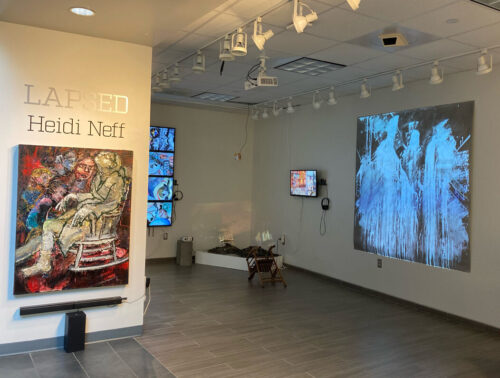
The Speed of Time: Film/Video Art in the United States, 1965-1980, on view at the Elizabeth Myers Mitchell Museum at St. John’s College, in Annapolis, presents representative works by seven artists who, through film and video, expanded the definition of art. The oldest work in the exhibition, Nam June Paik’s Digital Experiment at Bell Labs (1966) is a video of a microfilm Paik made by programming (in FORTRAN) a block of light to appear on the microfilm, moving along a diagonal line.

The most recent work is Gary Hill’s Around and About (1980). Hill’s idea, as quoted in An Art of Limina: Gary Hill’s Works and Writings, was to “cut images for every syllable of a spoken text.” In Around and About, fragmented, impersonal images of his studio flash in sync with the rhythms of an intimate, letter-like monologue to the viewer or perhaps a lover, as he reads it.
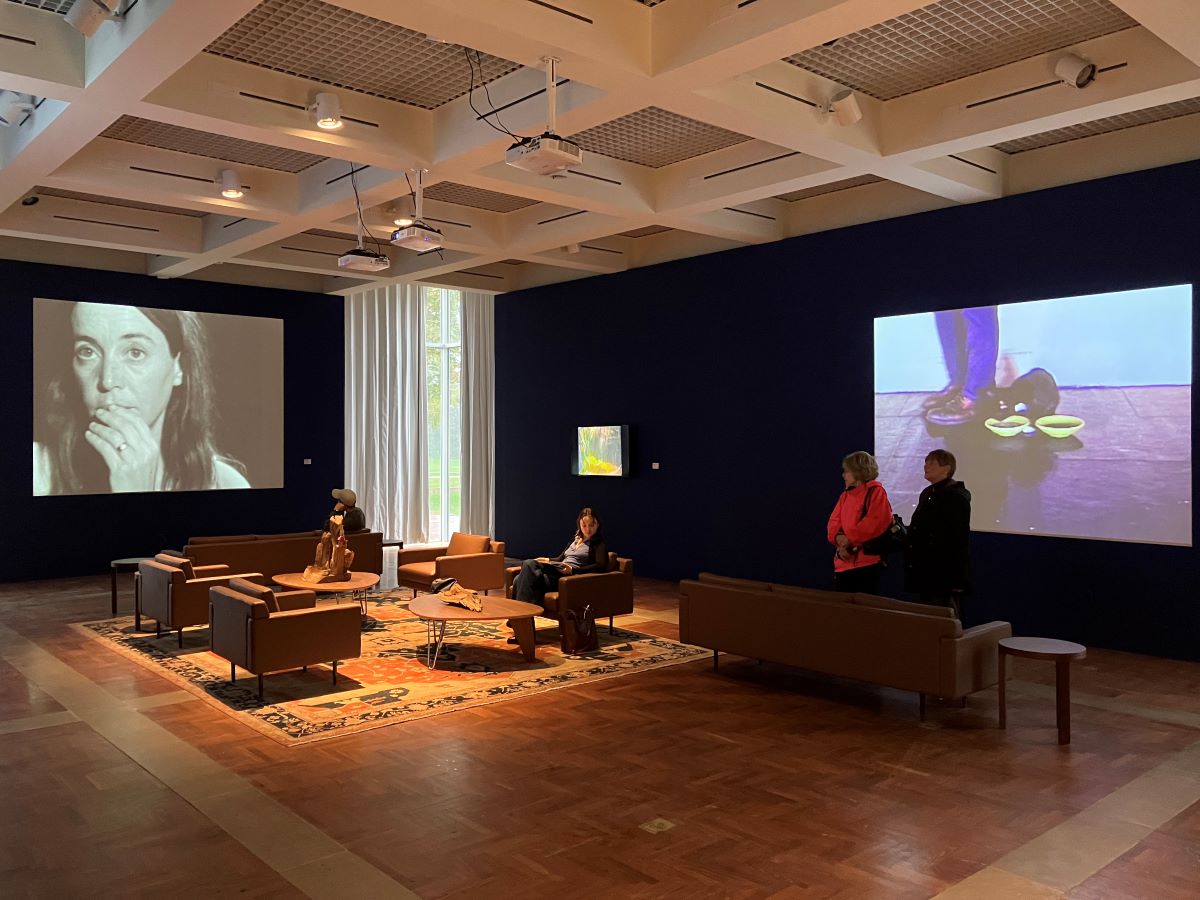
 

The Speed of Time: Film/Video Art in the United States, 1965-1980, installation view at the Elizabeth Myers Mitchell Museum, Annapolis
Still from Around and About, Gary Hill (1980)

Video also enabled more artists to become performers. Eleanor Antin’s black-and-white video Representational Painting (1971) shows her preparing her face for make-up. (As one of the museum staffers pointed out to me, the process is similar to preparing a canvas for painting.) We then see Antin applying the make-up, dressing, and modeling her outfit as if she were doing a fashion shoot. 

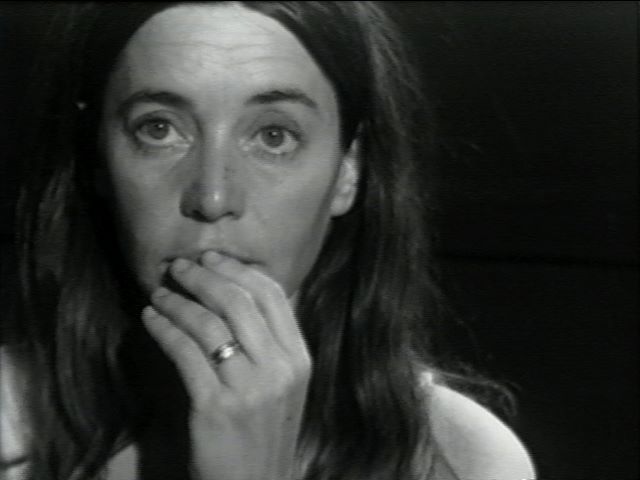
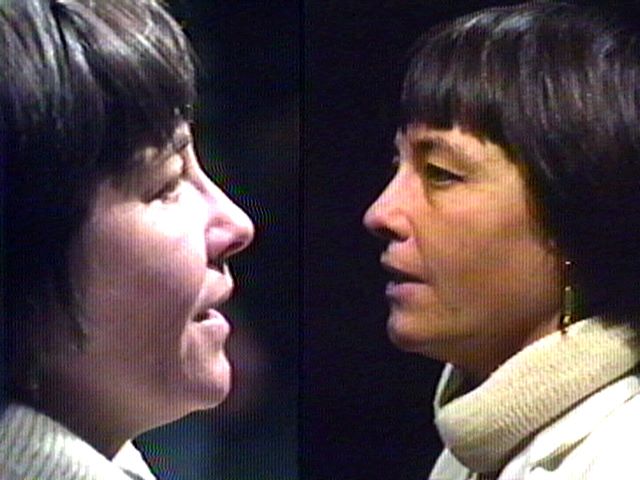
By contrast, Barbara Hammer’s Stress Scars and Pleasure Wrinkles (1976) is a video autobiography. In the first half, Hammer shows herself talking about how her face evolved with middle-age; the narrative includes yearbook and news photos of her. Then her face dissolves over shots from her films celebrating her lesbian friendships. Joan Jonas’ Duet (1972) shows the artist as a shadowy figure in the lower right of the screen howling at a video image of another woman, who begins to howl in response.

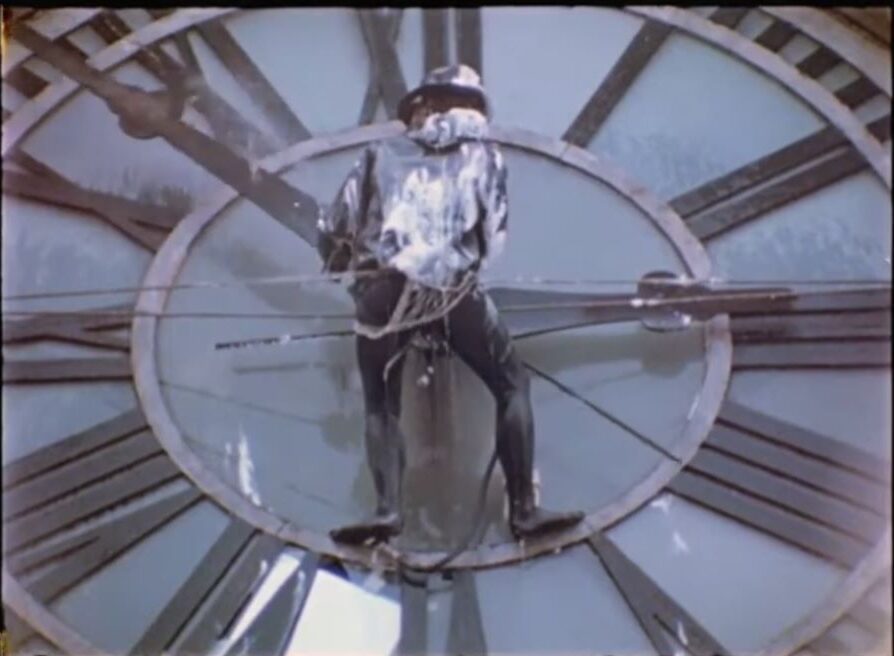
The most dramatic performance is that of Gordon Matta-Clark in Clockshower (1973). Matta-Clark is best known for “deconstructing” buildings: cutting holes in them or disassembling them to reveal their structures. In Clockshower, Matta-Clark deconstructs the pretensions of an old office building. He climbs to the clock face at the top of the building as water gushes from a hose he had preset. We see Matta-Clark brushing his teeth and shaving. Originally shot in 16 mm film, the scene recalls Harold Lloyd’s Safety Last! (1923) and perhaps looks forward to Philippe Petit’s World Trade Center wire walk of 1974.


Still from Eleanor Antin’s Representational Painting (1971)
Still from Clockshower, Gordon Matta-Clark (1973)

The artists featured in The Speed of Time co-opted, even deconstructed film and video, media that, in their commercial form, were on their way to dominating the American consciousness. They demonstrate how technology can be used to reframe our perceptions of the world and the greater experiment that is our human experience within it.  

The Speed of Time: Film/Video Art in the United States, 1965-1980 was co-curated by the museum’s director, Peter Nesbett and his wife, Shelly Bancroft, the co-founder of Triple Candie, a gallery of ephemeral art in New York. The exhibition runs through December 10. Hours and directions are available on the Elizabeth Myers Mitchell Museum’s website.

Until the end of 2024 the museum is also hosting Librería Donceles, a touring pay-as-you-wish Spanish language bookstore. The bookstore was founded in Brooklyn, New York, 10 years ago by Pablo Helguera. Everyone’s invited to the store’s 10th birthday celebration on December 9, 2023.

Images courtesy of Elizabeth Myers Mitchell Museum

Related Stories
MDFF Celebrates the 55th Anniversary of "Multiple Maniacs" with a Special Friday Night Screening at the Parkway

As America deindustrialized, John Waters and his keen observations of Baltimore's decadence have become a chief export. What more content can be extracted? Refined?

A Case for Why Maryland's Version of the Cinema Olympics is Unique... and Better for Film Artists

Since its inception in 1999, the MdFF has always defined itself as a discovery festival, a place to see films you might not see anywhere else. This year's Festival pivots to fall, running November 5-9.

We've Got Your Must-See Picks for October 2, 3, 4, and 5

Baltimore's New/Next Film Festival is back, with 30 feature-length movies, premiers, vintage gems, and more shorts than you can possibly watch. Brandon Soderberg has your guide to what not to miss.

Documentary Following Brandon Scott from Candidate to Baltimore Mayor Set for National Broadcast

Four years in the making, this local production offers a nuanced, deeply observed study of Baltimore City politics that speaks to audiences near and far. The film is now poised to reach a national audience with its broadcast premiere November 25 on PBS’ POV series.