Elena Volkova’s Folds and Edges is a collection of post-minimalist (or is it post-minimalist minimalist?) drawings and sculpture, which depict the precious lines and curves that are key in defining perception. A dozen or so pieces hang in the Baltimore Theatre Project’s small lobby gallery, each a pristine white field marked with a plain silver point line and slight shadow. Aesthetically, the drawings are dynamic, creating a strong contrast within the white space, and are pleasing to the eye. However, this is where the clarity comes to an end. The simple lines, defined by their lack of definition, encourage the viewer to think not of one subject in particular but every single object consisting of these basic contours.
Within the world of visual arts, minimalism is generally defined by images and forms which reference the industrial world. One could call it “art from the machine.” American minimalism ran its course from the nineteen fifties to late sixties. Today, in the two thousand teens, the world is one of posts; post-modernism, post-humanism, post-environmentalism, post-offices (that last one is a joke, though the era of post-post-offices may happen soon enough). Minimalism is no different. If one can make a general statement about “post-”s, they continue the movement they follow but, in a sense, do the exact opposite – if minimalism is industrial, post-minimalism is natural. The art no longer comes from the machine, but the artist or nature.
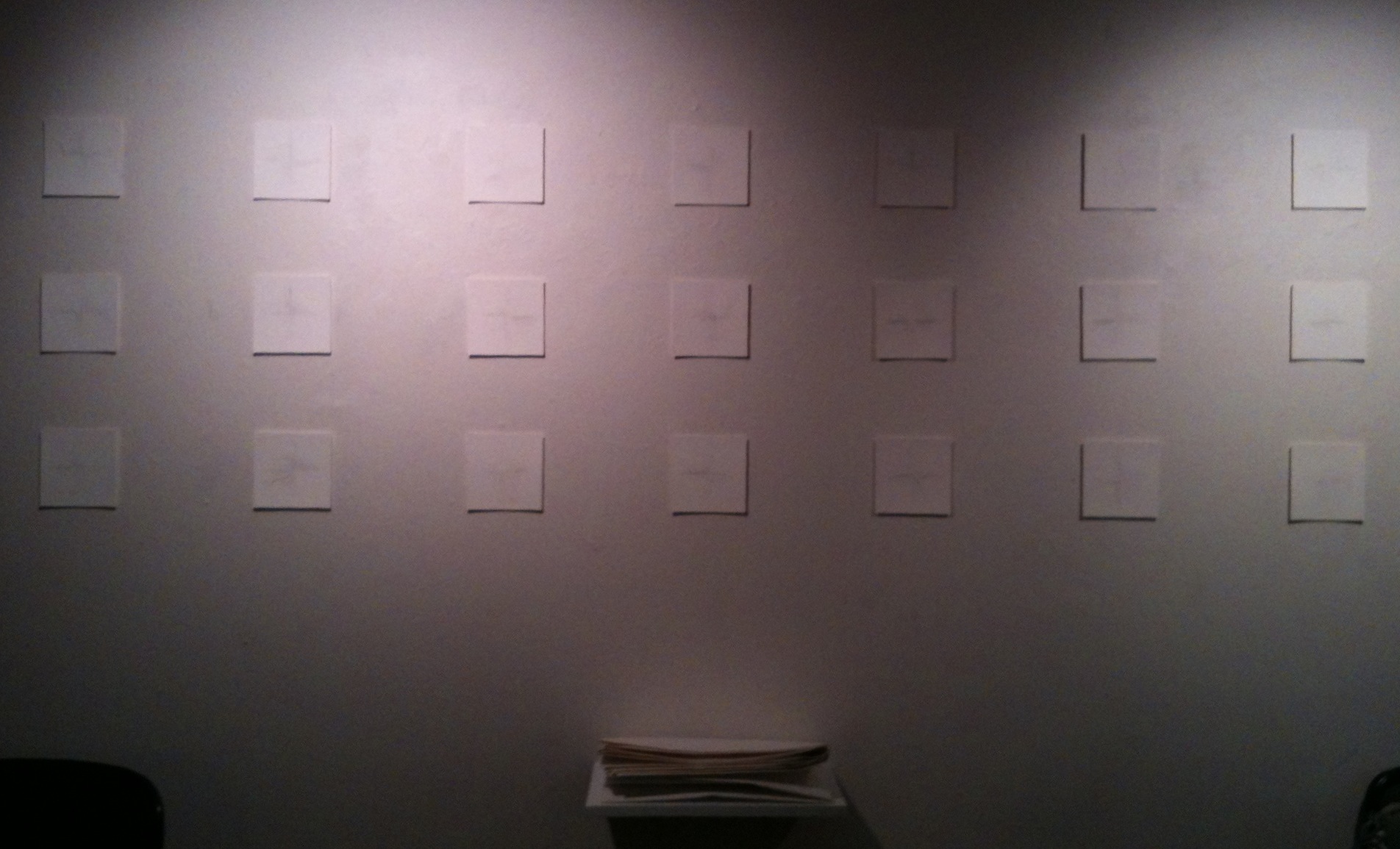
Although minimal, Volkova’s work, as a whole, creates a sense of landscape. The concave and convex lines on paper quickly draw parallels to sand bars, slopping hills, or snow embankments. Their sparsity causes one to recall moments of intense light, or lack thereof. Volkova further plays with light by hanging her work slightly off the wall. Each drawing further creates a landscape with its own shadow. Volkova obviously wants the audience to realize this second layer to her work is intended, as indicated in the title of the show. What may not have been intended is the quality of the gallery’s lighting in relation to the drawings. Pieces such as these demand a strongly lit, bright setting to allow full appreciation. While gallery space is in a beautiful and historic Baltimore row house, it doesn’t supply the clean environment that Volkova’s work requires.
Regardless, the show is rather successful. The work is provocative and provides viewers with a fair amount to consider. As the two thousand teens continue, work within the post-minimalist genre could see increased demand. Especially, facing the digital age, work emphasizing the simple edges and folds of the natural world becomes more relevant.
Elena Volkova: Folds and Edges is up at the Baltimore Theatre Project’s Lobby Gallery until February 10th.
Author Sean Ostrowski is a MICA Graduate and Baltimore-based Designer, Artist, and Writer.