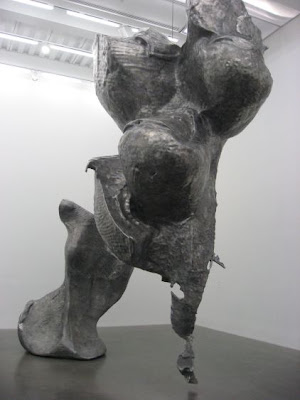
I went to the New Museum prepared to hate this show. I expected it to be all bluster and cleverness, lacking a heart or conscience. I had read an Urs Fischer profile in the New Yorker a few months ago, and was completely unimpressed with the idea of an artist grabbing up fistfulls of clay, squishing it around for a second or two, and then casting these turds into giant aluminum sculptures. What is the point? It just seemed like an exercise in shameless art world ego.
 This was the entry point of the exhibit for me and I was startled by the effective application of one simple rule: SIZE makes a DIFFERENCE. I had imagined these clay blobs as a few feet tall, maybe human-scale, and was unprepared for their sheer immensity. They towered over us, like fat cartoon walruses or bulbous whales, threatening and comical at the same time. These sculptures are preposterous and extravagant, quite delightful really, and their power was all because of a shift in scale. Every once in a while you’d see a bit the artist’s finger print, larger than your face, while the visible seams in the metal alluded to the industrial casting process.
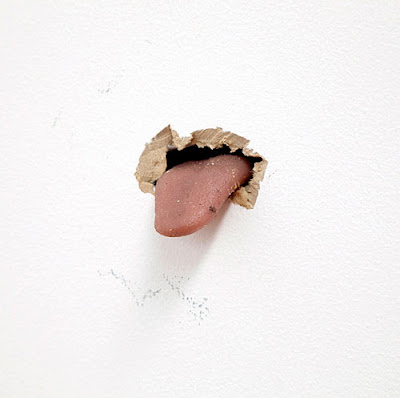
Along the edges of the top gallery (the museum recommends going to the top floor and then coming down, one floor at a time), were more of the jokey installations and sculptures I expected: a rubber tongue that darts out of a hole in the wall when you stand close enough and a bubblegum pink vintage lamp post which appeared to be melting.
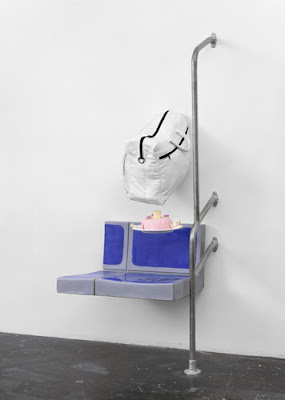
 The other piece I almost missed in this first gallery is titled ‘The Lock’ (pictured below). On first impression, it looks like a lumpy Claes Oldenburg fragment. So what? Made of cast polyurethane, steel pipes, and electromagnets, this sculpture appears to be part of a public bus with a round pink cake levitating in the air over the seat and a white gym bag attached to the wall.
 Spoiler Alert: Finally, we figured it out, after reading the wall plaques, which looked strange, too. The entire room was a site specific trompe l’oeil environment. Fischer had photographed every square inch of the walls, then reprinted these as wallpaper, which then covered the same walls and ceiling. In the photo below you can see it – the actual exit sign over top of the photographed one, the actual round air vent over the photographed one. Every wall plaque, fire alarm, and molding were all there, twice but overlapping, creating a disjointed and subtle image of the architecture itself.

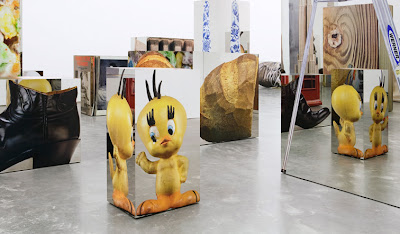
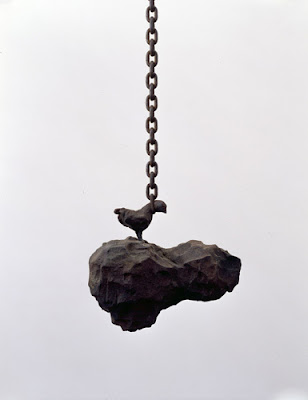 Last, we ventured down to the second floor, for the installation called Service à la française (2009) – which, according to the New Museum is “Fischer’s most ambitious work to date— a technical tour de force that required more than 25,000 photographs and over twelve tons of steel.”
 More than fifty chrome boxes occupy the gallery, creating a maze of mirrored cubes, each with a 3-D depiction of a random object. The artist silkscreened the images onto the mirrors, some actual sized and others larger than life, and the effect is dizzying, yet friendly at the same time.
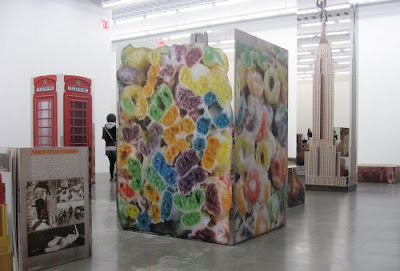
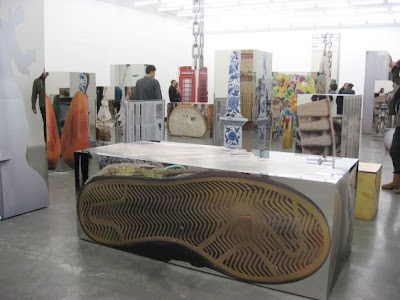 These boxes are banal and cheeky, odd and mysterious. As you gaze around the room, your eyes put it all together like a collage. You can’t really focus on any one thing, but the overall experience is an optical puzzle and feels nice on the eyes. The museum describes it as “simultaneously immaterial and hyperreal,” which is, actually, a fair assessment.
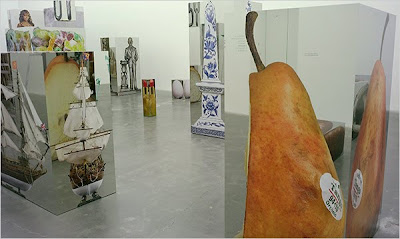
I wasn’t sure if I wanted to shell out the twelve bucks to see this awkward and eccentric maze of oddities, but in the end, I am glad that I did.

 The other piece I almost missed in this first gallery is titled ‘The Lock’ (pictured below). On first impression, it looks like a lumpy Claes Oldenburg fragment. So what? Made of cast polyurethane, steel pipes, and electromagnets, this sculpture appears to be part of a public bus with a round pink cake levitating in the air over the seat and a white gym bag attached to the wall.
 The floating cake is the cool part and you almost don’t even see it. We stared at this piece for a few full minutes from all angles, trying to see if there were any tiny wires suspending the cake in the air. We guessed that the piece used some sort of magnet to keep the cake midair and, after reading about it, discovered this was correct. Urs Fischer definitely lives up to his monicker as a naughty trickster in this exhibit, but what I didn’t expect was to be included in the joke.

Moving to the third floor gallery, we went down a long series of vertical steps, went past a tiny gallery with wilting vegtables mounted on the ceiling (ew), and into the next big space.
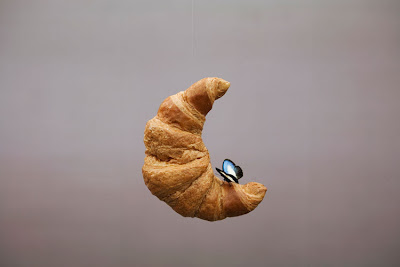
I knew there was something strange about the walls – an odd Revlon-esque shade of metallic purply brown, that seemed to fade from one shade to the next. Some of the overhead lights were warm, others cool, so maybe that explained it? There was a lavender grand piano in the middle of the room, which appeared to melt and sag, and a croissant dangling at eye level from a thin string with a fake butterfly on it, and lots of empty space. What’s with this weird space? Why is it so strange?

 Spoiler Alert: Finally, we figured it out, after reading the wall plaques, which looked strange, too. The entire room was a site specific trompe l’oeil environment. Fischer had photographed every square inch of the walls, then reprinted these as wallpaper, which then covered the same walls and ceiling. In the photo below you can see it – the actual exit sign over top of the photographed one, the actual round air vent over the photographed one. Every wall plaque, fire alarm, and molding were all there, twice but overlapping, creating a disjointed and subtle image of the architecture itself.
 Last, we ventured down to the second floor, for the installation called Service à la française (2009) – which, according to the New Museum is “Fischer’s most ambitious work to date— a technical tour de force that required more than 25,000 photographs and over twelve tons of steel.”
 More than fifty chrome boxes occupy the gallery, creating a maze of mirrored cubes, each with a 3-D depiction of a random object. The artist silkscreened the images onto the mirrors, some actual sized and others larger than life, and the effect is dizzying, yet friendly at the same time.
Bright colors abound in cartoon figures, women’s high heeled shoes, giant cocktail glasses, buildings, ships in bottles, and cardboard cut-outs of handsome people. As you walk around each cube, you see a flat image of the object: the front, back, right and left sides, but the mirrored surface causes you to see yourself, other patrons, and other boxes in the negative shapes. They are simultaneously flat as a Warhol, but swimmingly deep and moving.

 These boxes are banal and cheeky, odd and mysterious. As you gaze around the room, your eyes put it all together like a collage. You can’t really focus on any one thing, but the overall experience is an optical puzzle and feels nice on the eyes. The museum describes it as “simultaneously immaterial and hyperreal,” which is, actually, a fair assessment.

I wasn’t sure if I wanted to shell out the twelve bucks to see this awkward and eccentric maze of oddities, but in the end, I am glad that I did.
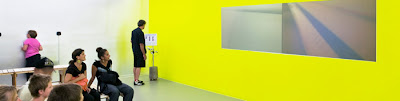
The New Museum’s strength, besides the commitment to a specific artist’s vision, no matter how ridiculous, is in the use of the architecture. A somewhat goofy and awkward stack of boxes, the museum utilizes its architectural strengths and uses them as part of the work itself. This was also true in the unrelated Museum as Hub: In and Out of Context on the top floor, where works blended seamlessly into a florescent yellow wall and sound stations were as aesthetically appealing as their oral narations.