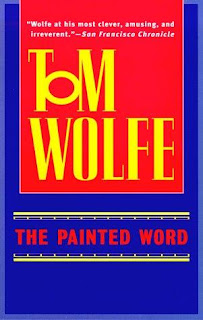
 After discovering Tom Wolfe’s “The Painted Word” on a friend’s bookshelf the other day, how could I resist? Known best for “The Electric Kool-Aid Acid Test,” Tom Wolfe manages to satirize the holiest and most profound cultural relics of the contemporary art world with devastating accuracy.
Published in 1975, “The Painted Word” is an informal survey of the social history of modern art – from it’s earliest inception as a revolution (approx 1900) against literary and bourgois content to
the ‘current’ state of art in the 1970’s. Wolfe dissects modern art’s emphasis on dogma and theory, and portrays it like an absurdist drama where bohemian ‘values’ are turned into commodity, where artists are cannonized more because of certain guru-critics, than their sales or actual work. In short, Wolfe portrays ‘today’s’ art world as academic, literary, and elitist as the original salons modern artists rebelled against.
Rather than being dour or bitchy, Wolfe is hilarious and chatty, pitching insightful zinger after zinger into a casual conversational tone. This books is incredibly easy to read and, at under 100 pages, is done in an hour or so. There’s really no excuse NOT to read this.
Wolfe starts out skewering Modern Art – “All profoundly original art looks ugly at first!” – and discusses its dualistic relationship with fashionable society, i.e. ‘Cultureburg.’ Wolfe’s description of the Art Mating Ritual – the Boho Dance and the Consummation – is right on. To be taken seriously contemporary art must reject and challenge the values of society but also surrender to it, without seeming to. This is funny because it is true.
Wolfe discusses the critics who have shaped the course of contemporary art more than any artist, and describes the currents of Abstract Expressionism, Pop, Op, Minimal, and Conceptual Art. According to Wolfe, Clement Greenberg, Harold Rosenberg, and Leo Steinberg are the names who really matter – not Jackson Pollock, Willem de Kooning, or Jasper Johns. His argument is entertaining, logical, and wicked. As a social historian, as well as an uncomprehending art-wannabe-appreciator, Wolfe asks the questions many of us are afraid to.
Particularly interesting is Wolfe’s take on the inherent elitism of the art world (Chapter 2 – The public is not invited & never has been) and an admission that art is created for the tiniest sliver of society to purchase and enjoy. The art world is a relationship between artists and culturati, and no one else. According to Wolfe, artists constantly up the ante, creating works that shock and astound, and les beaux mondes buys it, feeling smug and superior in their modernity.
If the emperor appears to be naked, is it because we’re too dumb to appreciate the concept of his fashion designer or is this guy pulling a fast one? Wolfe does not use his eye to criticize or moralize, he merely translates an argument for and against to understand, enjoy, and explain a cultural phenomena that leaves most people out in the cold.