 “Collection of Forty Plaster Surrogates,” 1982-84, by Allan McCollum, on view in the Metropolitan Museum of Art’s current exhibition “The Pictures Generation, 1974-1984.”
HOW does cultural history get written? Who chooses which portraits will hang in the hall of fame, which art will live on in museums, which books will end up on the classics shelf, which music will be standard fare in tomorrow’s concert halls?
We are encouraged to think that such judgments have lives of their own, are decided by a kind of natural selection. The most beautiful art will prevail, the most ambitious, the most morally uplifting, the most universal in emotional appeal. Everything else is by default of a lesser order. We shouldn’t fret if it disappears.
This view is, of course, wishful thinking. Moral and universal are concepts up for grabs; my notion of beautiful may leave you cold. Many of our masterpieces owe their origins to the distinctly immoral ambitions of power politics, their survival to prosaic strokes of luck, their present pre-eminence to institutional marketing, scholarly attention and popular sentiment. Even so, survival can be chancy. Fine things are tossed out and crummy things kept all the time.
In the case of art from the deep past we can usually only guess at how the selection process worked. With contemporary art we can see it in operation. We can see history being written — recorded, edited, enhanced, invented — right before our eyes. It can be a disturbing sight.
I was reminded of this after visiting two big history-writing and history-inventing exhibitions in New York this spring, “The Pictures Generation, 1974-1984” at the Metropolitan Museum of Art (through Aug. 2) and “The Generational: Younger Than Jesus” at the New Museum (through July 5).
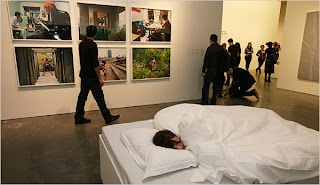
 Chu Yun, “This is Lacy,” 2006, a living sculpture installation with sleeping person at The New Museum Triennial.
Both are eagerly anticipated surveys, one of influential art from the near past, the other of art very emphatically of the here and now, and with an eye to the future. And neither show is modest in its aims. Both speak of art they are presenting in epochal terms, as defining not styles or trends but generations. This is a bold take on history, but a tricky one, gratifyingly dramatic, inevitably distorting.
To read the whole “Generation” review, click here.
To read Cotter’s “Young Artists, Caught in the Act” from April 9, click here.