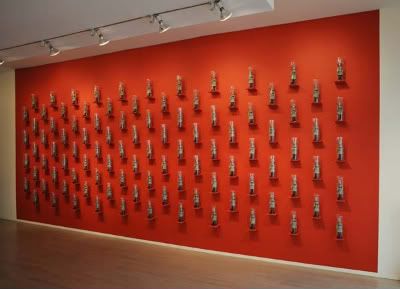

While looking at Mina Cheon’s outstanding exhibition at Grimaldis Gallery, one is struck by effective accumulation of hand-made dolls and life-size digital printouts of paper dresses. As one artist friend mentioned to me, “There are high-intensity, low effort exhibitions and high-intensity, high effort exhibitions. This exhibition falls into the later category.” Ms. Cheon’s work for this exhibition is divided into two main bodies of work: the 99 Miss Kim(s) consisting of 99 identical handmade female dolls in North Korean military uniforms and Party Dresses & Home Dresses consisting of large-scale digital printouts of paper doll dresses intended for young Korean girls during the 1970’s.
Party Dresses & Home Dresses are residual artifacts of the goals and aspirations of a third-world country on its march towards Westernization and Modernism. Along the way there are bound to be embarrassing missteps and faulty translations. It is the cultural equivalent of looking at pictures of early teenage years and turning red over the sartorial choices. Ms. Cheon exposes the ridiculous and overblown styles intended for the “modern” Korean woman. Of course, paper dolls are intended for children. It is a thinly veiled attempt to expose young girls to “modern” fashion and cultivate an appreciation of it at the cost of the traditional Korean hanbok.

While paper dolls have long been an effective metaphor in art for women’s roles and the projective identity of young girl’s “playing” with them, I find the scale of Cheon’s work is effective in this instance. The life-size places them in the category of politicized objects of gender and race rather than in the world of children’s play. They are effective reminders of cultural and gender conflict as countries move away from traditional cultures and towards homogenized notions of what it means to dress and act the part of being “modern”.
The uncanny is that which is familiar and unfamiliar at the same time and the notion of the uncanny seems to me to be key to understanding and unpacking the layers of 99 Miss Kim(s). The female dolls dressed in the military dress uniforms of North Korea instill a sense of unease. Furthermore, North Korea is an enemy and presents a nameless danger to American security and safety. The viewer is at once attracted by the adorable “doll-ness” of the objects and repelled by the implications of their wardrobe and numbers.

Another level to this work investigates the idea of females in the military. Our technological developments in exterminating humans have advanced to the point that strength and stamina are secondary attributes to keen eyes and fast reflexes. Participants in asymmetrical warfare quickly realized that feminine fingers could pull a trigger and press a button just as easily as male fingers. The Western mindset still resists putting female soldiers directly into harms way (if they could help it). Perhaps we cannot reconcile our stereotype of the feminine nurturer with the stereotype of the soldier as killer. Cheon’s dolls are signifiers of another country’s willingness to do what we ourselves cannot.
Cheon adds to the loaded relationship girls have to dolls by using this relationship to examine serious questions about race, gender and modernity. The artist capably points out, using the simple metaphor of dolls, the divide and disconnect between Korean-ness and American-ness. It is an excellent exhibition and perhaps brings more understanding to the contradictoriness of post-colonial bodies and their location in the “modern” world.
– Jarrett Min Davis