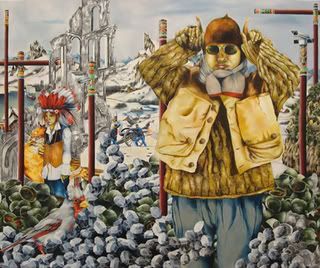

WinterIndex by Jarrett Min Davis
Authenticity only exists on a personal level. The public level of authenticity is so corrupted by our culture of copying that distinguishing the authentic from the fake is almost impossible. For me, authenticity is linked with the truth. We are surrounded by a world awash in a sea of the inauthentic: fake jewelry, fake breasts, fake vanilla taste, fake plants, print of Van Gogh’s “Starry Night”, and a primacy for the virtual experience (TV and internet) rather than actual experience. I question whether this makes us hunger for something more authentic or it has gotten to the point where a majority of people don’t care whether something is real or not.
Art has always struggled with authenticity. Most court painters painted out warts for princes after all or painted images from Greek and Christian mythology. The 1960’s really is the time authenticity shined in the art world. It became a psuedo magical mantra about painters like Pollack, DeKooning, Rothko ect. Blame Clement Greenberg. Even though this stance was challenged by contemporary artists like Jeff Koons, authenticity is always part of discussion about art.
I think that authenticity and its counterpoint cynicism are always brewing in contemporary artists, like a Yin and Yang balance. There are positives and negatives about both. Authenticity without some cynicism can create work that is terribly naïve and a natural jumping point for artistic solipsism. The idiotic artist that states, “It is what I really feel!” as if it is therefore true and/or interesting.” Cynicism without authenticity is a spiritual emptiness that never bothers with personal introspection and substitutes it with the question of “What can I get out of this?” The best work always is true to the artist creating it but has the touches of wisdom that a little cynicism can bring.
I think contemporary artists playing with both of these elements makes it harder to see visual evidence of authenticity. Paintings look like photos and photos occasionally look like paintings, ect. When looking for authenticity, I look for intensity. How focused is the work? Is it mounted / framed and fabricated like the artist cares about the work? Is it a complete work or does it have problems with simple things like composition or use of media? Any work with a controlled intensity has elements of authenticity. I then hope that there is more than one piece by the artist and look for the exact same things in them.
Authenticity isn’t the be all and end all that makes good work. It is an element but I think all good artists must be true to themselves. You can always trick a number of people and critics with massive amounts of theoretical bullshit but you can never trick yourself.
– Jarrett Min Davis