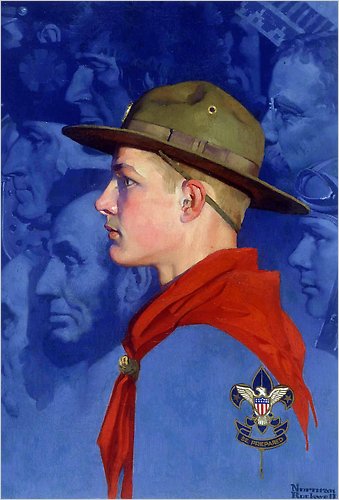
 “Spirit of America,” by Norman Rockwell.
In an age when Democrats and Republicans are barely on speaking terms, you might not think that decades-old paintings of freckled schoolboys and their loyal mutts could help revive the conversation about what we value as a nation. Yet Norman Rockwell’s cheerful America has lately acquired a startling relevance both inside and outside the art world, in part because it symbolizes an era when connectivity did not require a USB cable.
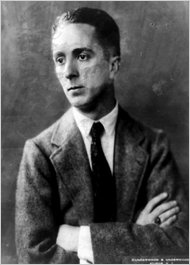 Norman Rockwell in 1921.
Rockwell’s paintings are easy to recognize. In the years surrounding World War II his covers for The Saturday Evening Post depicted America as a small-town utopia where people are consistently decent and possess great reserves of fellow-feeling. Doctors spend time with patients whether or not they have health insurance. Students cherish their teachers and remember their birthdays. Citizens at town hall meetings stand up and speak their mind without getting booed or shouted down by gun-toting rageaholics.
This is America before the fall, or at least before searing divisions in our government and general population shattered any semblance of national solidarity. Rockwell’s scenes of the small and the local speak to us in the age of the global because they offer a fantasy of civic togetherness that today seems increasingly remote. “To me the most important part of Rockwell’s work is that it illustrates compassion and caring about other people,” the filmmaker George Lucas, who lives in Marin County, Calif., said recently. “You could almost say he was a Buddhist painter.”
Steven Spielberg, speaking from Los Angeles, had similar praise. “Anything for Norman,” he said, when asked to discuss his work. “He was always on my mind because I had a great deal of respect for how he could tell stories in a single frozen image. Entire stories.”
Mr. Spielberg and Mr. Lucas may be best known for vaulting E.T. and Luke Skywalker into the reaches of outer space, but they happen to be serious collectors of Rockwell’s scenes of earthlings set in a galaxy close to home. Now they have pooled their art holdings and created a likely summer hit in a medium other than film. “Telling Stories: Norman Rockwell From the Collections of George Lucas and Steven Spielberg” opened Friday at the Smithsonian American Art Museum in Washington, where it remains on view until early next year.
Asked what led him to undertake the show, Mr. Lucas said in a halting voice: “I did this really because Steven wanted to do it. It was Steven’s idea. I don’t normally do that kind of stuff.”
To read the whole article, click here. To see more images in a multi-media slide show, click here.