OSAYCANYOUSEE: Post Typography at The Windup Space by Lisa Lance
“And where is that band who so vauntingly swore
That the havoc of war and the battle’s confusion,
A home and a country should leave us no more!
Their blood has washed out their foul footsteps’ pollution.
No refuge could save the hireling and slave
From the terror of flight, or the gloom of the grave:
And the star-spangled banner in triumph doth wave
O’er the land of the free and the home of the brave!”
This is the third verse of our national anthem. Recognize it? Except for the last line, I didn’t. Written by Francis Scott Key in response to a fiery battle at Fort McHenry during the War of 1812, the song is now more commonly associated with sporting events and the 4th of July than with a military conflict, and these darker, less commonly known lyrics of “The Star Spangled Banner” are left out of the soaring hymn sung before every baseball game.
OSAYCANYOUSEE, the exhibit by Nolen Strals and Bruce Willen of Post Typography on display at The Windup Space in Station North, was inspired by the War of 1812 and examines the way our national symbols evolve in meaning over time.
“[The War of 1812 is] interesting because it’s this war that most people don’t remember. It’s kind of an afterthought,” Willen said when I talked to him by phone. “But at the same time, it was the first truly American war, and it defined us as a country.” Westward expansion, manifest destiny and economics all came into play, and, 200 years later, the results of the conflict still permeate our lives.
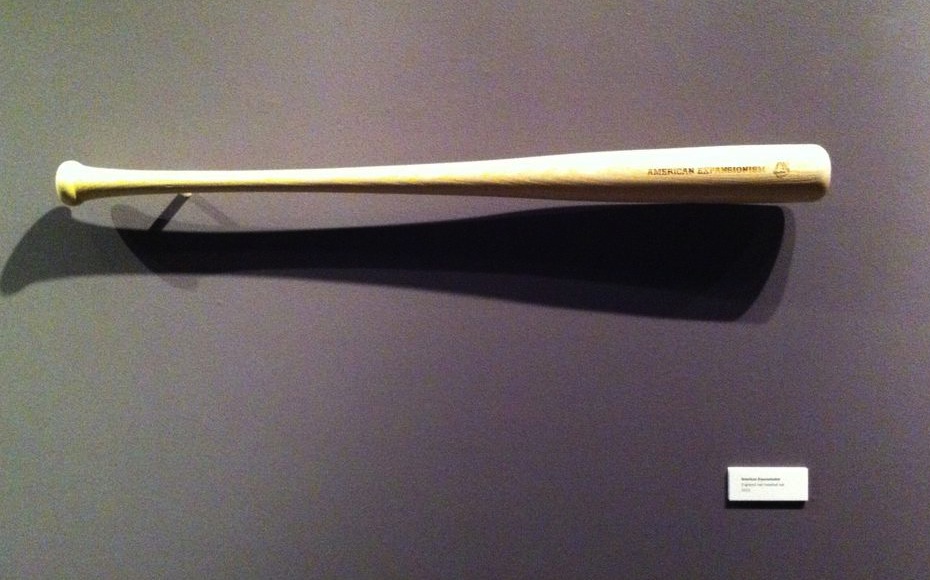
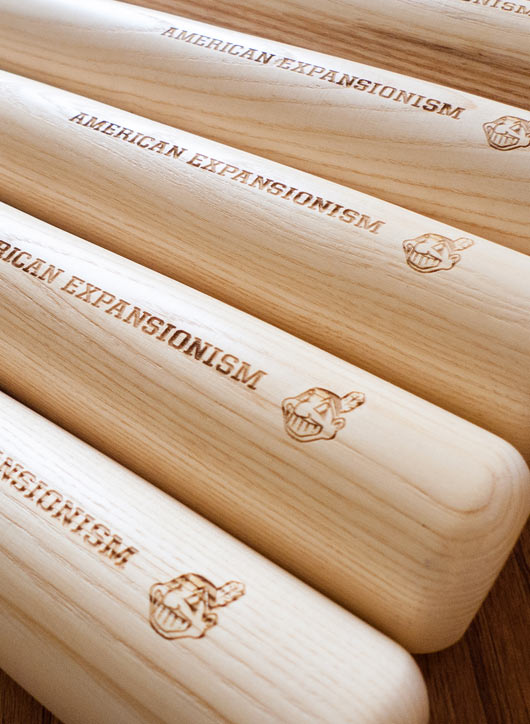
The prints and objects (really, one object—an engraved ash baseball bat) line the wall to the left as you walk in the door. Set in clean white frames against a flat grey wall, the images are, on first glance, deceptively simple. But as I took them in, I began to see a greater depth of meaning.
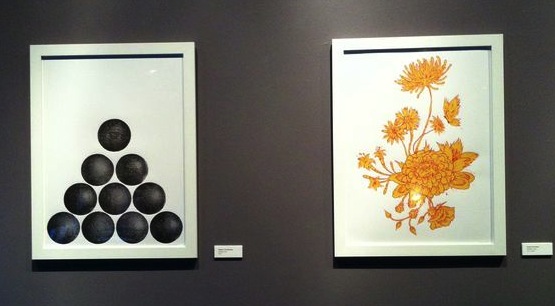
Anyone who’s been to Fort McHenry will recognize the image in the first print, “Twilight’s Last Gleaming.” Ten cannon balls are stacked in a pyramid, black with some silver to give them dimension. The shadow of an eye—the eye from the top of the pyramid on the one-dollar bill—stares out at you from the top cannonball.
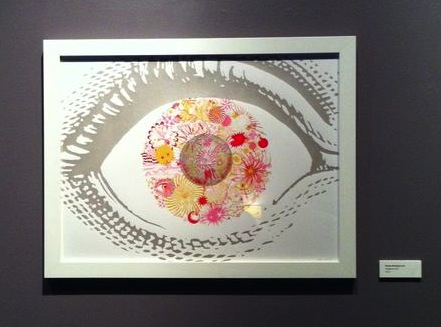
As I examined each piece, I couldn’t help but hum “The Star Spangled Banner” to myself. Next came “Rocket’s Red Glare,” a botanical print of exploding yellow and red flowers. The use of color continues in “Bombs Bursting in Air,” in which a psychedelic swirl of bombs, fireworks, rockets, stars and stripes explode in the iris of a wide-open eye.

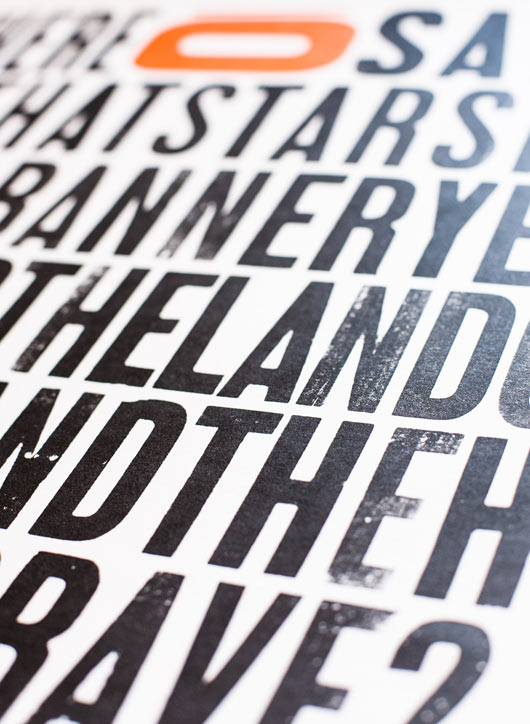
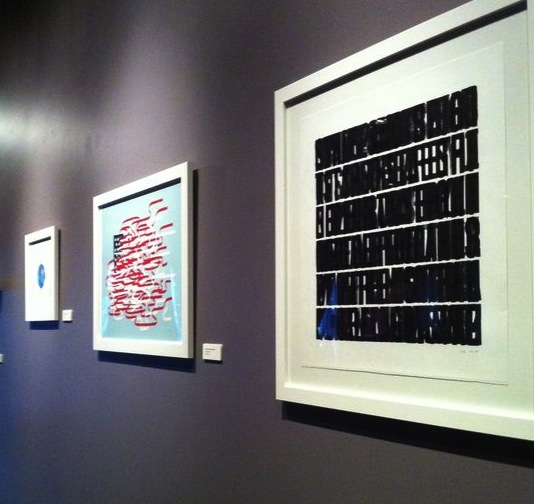
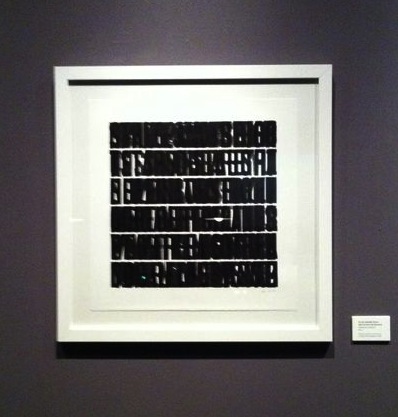
The cluster of four prints for which the exhibit is named depicts the words of “The Star Spangled Banner” running together, in all caps and with no punctuation. “We hear the national anthem at a sporting event, but if you read the lyrics of all four verses, it’s about a violent battle and now you don’t really think of it,” said Willen. The “O” in the fourth print is orange and horizontal as a tribute to the yell of Orioles fans.
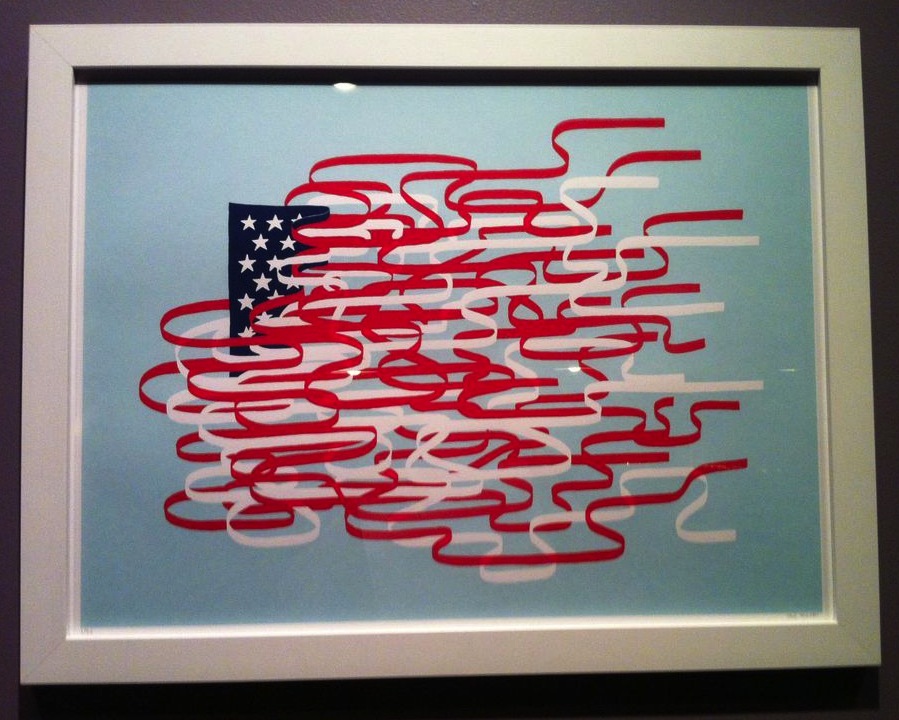
After the engraved ash bat (“American Expansionism”) and an “Untitled” single, stark, cannonball, I paused at “Through the Perilous Flight,” a serigraph print of an American flag. The red and white stripes look like ribbons popping off the light blue background and give the feeling of unraveling, anchored in the top left corner by a patch of dark blue field where 13 stars remain.
The song lyrics are revisited in “The Star Spangled Banner (Half Conceals, Half Discloses),” but in this case they are layered in a single print. Some letters were easy to pick out, but my eyes strained to make sense of others, though I knew the familiar words. I was left with a sense of both clarity and confusion.
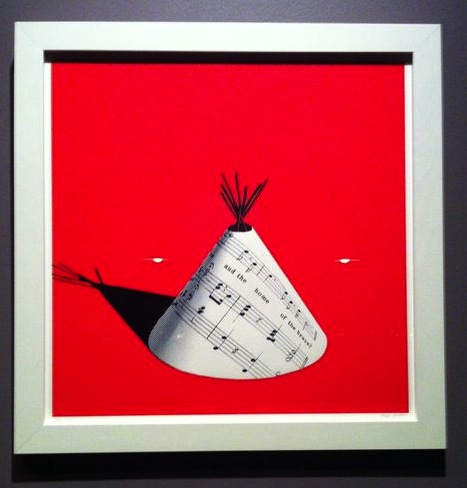
The final print in the exhibit, “And the Home of the Brave? (Tribute to Chief Noc-A-Homa),” brings back the baseball theme, as it references the original mascot of the Atlanta Braves in its title, and also touches on the Native American experience. A teepee constructed of a white musical score showing the measure that reads “and the home of the brave” stands out against a bright red background, its shadow falling to the left. Willen said in the course of their research he and Strals were struck by the effect the end of the War of 1812 had on Native Americans. “The original part of the treaty would have created a sovereign nation…and America decided to take the land for themselves,” he explained. I couldn’t help but think of our country’s tendency to take history and water it down, turning battle songs into sports anthems and making caricatures of complex figures.
And that’s just what the exhibit is supposed to do: make you think. “We’re not trying to make any specific point,” said Willen. “But [we’re] raising some questions and thinking about America and patriotism and war and historical events and how it relates to our private lives. And baseball.”
OSAYCANYOUSEE will be on display at The Windup Space through October 27.