BmoreArt is a creative and critical daily online journal. We believe that Baltimore’s creative class deserves to be discussed, critiqued, and well-informed.
Picture this: it’s 1984 and New York’s Museum of Modern Art is putting up an authoritative new exhibit, An International Survey of Recent Painting and Sculpture. According to the museum’s press release, this survey of contemporary art revealed “the high quality and extraordinary vitality of recent artistic production in acknowledging a variety of works by a younger generation of artists.” Of the 169 artists deemed worthy of inclusion in this career-validating show, less than 10 percent were women.
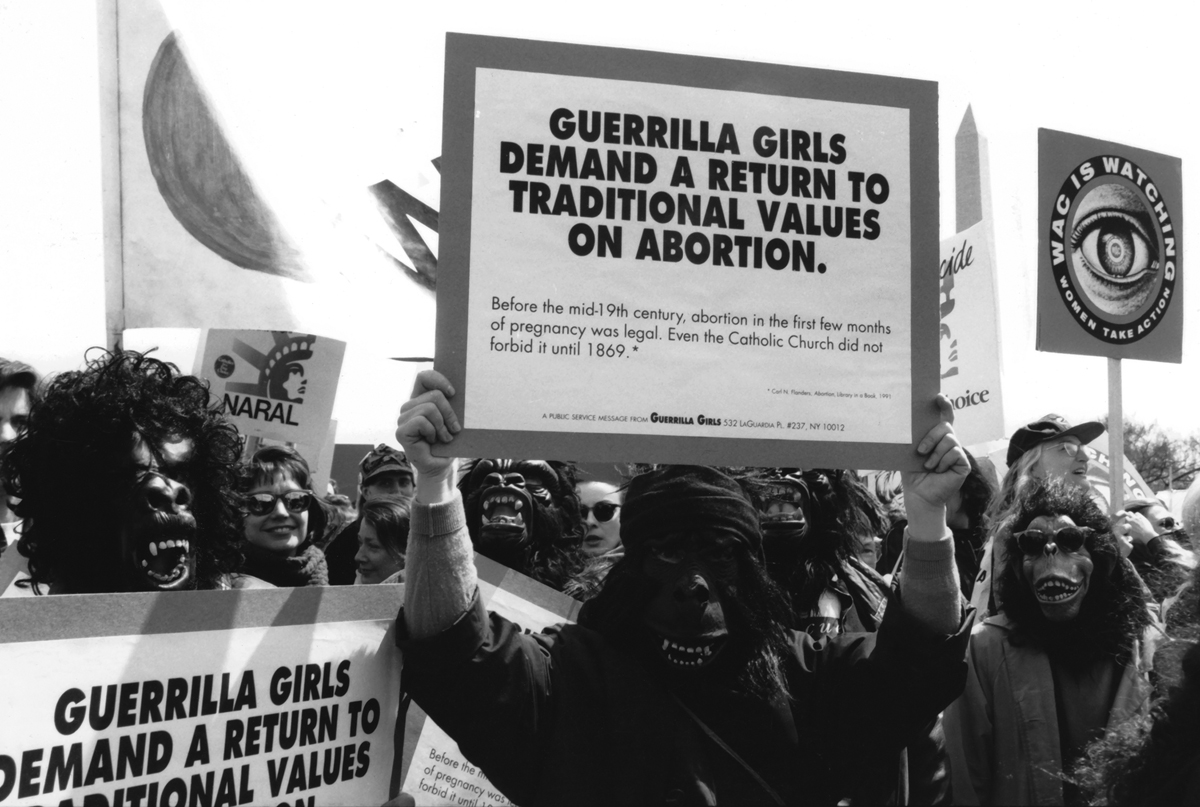
Outraged and disappointed that the picket lines organized to protest outside the MoMA were simply being ignored by both passersby and museum leadership, a group of feminist artist-activists got to brainstorming about how to more effectively call to account the art world for its entrenched sexism.
“The old picket line wasn’t working for this issue,” one of them recalled later in an oral history of these heady days. “There had to be a more contemporary, different, better way to get this message across.”
And so was born the feminist collective Guerrilla Girls whose ensuing 40-year history of provocative art-making and activism is on display at the recently opened Guerrilla Girls: Making Trouble at the National Museum of Women in Art in Washington, DC. The group’s fortieth anniversary served as “the big inspiration for putting the exhibition together,” Assistant Curator Hannah Shambroom said in a recent phone interview. “It definitely felt like the right time to revisit them and display them in a dedicated exhibition.”
Installation view of "Guerrilla Girls: Making Trouble" at the National Museum of Women in the Arts, Washington, D.C.; Photo by Kevin Allen Photography for NMWA
Installation view of "Guerrilla Girls: Making Trouble" at the National Museum of Women in the Arts, Washington, D.C.; Photo by Kevin Allen Photography for NMWA
We were immediately THE topic at dinner parties, openings, even on the street. Who were these women? How do they dare say that? And what do their facts say about the art world?
Anonymous member of the Guerrilla Girls
Envisioning themselves as freedom fighters of Lower Manhattan and a self-appointed “conscience of the art world,” the Guerilla Girls quickly landed on a distinctive voice—combining pointed humor with facts and data into provocative critiques about the discrimination against women and people of color by museums, galleries, critics, and even fellow artists.
At night, they would wheatpaste eye-catching posters of bold, simple text in the New York neighborhoods frequented by the art cognoscenti. Postering eventually gave way to billboards, bus advertisements, and multiples (artist-designed objects produced in a series of identical editions) to spread their message.
Adding to the group’s mystique was the adoption of their trademark gorilla masks (inspired by a member’s misspelling of “guerrilla”) and taking the names of deceased historical women artists as their noms de guerre. Members of the Guerrilla Girls collective, of which there have been more than 60 since the group’s founding, remain anonymous.
“We were immediately THE topic at dinner parties, openings, even on the street. Who were these women? How do they dare say that? And what do their facts say about the art world?” an original member recalled their early escapades in an interview. “Women artists loved us, almost everyone else hated us, and none of them could stop talking about us.”
Four decades later, the Guerrilla Girls are still being talked about. Making Trouble’s mini-survey of their oeuvre is a worthy celebration of the collective’s brand of witty but serious-minded trouble-making and it offers an opportunity to consider their legacy against the backdrop of these turbulent times.
“I don’t want the exhibition to be doom and gloom necessarily, and saying, ‘Oh, I can’t believe we’re still dealing with these issues,” explained Shambroom of her curatorial intent behind Making Trouble. “Instead, I hope it provides the opportunity to reflect on what has changed and progress that has been made, while also understanding that the work is ongoing.”
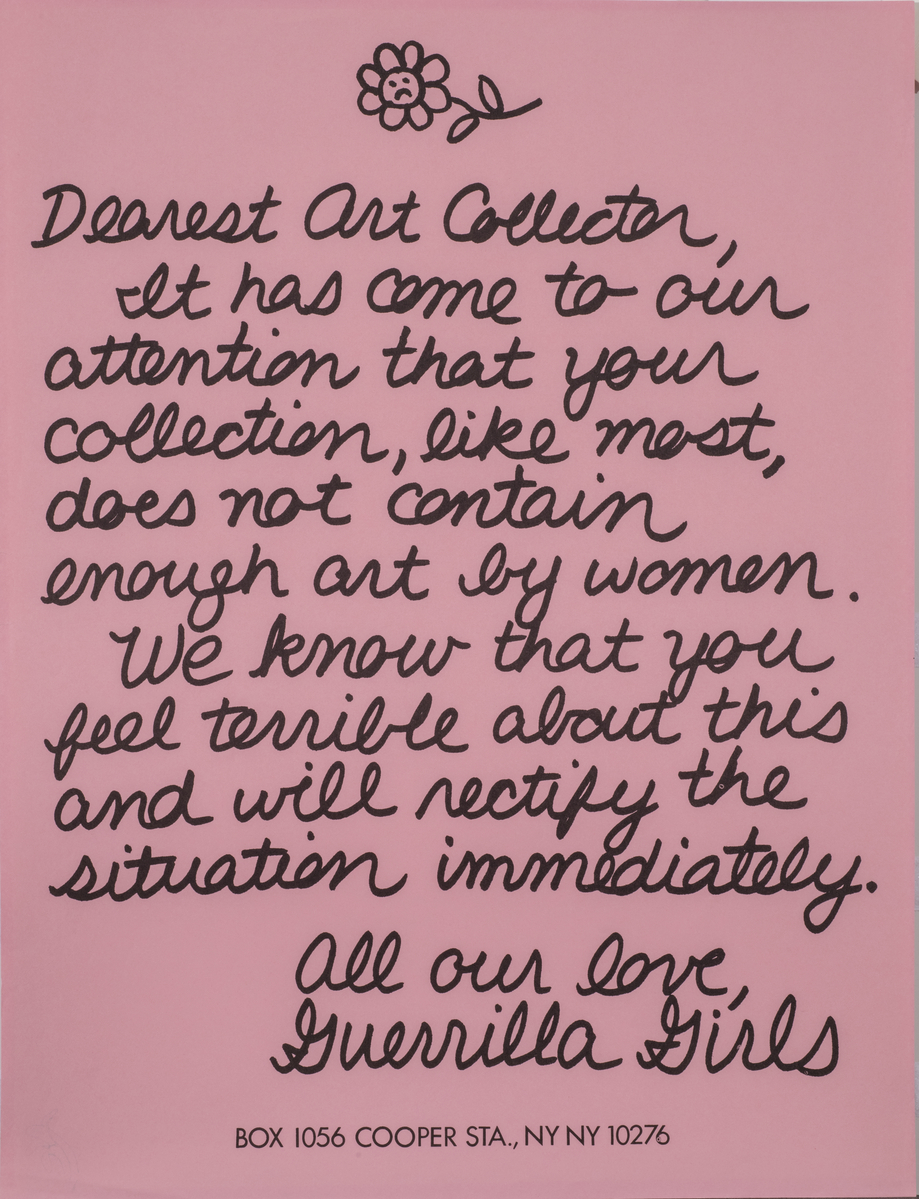
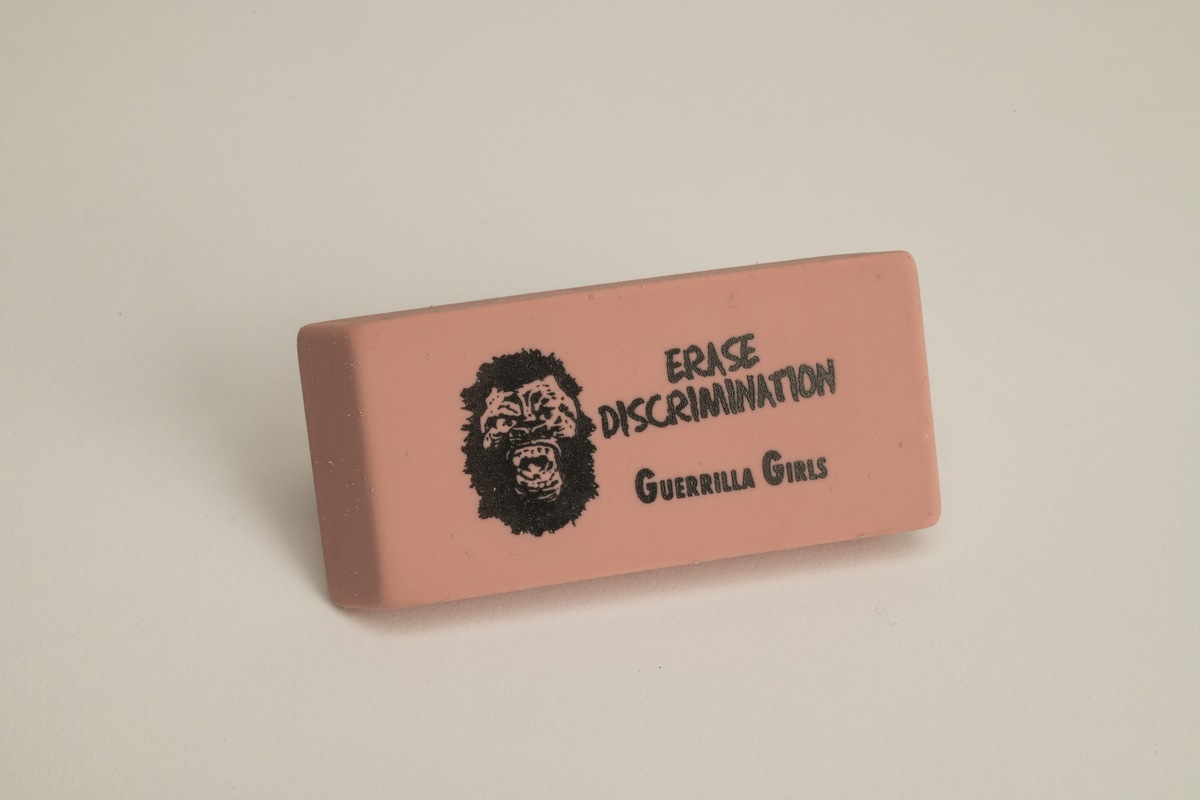
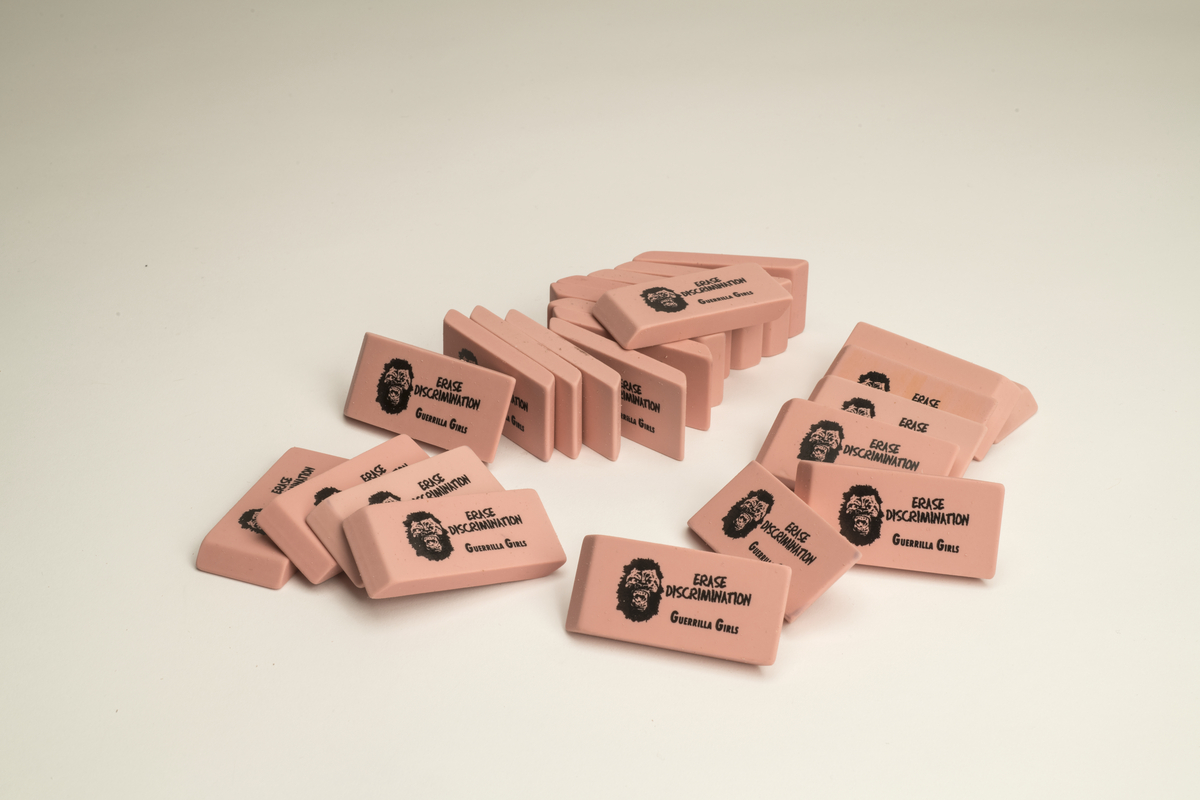
Making Trouble shows off well the scalability of the Guerrilla Girls’ work, from the “Guerrilla Girls ManifestA: For Art Museums Everywhere,” which is blown up to the size of a billboard on one gallery wall, down to the few inches of an eraser cheekily stamped “Erase Discrimination” in a glass display case.
Coley Gray
Making Trouble displays, in a compact gallery, about 30 posters and objects drawn exclusively from the museum’s deep Guerrilla Girls collection, including four new acquisitions. The pieces dating from 1985 to 2024 showcase both the group’s consistency and evolution.
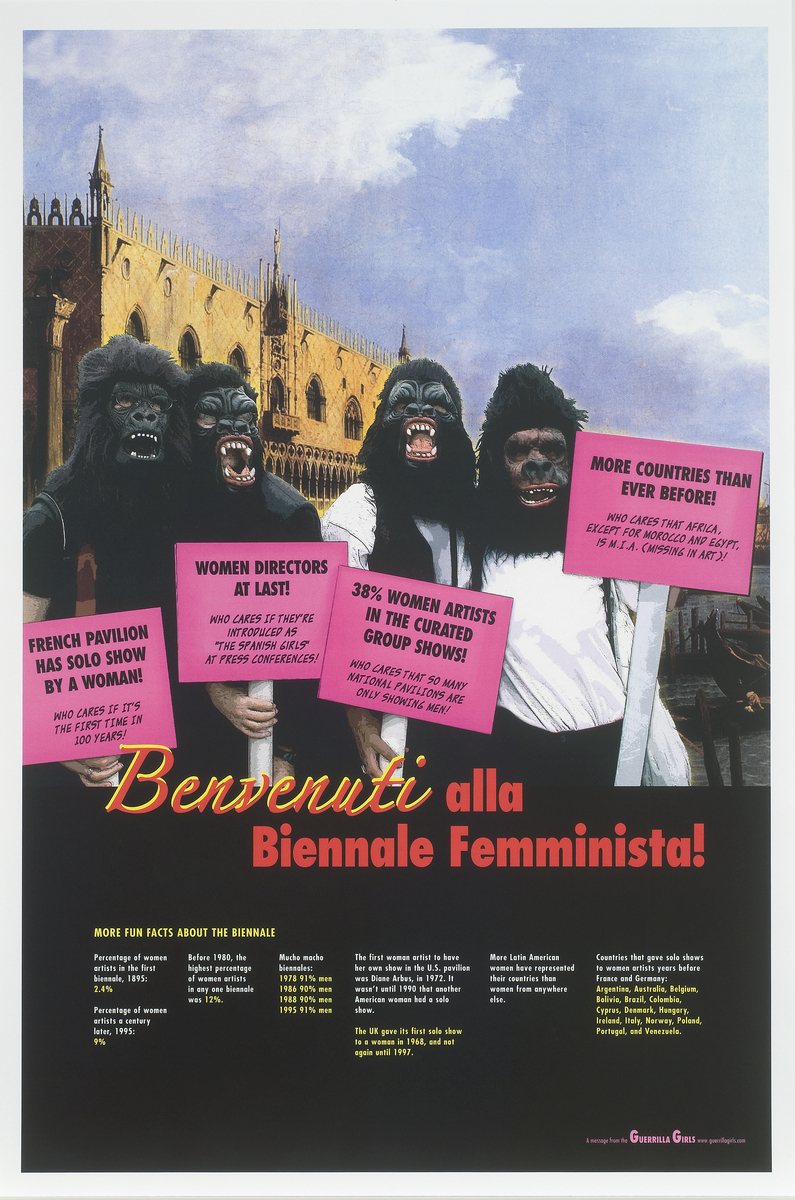
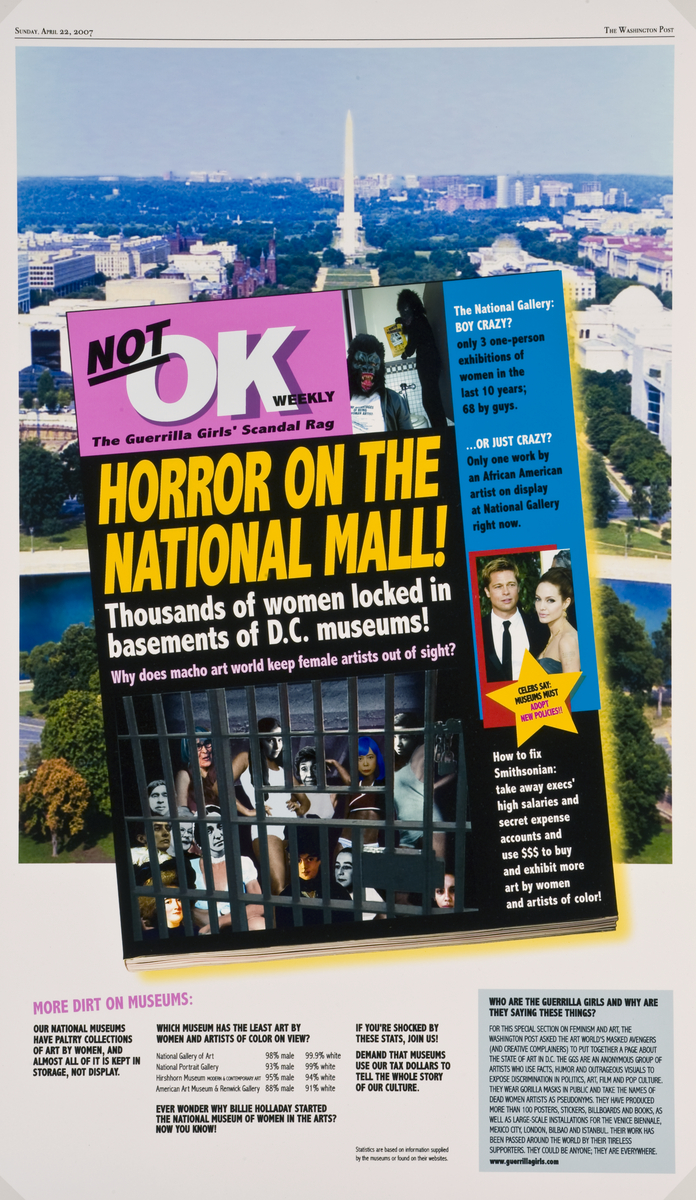
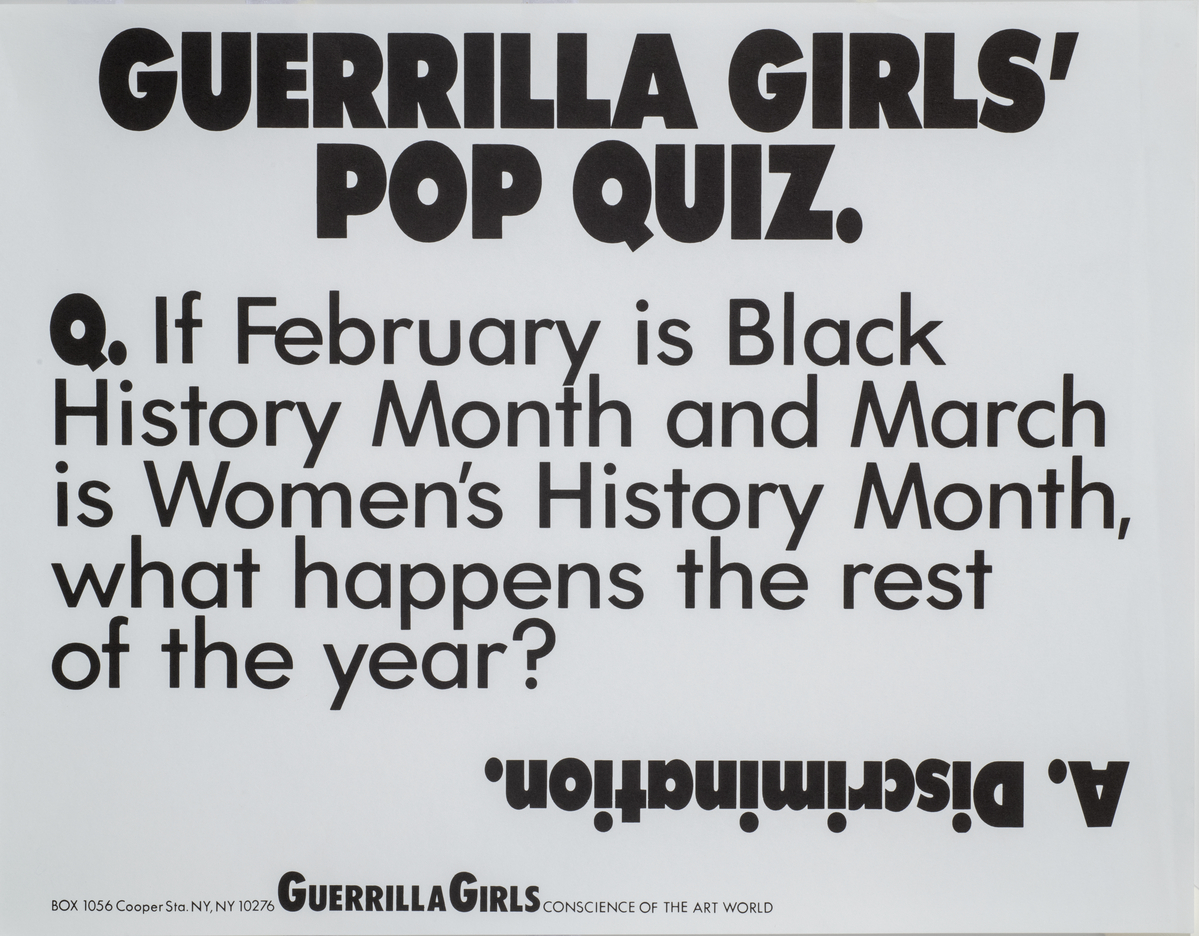
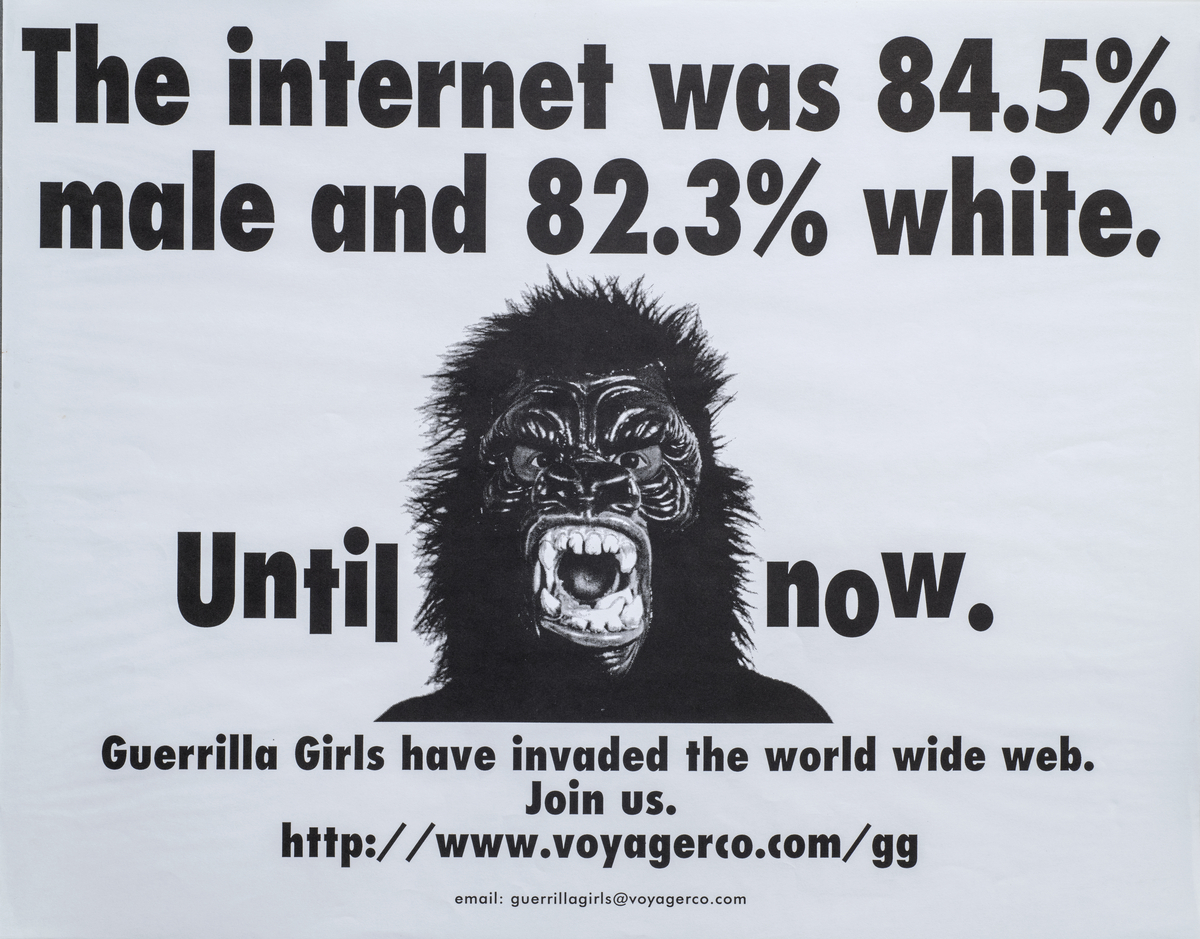
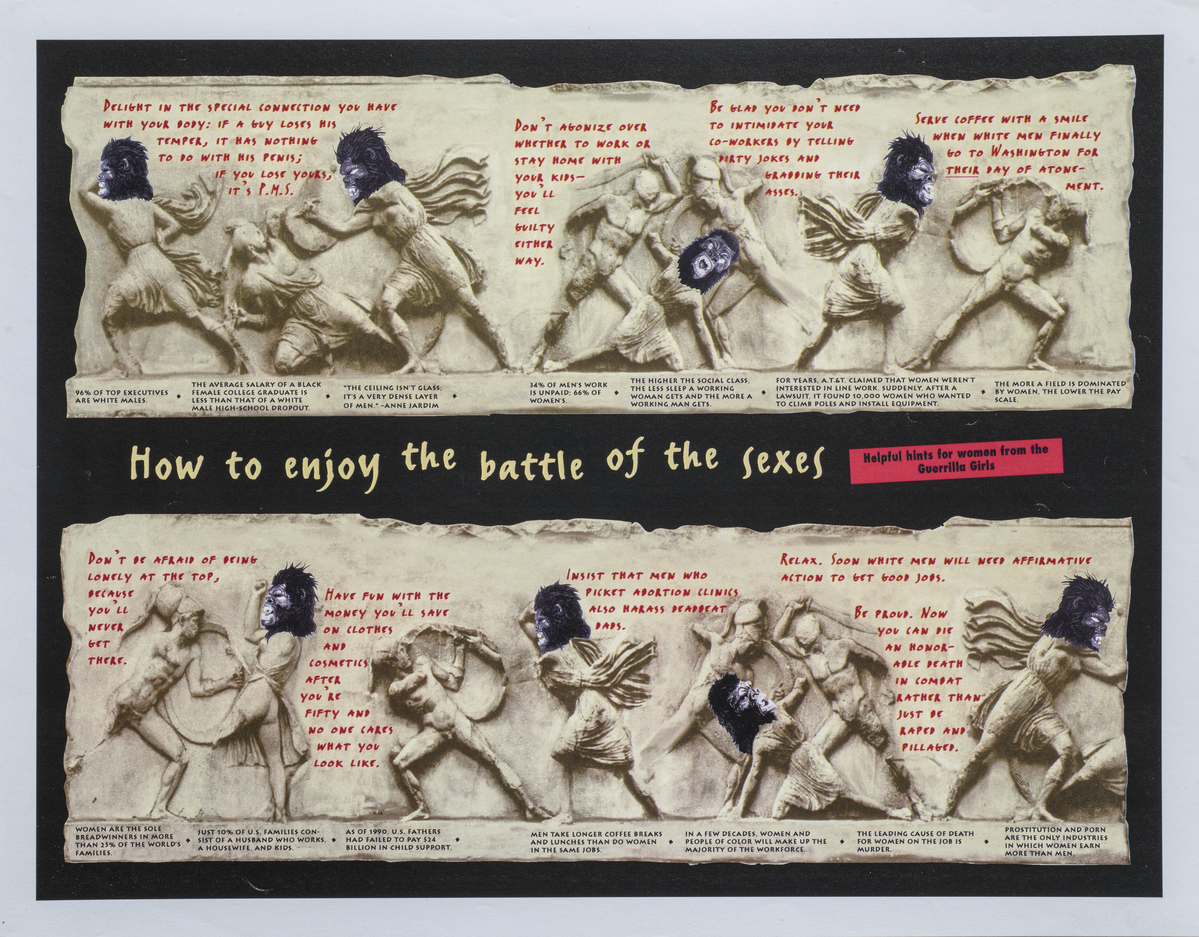
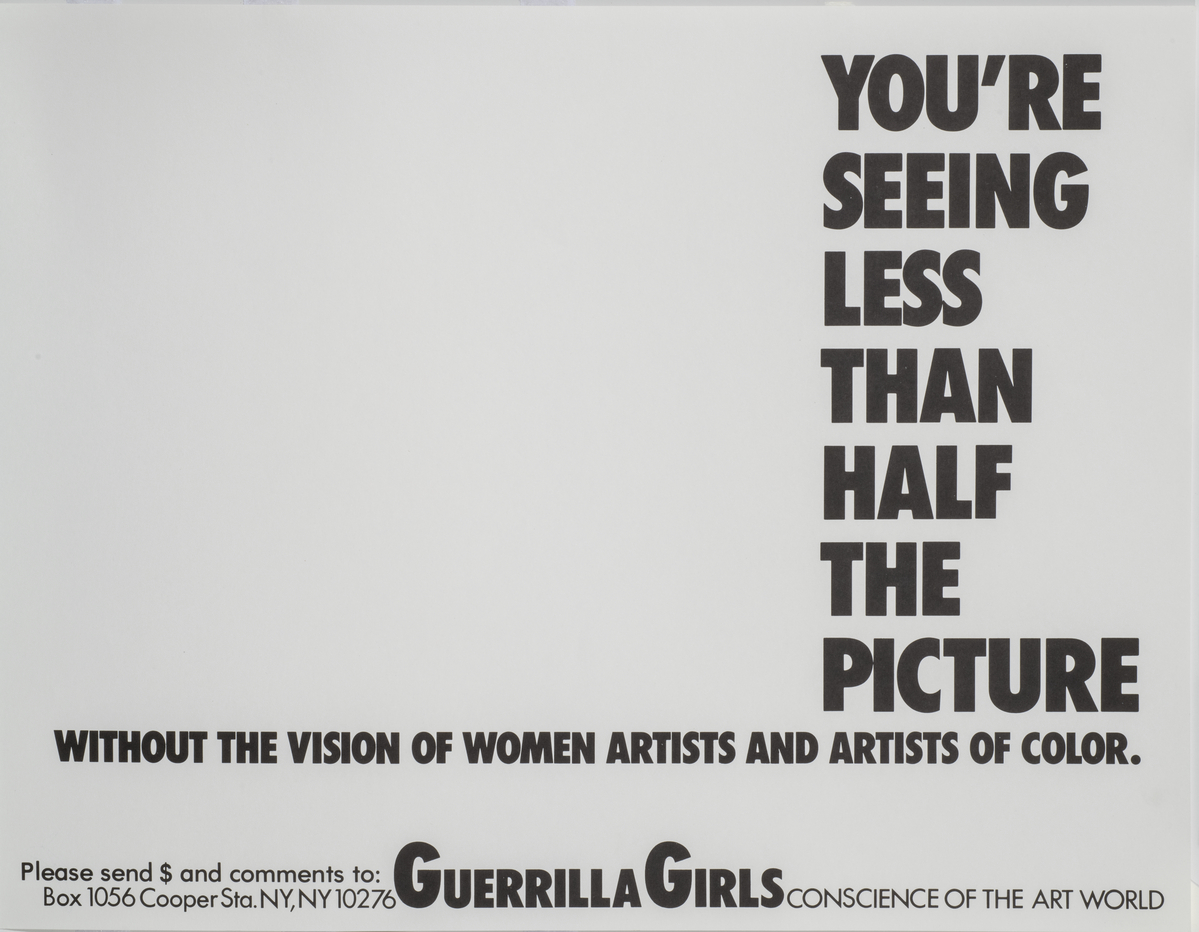
Relying often on ironic humor paired with data, the group initially took on sexism, discrimination, and hypocrisy in the art world, and then expanded to a broader range of social issues like reproductive rights, environmentalism, and money in politics. They have leaned heavily on bold text, and over time played more with fonts and adding imagery, color, and photo collage.
The pieces aren’t arranged in a strict timeline. Because many people are familiar with the Guerrilla Girls’ work and their story and history, “I didn’t necessarily feel like viewers would need a step-by-step chronology,” Shambroom told me. “I was really thinking about looking at some of their work from the 80s and 90s side-by-side with more recent works and seeing how many of the themes have overlapped or evolved over the years.”
Making Trouble shows off well the scalability of the Guerrilla Girls’ work, from the “Guerrilla Girls ManifestA: For Art Museums Everywhere,” which is blown up to the size of a billboard on one gallery wall, down to the few inches of an eraser cheekily stamped “Erase Discrimination” in a glass display case.
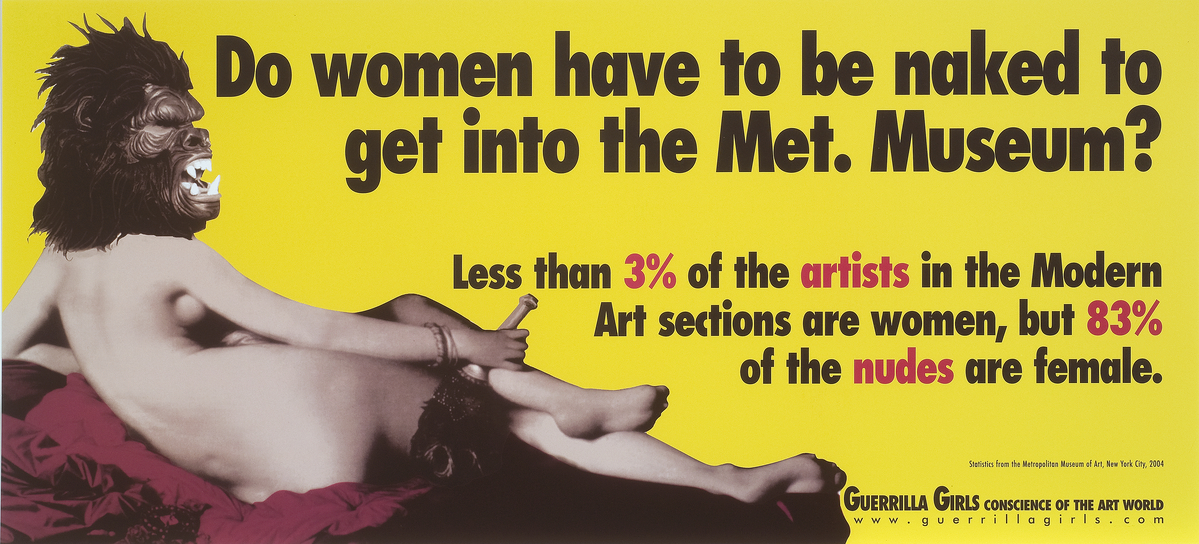
The exhibit’s bright yellow accent walls mimic the background of the iconic 1989 “Do Women Have to Be Naked to Get Into the Met. Museum?” poster. “It’s a color that is both warm and welcoming, but it’s also a caution signal,” Shambroom said of the color choice. “I think that really kind of bridges their work—engaging and welcoming. It draws you in and you want to read it. But often the messages that they’re producing are warning signals or blaring an alert to an issue that they’ve identified.”
In the case of this poster, the attention-grabbing headline does that initial work of drawing viewers in. Then they are hit with two alarming data points contrasting the exceedingly low percentage of women artists represented in the Met’s collection to the proportion of nude figures on view that are of women. In the 2005 update of the poster (the version included in the exhibit), the figures of 3% and 83%, respectively, are infuriatingly essentially unchanged from the original’s a decade-and-a-half earlier.
It is the quintessential pose from the Western fine arts tradition—a naked woman appeasing the male gaze. But in this sly appropriation, the model has been fitted with a gorilla mask, suggesting she has been recruited as a Guerrilla Girl.
Coley Gray
The masterful play between the text’s message, garish pink lettering and yellow backdrop, and the accompanying image intensifies the poster’s punch. A reproduction of the reclining nude from Jean-Auguste-Dominique Ingres’s 1814 “Grande Odalisque” anchors the lower left corner. It is the quintessential pose from the Western fine arts tradition—a naked woman appeasing the male gaze. But in this sly appropriation, the model has been fitted with a gorilla mask, suggesting she has been recruited as a Guerrilla Girl.
The earliest posters that named and shamed galleries, museums, artists, and critics deemed discriminatory by the Guerrilla Girls are even more spare in their design, simply stark black lettering (employing a font popular in advertising) on a white background. Adding simple graphic elements, such as the one-dollar bill with a dotted line crossing its right one-third in “Women in America earn only 2/3 of what men do.” renders a big idea like sexism-driven structural inequities instantly graspable. This meme-like sensibility, combined with the group’s buzzy street theatrics, makes it easy to see why their messages achieved such IRL virality when they burst onto the scene.
Later works are strongest when they tap into the zeitgeist and apply a Guerrilla Girls twist. “The U.S. Homeland Terror Alert System for Women” from 2003 satirizes President George W. Bush’s color-coded alarm system aimed originally at assessing threats from foreign terrorists by turning it into, as described on the group’s website, “a chart listing some of the terrible things his administration did to erode women’s rights.” “3 Ways to Write a Wall Label When the Artist is a Sexual Predator” (2018) is a powerful #MeToo-inflected iteration on their long-standing indictments of the dubious ethics of museums and the art establishment’s anointment and enabling of so-called white male artist “geniuses.”
To my mind, others of the collective’s more recent work show some falling off in content and form, however worthy their subjects. The humor that connected the viewer to the message gives way to didacticism—“Democracy is freedom, equality, and justice for all people and all genders” reads “It’s Not Apple Pie Without Ice Cream! It’s Not Democracy Without Feminism! U.S.” (2023-2024)—and the interplay between images and text is less clever.
This may not matter much, though, if we consider that the impact of Guerrilla Girls in this moment is felt less through the work they are currently producing and more through their influence on next generations of activists fighting the same fights.
Take Katy Hessel, for instance, who has spearheaded for the last decade the immensely popular @thegreatwomenartists Instagram account and juggernaut of related side projects that spotlight the contributions of women to art history and critique the discriminatory status quo. Her tone and tactics, quite unlike the Guerrilla Girls’, lean into uplifting rather than denouncing and into working within the establishment to expand the canon rather than firing shots from the outside. But she readily and effusively credits the group (with whom she admits to being “obsessed”) as feminist trailblazers whose critiques are still, maddeningly, true and whose courageous outrage inspires those who follow in their own fashion in the collective’s footsteps.
In a turn of events the renegade poster-hangers of the 80s likely could hardly have imagined, the Met partnered with Hessel last year to highlight works by women and gender non-conforming artists in its collection for an episode of her audio guide Museums Without Men. The first piece discussed: the Guerrilla Girls’ 1989 poster damning with data the museum’s shameful state of gender representation.
Signs of progress? Undoubtedly. And yet, in a report surveying 1,200 women artists released the same month that Making Trouble opened, a significant majority of respondents (68%) said gender discrimination has had either a “negative” or “strongly negative” impact on their experience in the art world. Almost two-thirds said that a lack of museum or institutional backing hinders their careers.
“What [the Guerrilla Girls] unveiled was the fact that museums are celebrating the history of patriarchy, as opposed to the history of art,” Hessel said in a 2023 Artnet interview. “And if we’re not seeing art by a wide range of people and subjects of a wide range of people, then we’re not seeing society as a whole.”
That such a seemingly straightforward notion should continue to be debated, much less subjected to concerted attack, proves Making Trouble is exactly the show we need right now. This small, determined band of feminist artists-slash-agitators haven’t given up the fight for forty years and counting. Now more than ever, isn’t it on all of us, with or without gorilla masks, to join them? Vive la guerre!
Ikhide's "Tales From Future Past" is on View through November 22 at CPM
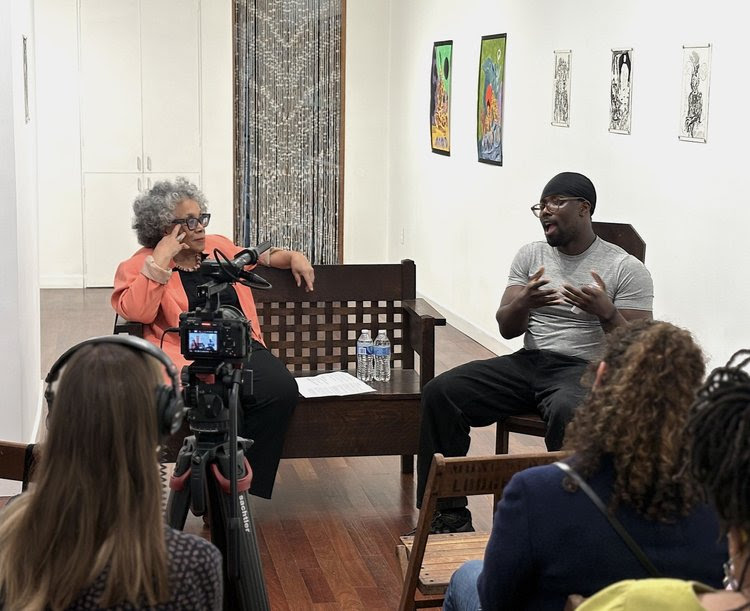
CPM Gallery recently announced that the run of Richard Ayodeji Ikhide's solo exhibition "Tales from Future Past" would be extended to November 22 by appointment. At the opening on September 27, the British-Nigerian artist was interviewed by luminary art historian, curator, and educator Lowery Sims.
Baltimore art news updates from independent & regional media
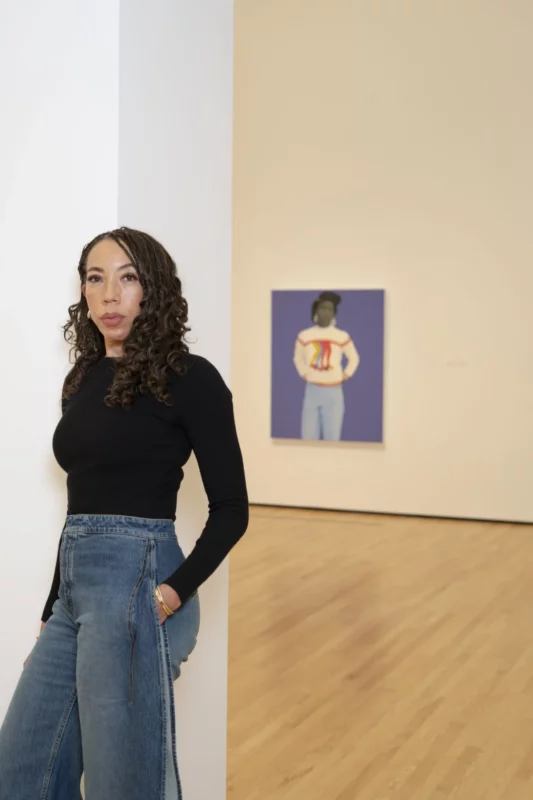
This week's news includes: Amy Sherald shines brightly in Baltimore, Hilton Carter makes his house a home, Inviting Light returns with a Wickerham & Lomax, John Akomfrah moving image + sound installation opens at the BMA, mayorial portraits unveiled at City Hall, Maryland Film Fest is here, and more