
Reading

The Shape of Power at SAAM: the Exhibition the Trump Administration Doesn’t Want You to See

Previous Story
Article Image

Friction and Frustration: Wickerham & Lomax [...]

Next Story
Article Image

An Evening at Aunt Hazel’s

The nation is in the midst of an ongoing assault on civil rights, government services, and freedom of speech, as well as diverse or critical intellectual, cultural, and historical pursuits. In this troubling context, The Shape of Power: Stories of Race and American Sculpture at the Smithsonian American Art Museum (SAAM) offers a timely statement on the United States’ strengths, challenges, and values—both those stated and those experienced in reality. The Shape of Power accomplishes what the best curation is capable of: reflecting innovative and diverse aspects of our collective culture while illuminating the marginalized histories that our reigning administration wants to banish and erase.

The exhibition opened in November 2024, just days after the reelection of Donald Trump, offering a timely commentary on the state of our country and a call to action to build on the collective power of creative communities, pushing back against oppression and government corruption and speaking truth to power. I commend the Smithsonian American Art Museum and all of those who were part of bringing this important exhibition to life. It clearly made an impact, and was called out by name in a March 27 executive order, illustrating the current administration’s active action to maintain and expand white supremacy.

The Shape of Power shines light on historical violence and injustice, placing artists within these histories, and allowing artists (both contemporary and historical) to add voices to a growing knowledge of the many truths that make up our past. This casts aside the myths and white-washed media that too often go unchallenged in societies built on colonialism, capitalism, and oppression.
Installation view of The Shape of Power: Stories of Race and American Sculpture, photo by Albert Ting
Rina Banerjee, In Mute Witness…, 2015/2023, wooden spindles, aluminum cloth, waxed nylon, wood, steel armature, Murano glass horns, rooster feather, porcupine quill, silk tassel, cowry shell, hemp cord, silkscreen print silk cloth, cotton thread, acrylic paint, tribal jewelry, abacá fibers, and gourd, Courtesy of the artist
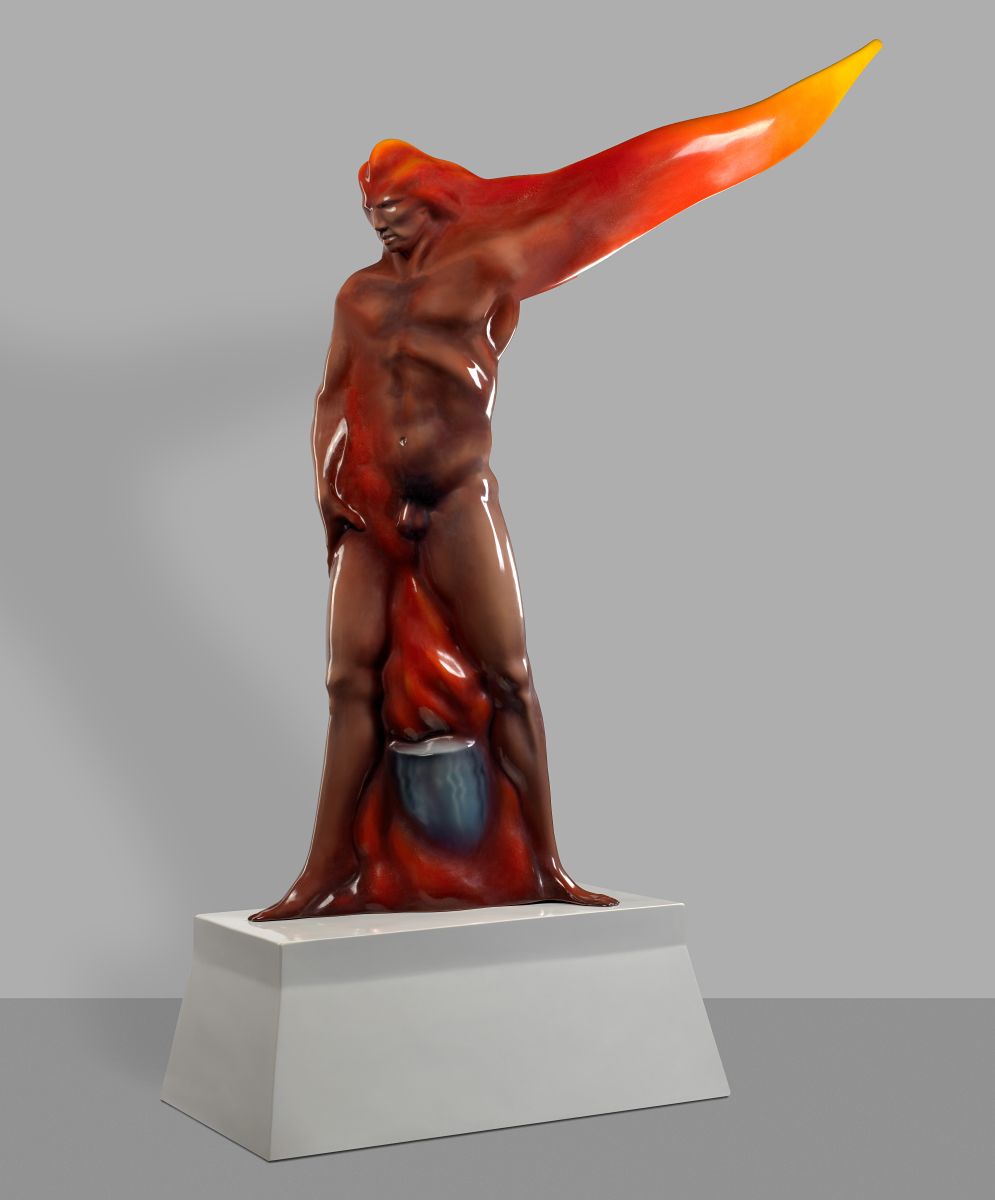
Luis Jiménez, Man on Fire, 1969, fiberglass in acrylic urethane resin on painted wood fiberboard base, Smithsonian American Art Museum, Gift of Philip Morris Incorporated, 1979.124, © 1969, Luis Jiménez

I am not sure I have ever seen an exhibition that pairs historical facts and art with contemporary artists in the way this one does. The 82 works in the show span from 1792 to 2023 and provide examples of a wide array of sculpture and materials.

Sculptures are the perfect form to examine issues of power and race as they are objects that live within our physical space. They can be used by empires to show off wealth and status, while simultaneously being used in the home as objects of utility and decoration for all people. Sculptures have lives, histories, and maintain a presence that media like paintings may not. A painting, although an object, is more of an illusion of the person, landscape or picture within the frame. Sculptures are solid, physical, and often lasting. Depending on the material they can be weighted and the value of some materials create weight that is more than physical, giving work permanence, monetary value, and deeper conceptual and historical meaning.

The sculptures on exhibit in The Shape of Power span a wide range of materials from ceramics, bronze, marble, wood, and other traditional materials to wallpaper, brick, rhinestones, and even US border patrol uniforms.

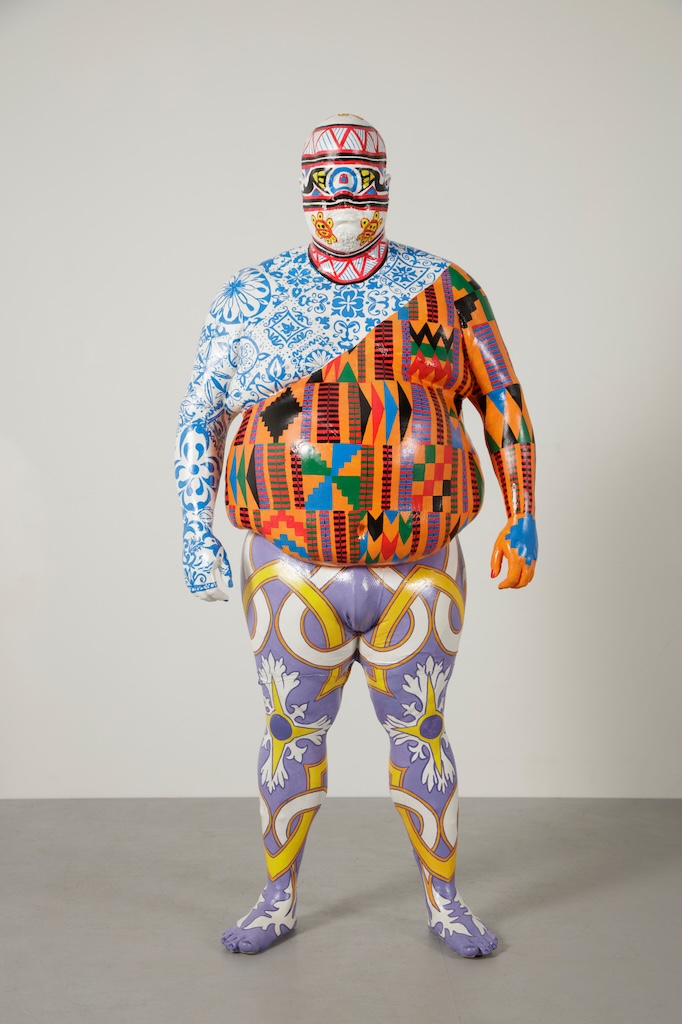
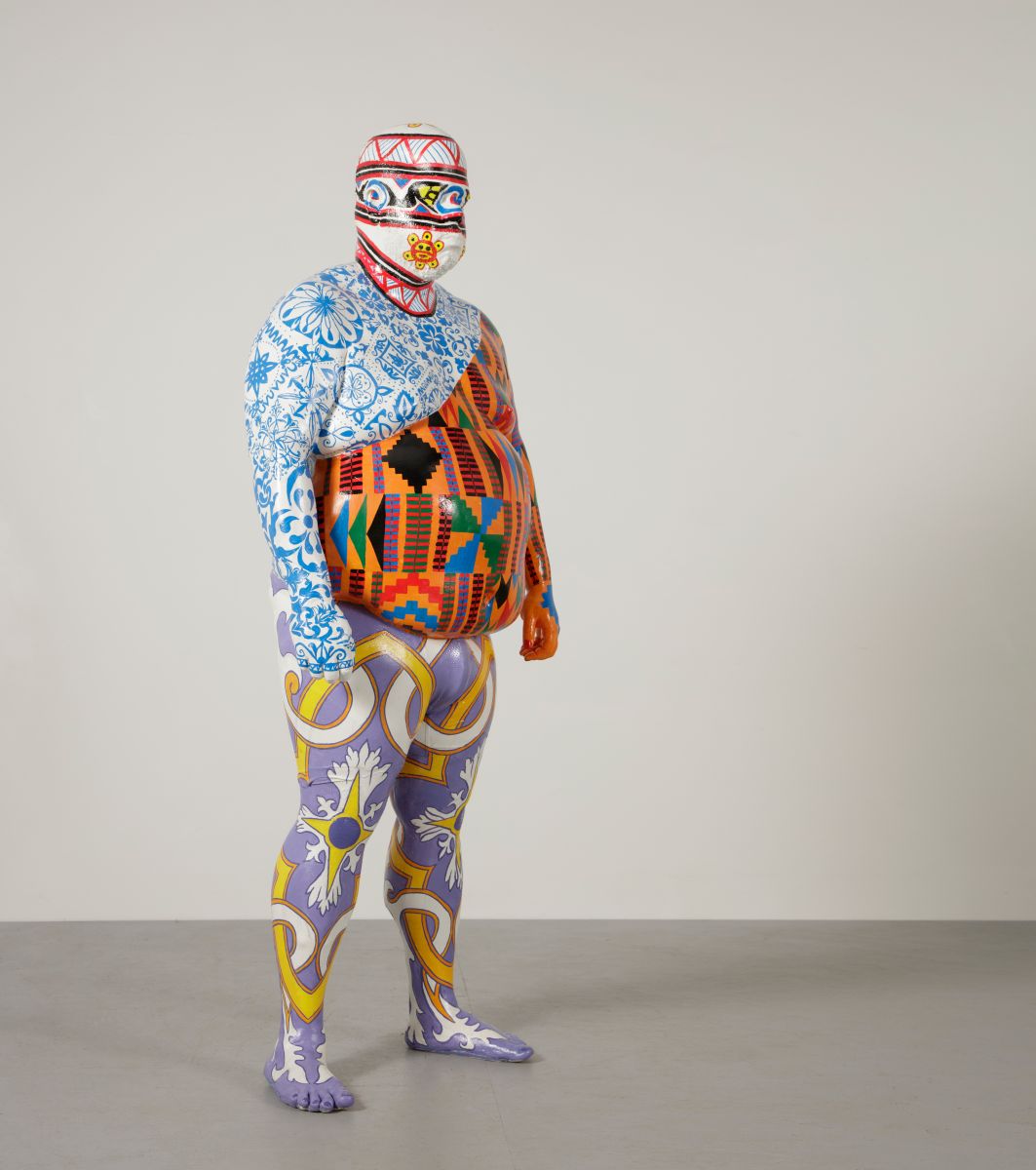
Roberto Lugo, DNA Study Revisited, 2022, urethane resin life cast, foam, wire, and acrylic paint, 66 × 27 × 17 in
Roberto Lugo, DNA Study Revisited, 2022, urethane resin life cast, foam, wire, and acrylic paint, Smithsonian American Art Museum, Museum purchase through the Catherine Walden Myer Fund, 2024.19

Visitors walk into the show past Roberto Lugo’s “DNA Study Revisited,” a life-size resin cast of the artist. Lugo’s self-portrait is painted with patterns of his ancestors, ensuring that viewers know he is proud of where he comes from, despite some of the ugly and dehumanizing practices of institutions who interacted with them and others. Lugo is from Philadelphia with ancestors who are Taíno (Indigenous people of the Caribbean), Spanish, African, and Portuguese. The colorful, unique, and differentiated patterns on his life size form demonstrate how it is possible to show up as one’s full self and own the space in which you and your ancestors exist.

A pair of historical sculptures are included through photos of Abraham Lincoln’s inauguration that were clearly in support of white supremacist ideas. The works titled, “Discovery of America” and “The Rescue (or Civilization)” depict, in the first, Columbus standing authoritatively with a globe held above his head and an indigenous woman crouched looking up at him. The second is a European pioneer fighting a Native American with a tomahawk extending his arm to protect a white woman and child.

Abraham Lincoln’s inauguration including sculptures, “Discovery of America” and “The Rescue (or Civilization)”

These sculptures were on view outside the Library of Congress until 1958 when they were removed due to disrepair. It makes one wonder, had the materials held up, would the sculptures and their falsified narratives—that Columbus was a hero and that white families needed protection from indigenous communities—still have stood as a monument to white supremacist history? If they had, these sculptures would have continued to perpetrate a history glorifying and excusing white violence at the expense of all others.

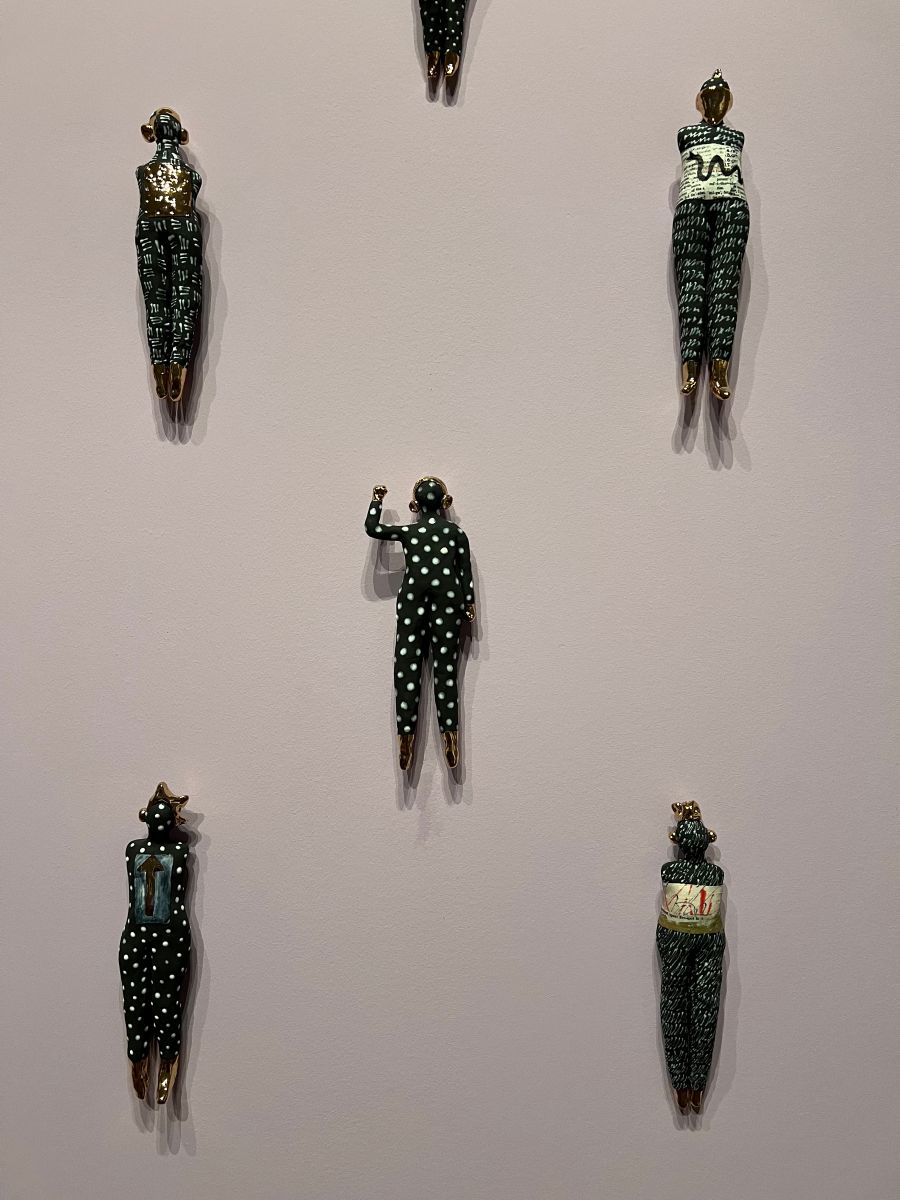
The sculptures from Lincoln’s inauguration stand in stark contrast to contemporary artists like Anita Fields whose “So Many Ways to Be Human” acknowledges the unique ways each of us shows up in the world. Ceramic figurines in black and white with gold luster detailing are installed in a gridded oval shape. Most of the figures do not have visible hands, several that do hold them to their hearts, one raises a fist. All figures have spots, patterns, and additional detail. One has their chest covered with gold plated armor, one has an arrow pointing up to the face, another a bullseye. Some have additional drawn, glazed or sculpted details; a red x, a textured flower pattern, a cross. The details illustrate the unique beauty and personality of the figures and shine light on some of the challenges they face.

Anita Fields, “So Many Ways to Be Human”, photo by Sarah McCann
Nicholas Galanin, The Imaginary Indian (Totem Pole), 2016, wood, acrylic paint, and floral wallpaper, totem: Private collection, Bentonville, Arkansas
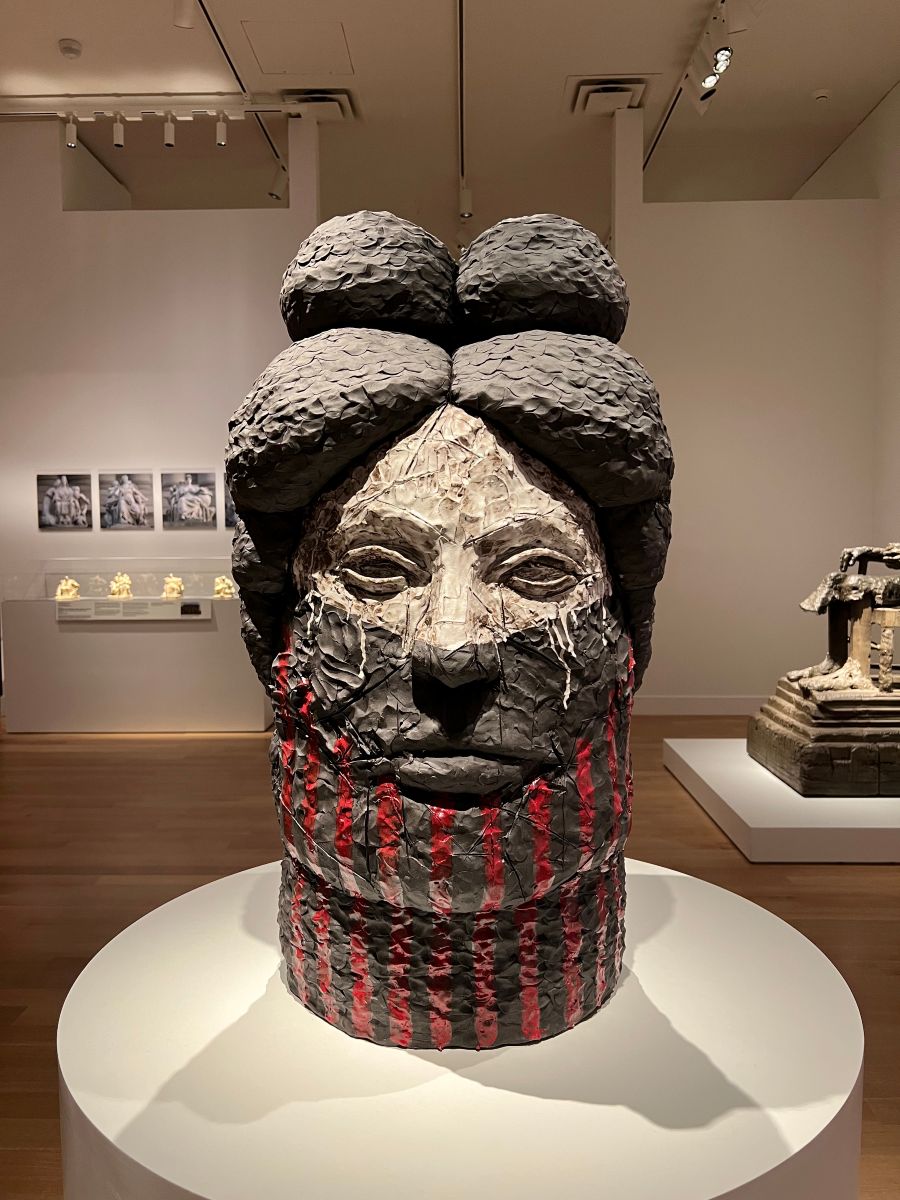
Installation view of Raven Halfmoon's “Do You Speak Indian?”, photo by Sarah McCann
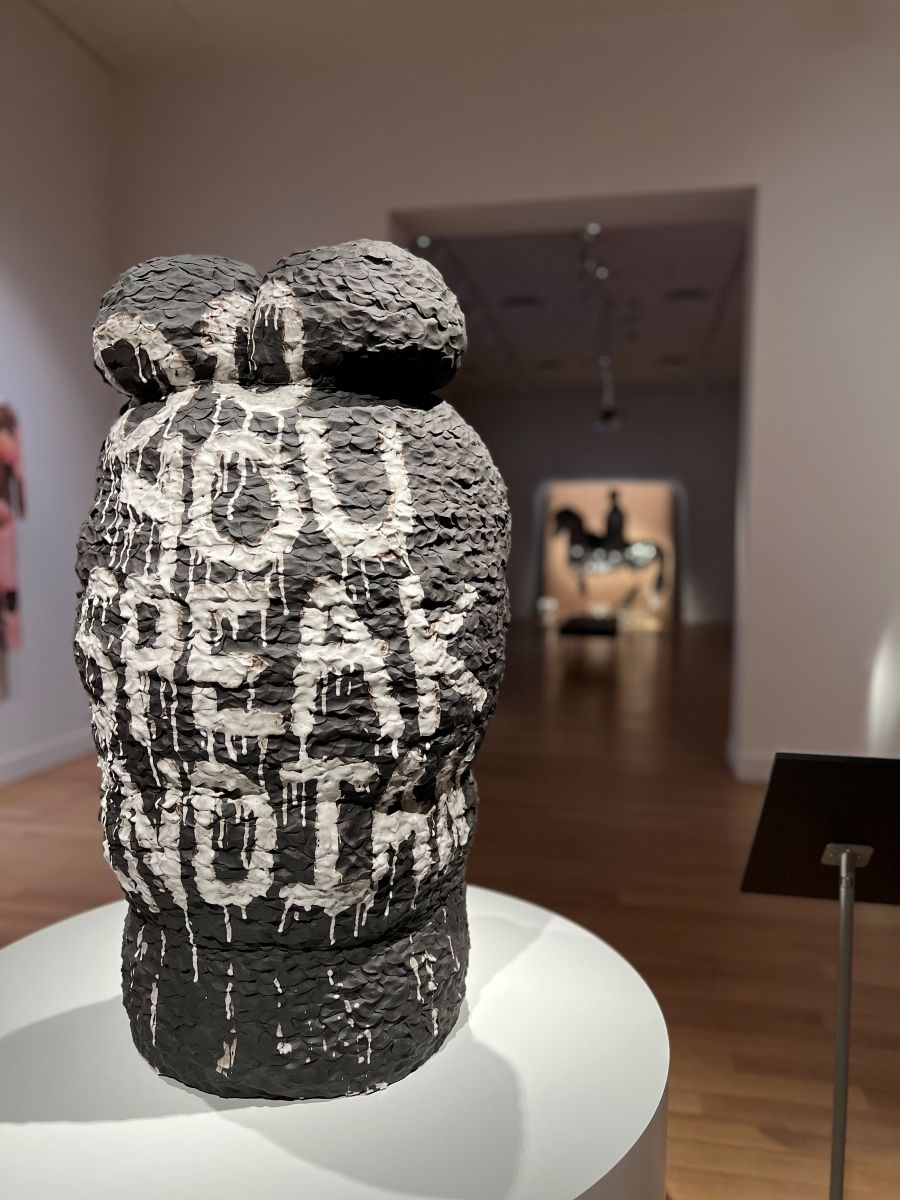
Back of Raven Halfmoon's “Do You Speak Indian?”, photo by Sarah McCann

Raven Halfmoon’s “Do You Speak Indian?” is a powerfully sculpted ceramic head that repeats some of the sentiment of Fields’ work. The text of the title is written on the back, looking almost like graffiti and marring the surface that shows the artist’s hand. It mimics the constant barrage of questions from ignorant people who think everyone from a certain cultural or ethnic group is the same.

The installation provides an added layer to the experience, moments where even after one has passed a piece, the sightline of it beyond brings it fully back into focus.

Walking around “Do You Speak Indian?” one gets a second look at “Monumental Inversions: George Washington,” by Titus Kaphar. Another work that reminds us that the telling of histories can be rethought from new perspectives and that heroes, despite the stories that uphold them, are often hollow once all the facts are considered. Kaphar who was born in Kalamazoo, Michigan, investigates the absence of Black people in Western art history, the recognized canon, and the stories of the empire.

This piece, made of steel, glass, and wood, allows Kaphar to create a hollow version of the sculpture of George Washington that sits in Union Square in New York City. The figure is a void that appears to be burned into the wood. The negative space is charred and filled with three dimensional glass shapes that are falling out of place, several already on the floor. Fire can be cleansing, it can destroy, it can also provide the space necessary for something new to emerge. Kaphar is making space for us to retell the history of the leaders of the United States with a full picture, where their enslavement of Black people is acknowledged, the contributions and brilliance of Black people recognized, and the illusions of empire that have narrated this country’s history peeled back so we can see the realities that made up the past.

Installation view of “Monumental Inversions: George Washington,” by Titus Kaphar. Photo by Sarah McCann
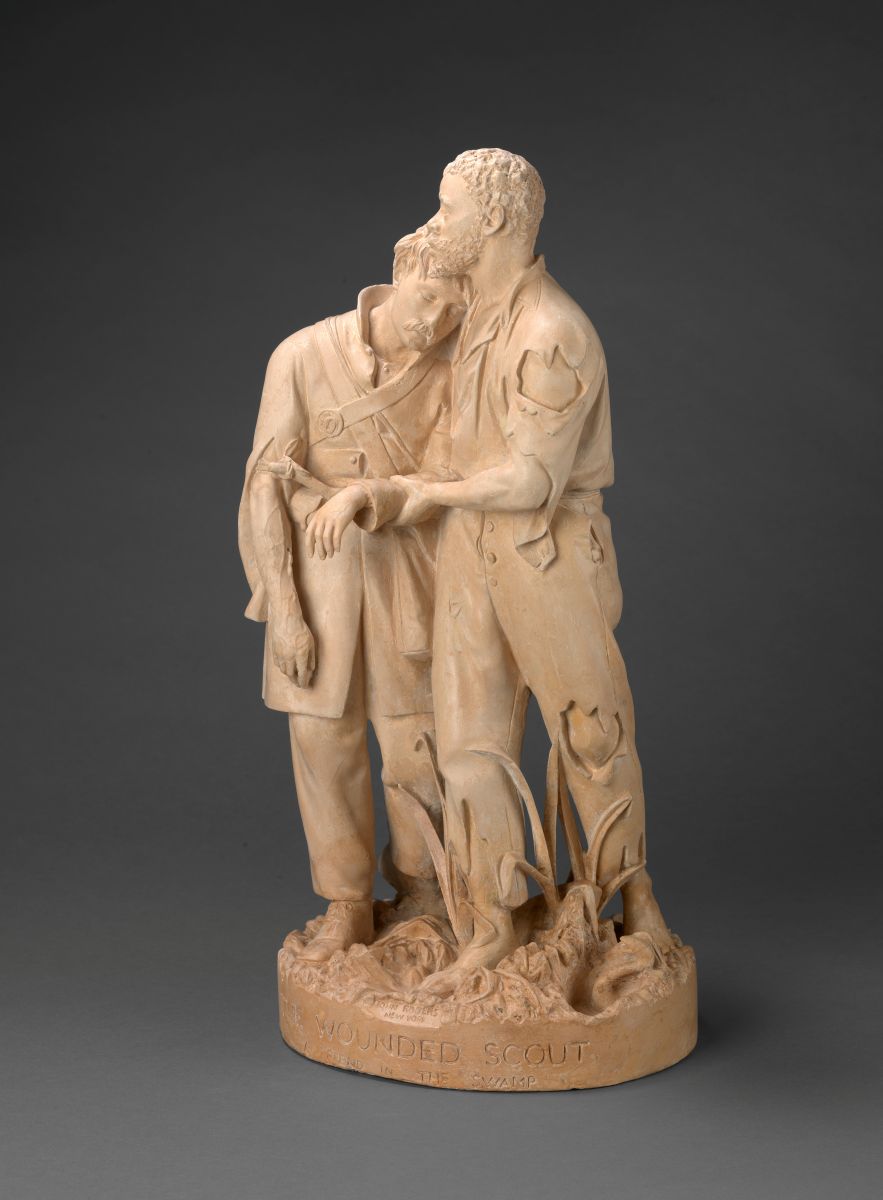
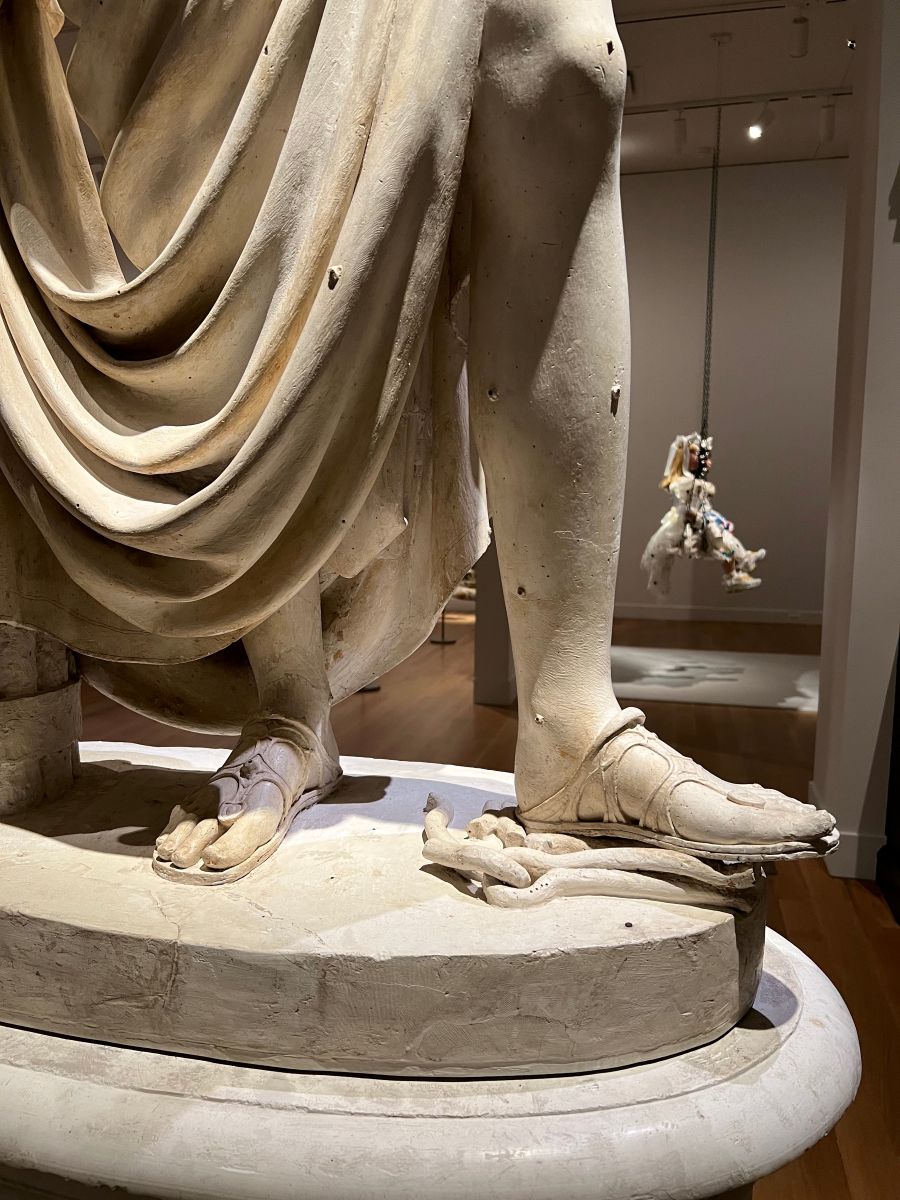
John Rogers, The Wounded Scout, a Friend in the Swamp, patented 1864, painted plaster, Smithsonian American Art Museum, Gift of John Rogers and Son, 1882.1.5
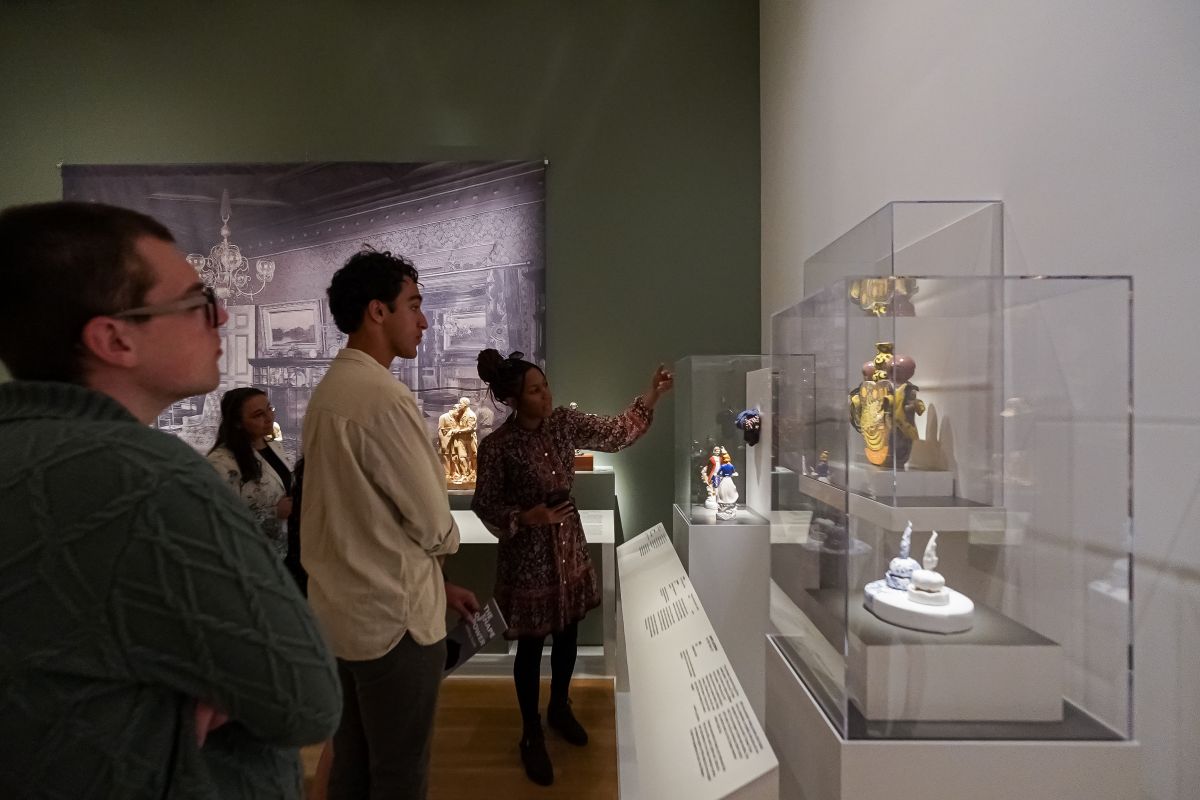
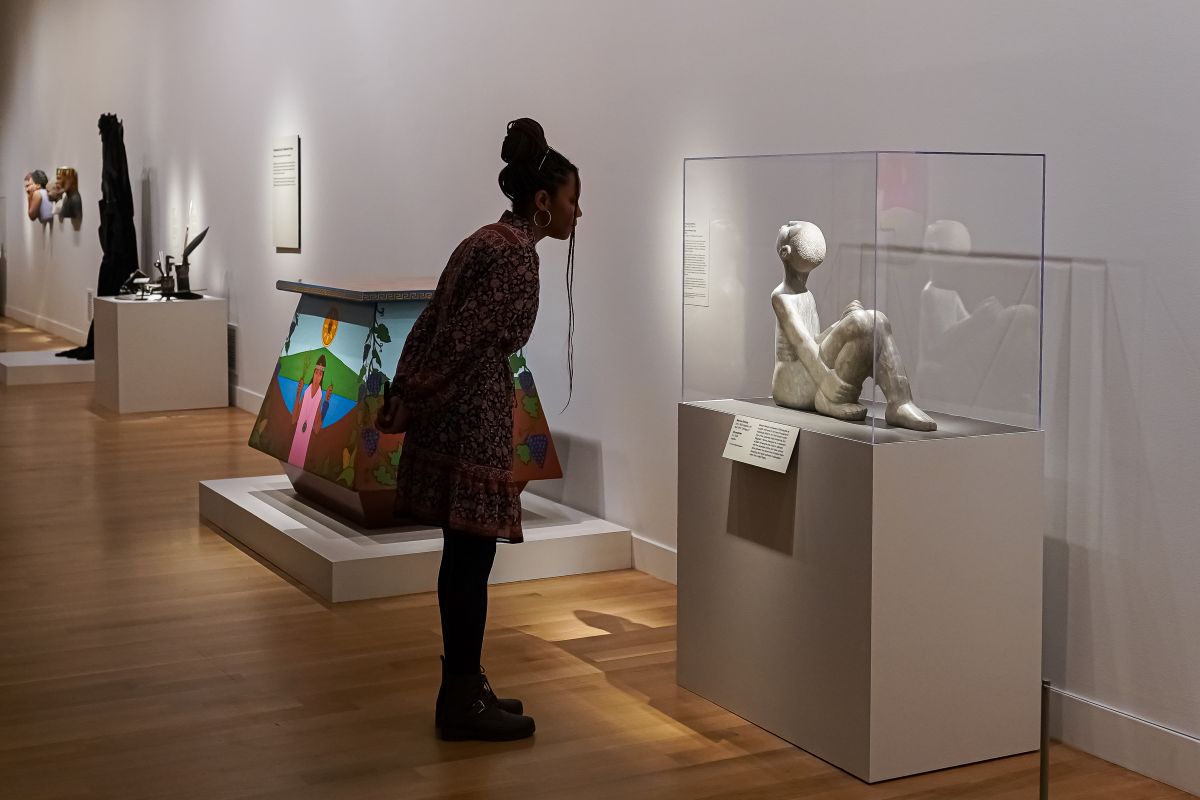
Installation view of The Shape of Power: Stories of Race and American Sculpture, photo by Albert Ting

This exhibition was collaboratively produced by a team of three curators: Karen Lemmey, the Lucy S. Rhame Curator of Sculpture at the Smithsonian American Art Museum; Tobias Wofford, associate professor of art history at Virginia Commonwealth University; and Grace Yasumura, assistant curator at the Smithsonian American Art Museum who spent five years in conversation. In addition, the curators worked with a team of SAAM educators and a group of students from Howard University and George Mason University. The breadth of those involved is felt in the selection and scope of the work included.

A video early in the exhibit narrated by Dr. Wofford adds to this by setting the stage for a broad audience to see the work. It features interviews with people on the street in DC about what sculpture, power, and race mean to them. It is worth a watch, I missed it on my first viewing, but did watch during the second visit. Some of those interviewed thought sculpture was: making things out of stone that can be touched, objects representing a country, what the U.S. is made of. Some of the answers about power are: inner power, that it should be shared, that it is control, responsibility, and the ability to act. Race was described as: bubbles on the SAT, complex and unique for each person, what empire is built on, identity, love, community, and also turmoil.

My visit to the SAAM also corresponded with reading James Baldwin’s Nothing Personal. In the book Baldwin discusses white people in the United States as both the perpetrator and victims of the myth the country is built on. “It is, of course, in the very nature of a myth that those who are its victims and, at the same time, its perpetrators, should, by virtue of these two facts, be rendered unable to examine the myth, or even to suspect, much less recognize, that it is a myth which controls and blasts their lives.” This inability to see the myth traps people in the past, and Baldwin continues, “To be locked in the past means, in effect, that one has no past, since one can never assess it, or use it: and if one cannot use the past, one cannot function in the present, and so one can never be free.”

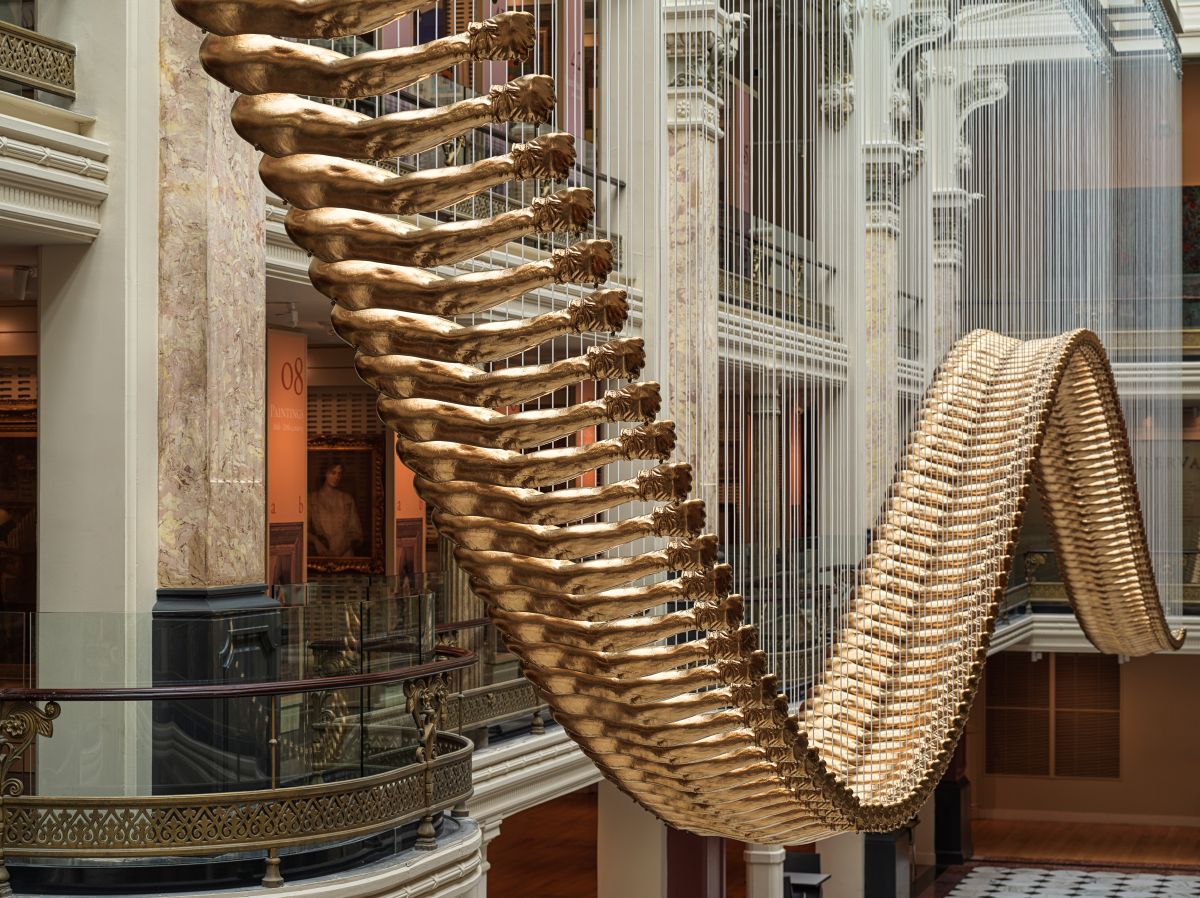
Glenn Kaino, Bridge, 2013-2014, fiberglass, steel, wire and gold paint, dimensions variable, Smithsonian American Art Museum, Gift of the Smithsonian Secretary and the Smithsonian National Board and museum purchase through the Luisita L. and Franz H. Denghausen Endowment, 2022.34, © 2013-2014, Glenn Kaino
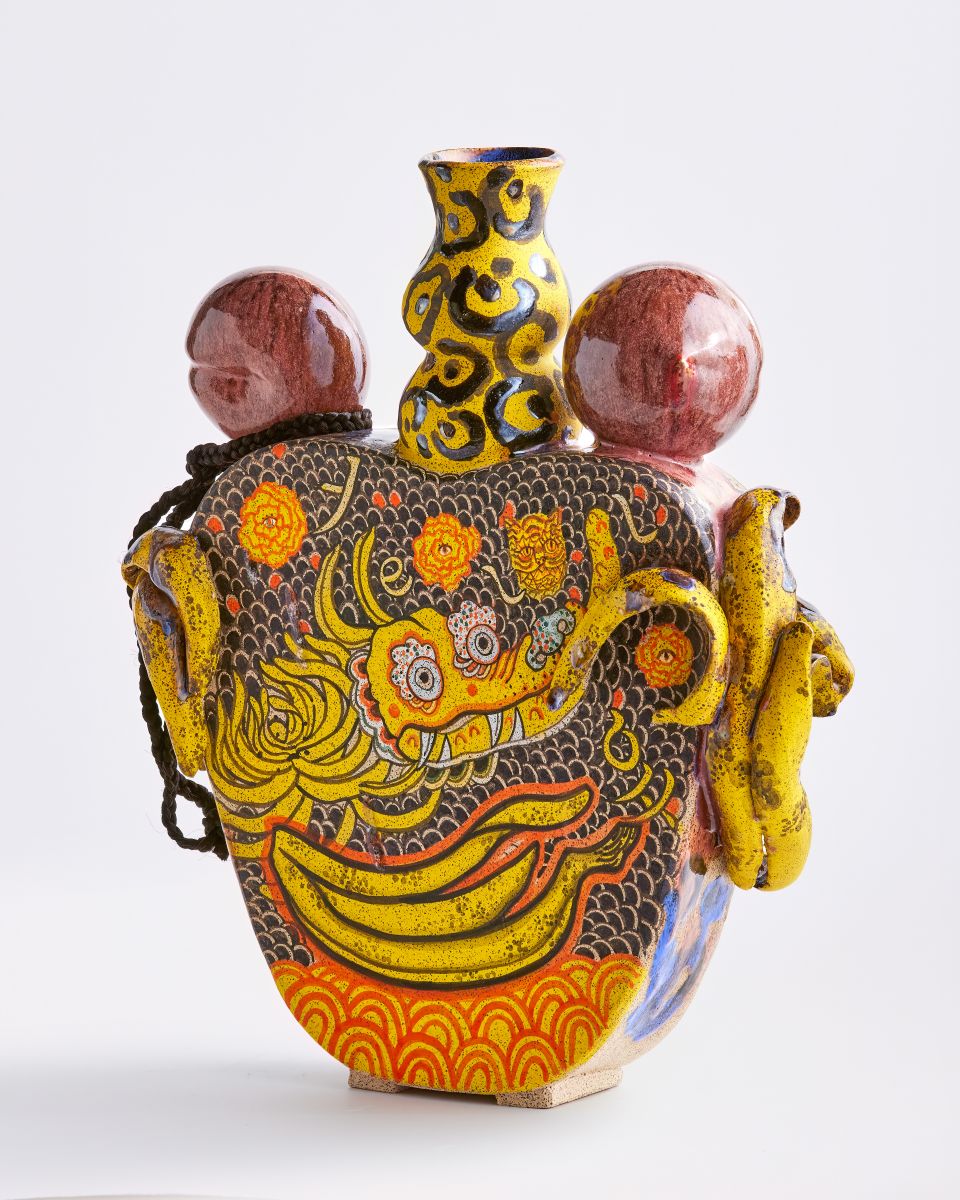
Jiha Moon, Tiger Banana, 2023, stoneware with underglaze, glaze, and synthetic hair, Smithsonian American Art Museum, Museum purchase through the Howard Kottler Endowment for Ceramic Art, 2024.12, © 2024, Jiha Moon
Installation view of Hiram Powers', “America”. Photo by Sarah McCann

The trap between being both victim and perpetrator and the lack of freedom through denying history is visible in pieces in the show like Hiram Powers’, “America” that depicts a mostly unclothed white woman with an arm raised and hand open, as if volunteering for something, wearing a tiara of stars, leaning on a column draped in fabric and leaves, and a broken shackle underfoot.

In 1848, this sculpture was considered as a commission for the US Capitol, but abandoned because of the sculpted shackle being crushed by the figures’ foot. The wall text shared that the concern was that this would be perceived as support of the abolitionist movement. The United States represents itself as the home of the “free and the brave,” but it is this irony and hypocrisy that is embedded in the foundation of US history. The exhibition does not shy away from calling out many moments like this where the reality for people in the United States, of all races, was far from free, though the messaging in media and culture framed it otherwise.

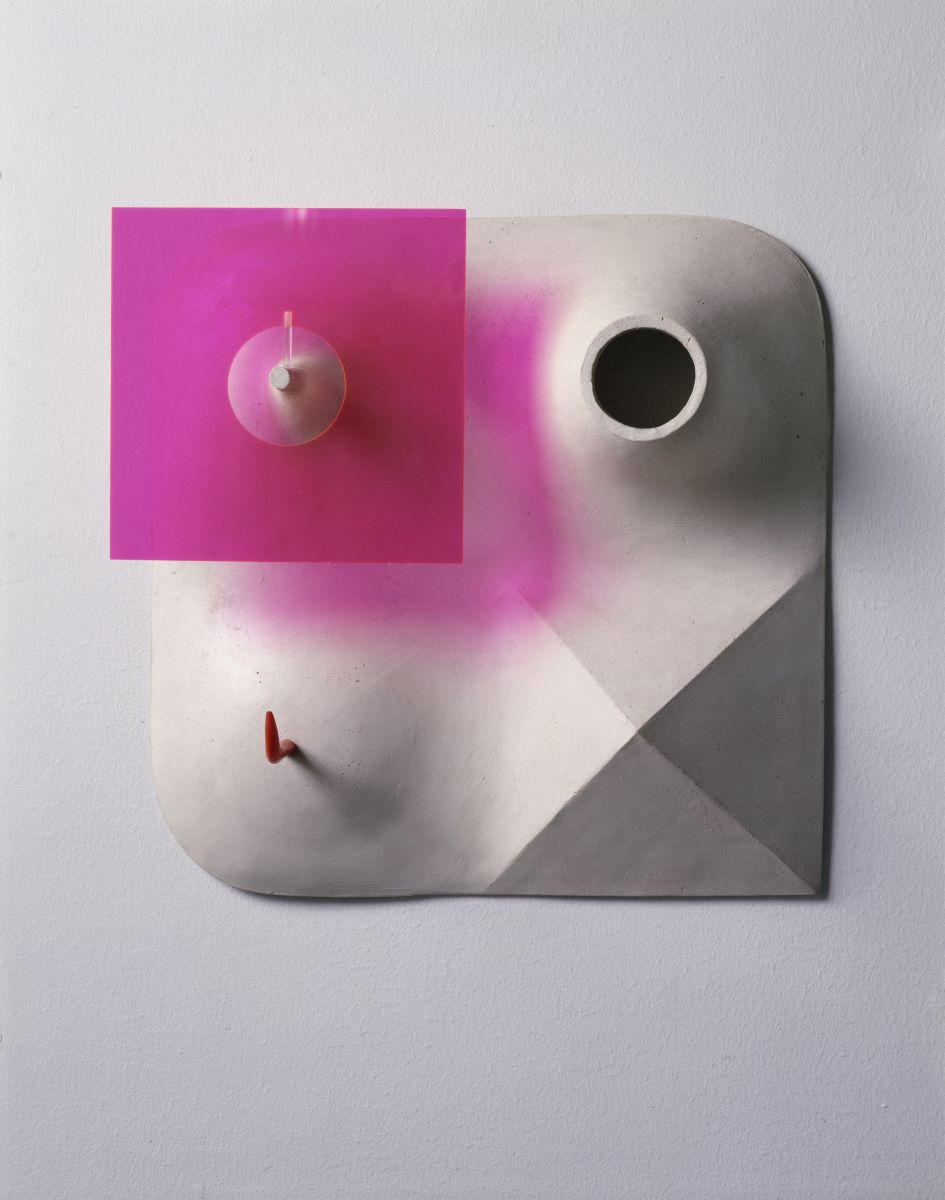
Another work, Isamu Noguchi’s “My Arizona” was created after Noguchi spent seven months in Poston, a detention facility for Japanese Americans used during World War II. With so many being deported to prison in El Salvador now, this piece is imbued with new prescience. The wall text shares that the federal government later acknowledged the treatment was unjust, but being in front of this piece now, and knowing that our current administration is repeating and expanding upon past mistakes broke something deep in my belief in our future. Yet, underneath, there is hope that the wider we can share past stories and organize around current issues, the more powerful we will be to stop these atrocities.

Isamu Noguchi, My Arizona, 1943, fiberglass and plexiglass, The Isamu Noguchi Foundation and Garden Museum, New York
Fred Wilson, I Saw Othello's Visage in His Mind, 2013, Murano glass and wood, Smithsonian American Art Museum, Museum purchase through the Luisita L. and Franz H. Denghausen Endowment, 2019.8, © 2013, Fred Wilson
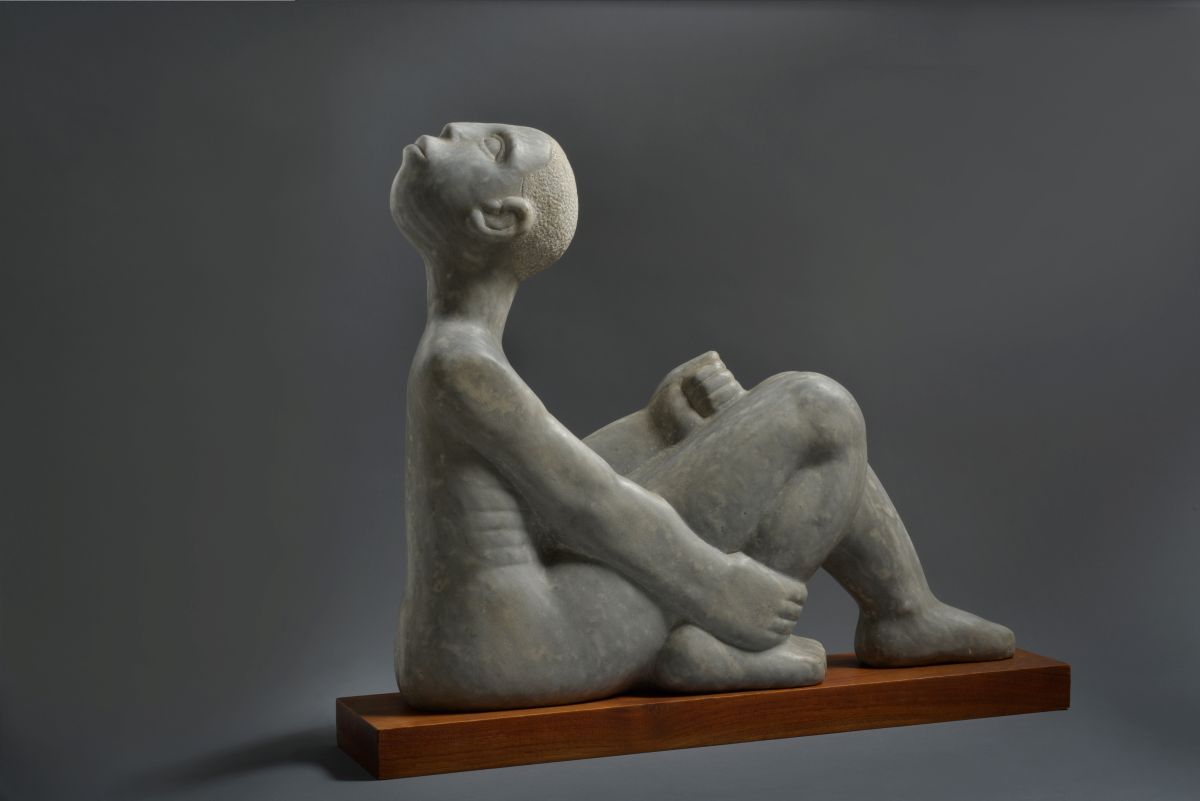
Marion Perkins, Skywatcher, ca. 1948, The Illinois State Museum

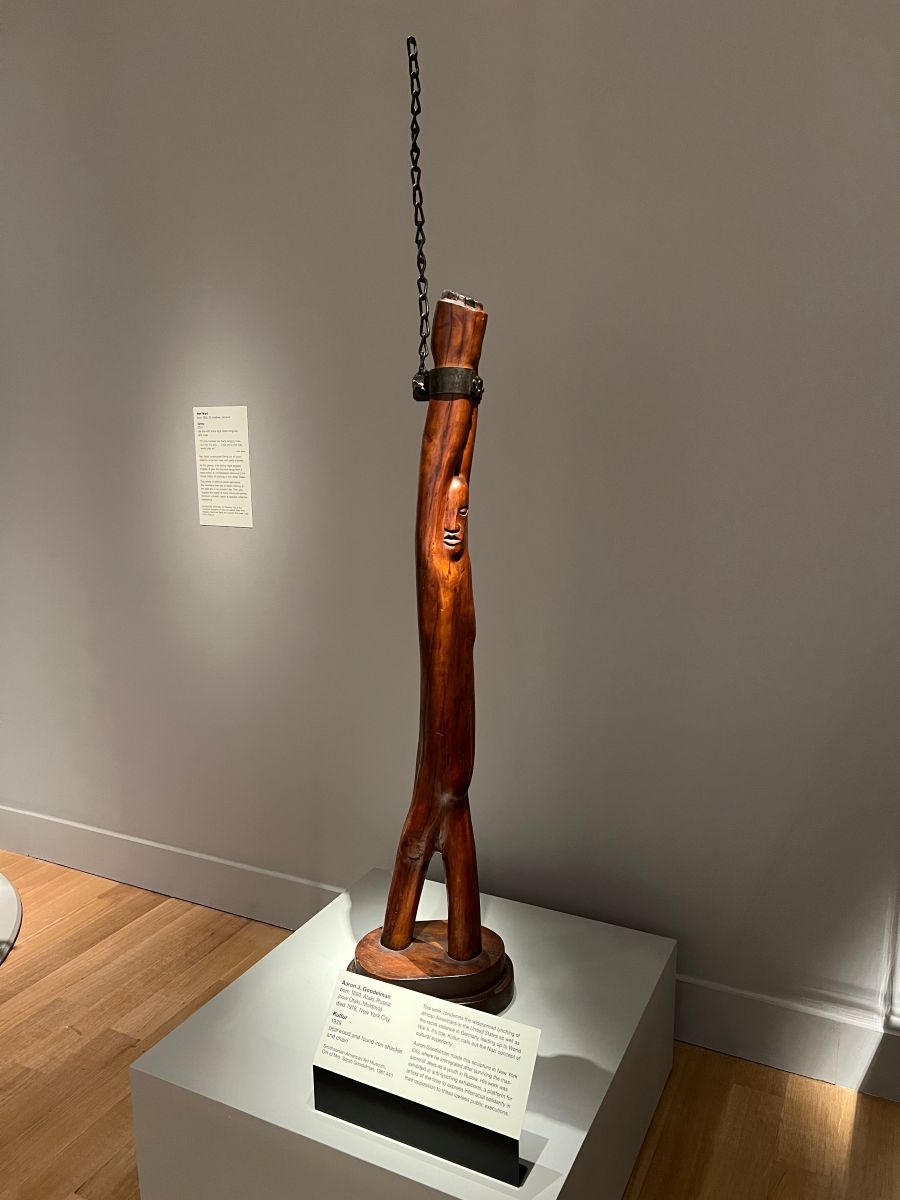
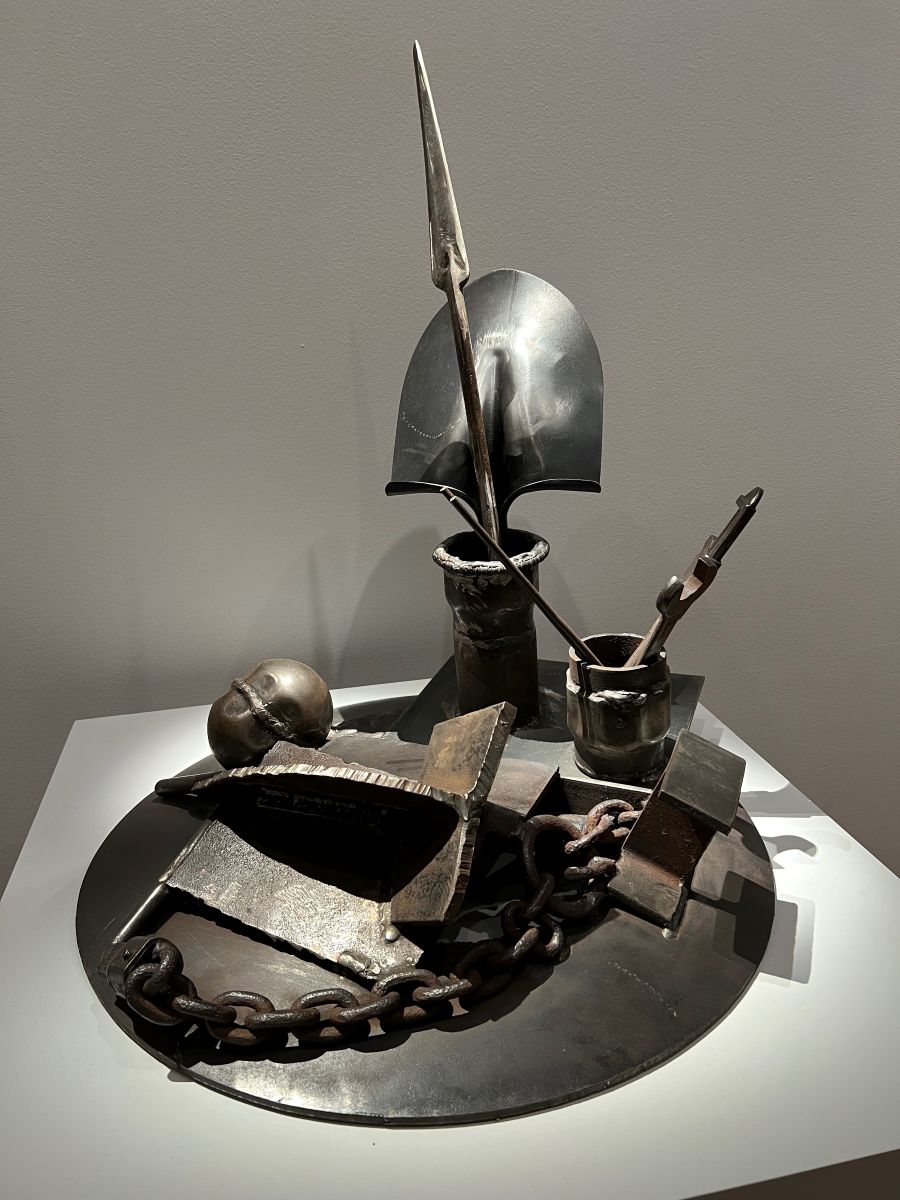
The next section of the exhibition features artists and work that acknowledge that no one’s suffering is ok. In a narrow gallery space these pieces including Aaron J. Goodelman’s “Kultur,” Emanuel Martinez’s “Farm Workers’ Altar,” and Melvin Edwards’ “Tambo” each make a statement.

Goodelman’s condemnation of the lynching of African Americans in the United States, and the racist violence in Germany leading up to World War II, is represented by a wooden figure with arms bound in an iron shackle above the head. The figure is elongated and the chain, although looking taught, is also cut and suspended midair. The figure’s expression looks directly at the viewer, suggesting that those doing violence are seen. This determination held in the direct gaze highlights the power of calling out violence in an effort to achieve justice.

Martinez draws attention to the exploitation of Filipino and Mexican migrant workers, farmers, union workers, and indigenous women. His altar is beautifully painted with vibrant colors and on each side a different image. An indigenous woman facing the viewer stands in front of a mountain, lake, and field wearing a peace sign and holding grapes and wheat. The two sides depict corn in the shape of a cross and four hands of different races intertwined with a grape vine. The final side faces the wall and is difficult to see, but is a depiction of a brown skinned Jesus being crucified. Crosses repeat across the work and the top shows four figures in this shape.

Edwards’ piece is an homage to a political activist who fought against apartheid in South Africa. It is an assemblage of iron alloy objects. These sit on a circular metal piece and include a shovel, spear, wrenches, ratchets, a chain, a piece of i-beam, and more. Some of these pieces are polished, some have a patina. The result is a strong, sharp, solid sculpture that must match the power of the political activist it is made in homage to. Each of these works has depth and care for the subject and the people it represents that is palpable as one views them. Again, it is through a combination of despair and hope that by telling the stories of the awful things experienced in the past, we can as a people succeed in creating something different in the future, towards which the final section of the exhibition looks.

Emanuel Martinez, Farm Workers' Altar, 1967, acrylic on mahogany and plywood, Smithsonian American Art Museum, Gift of the International Bank of Commerce in honor of Antonio R. Sanchez, Sr., 1992.95
Installation view of Aaron J. Goodelman's “Kultur,” photo by Sarah McCann
Installation view of Melvin Edwards' “Tambo”, photo by Sarah McCann
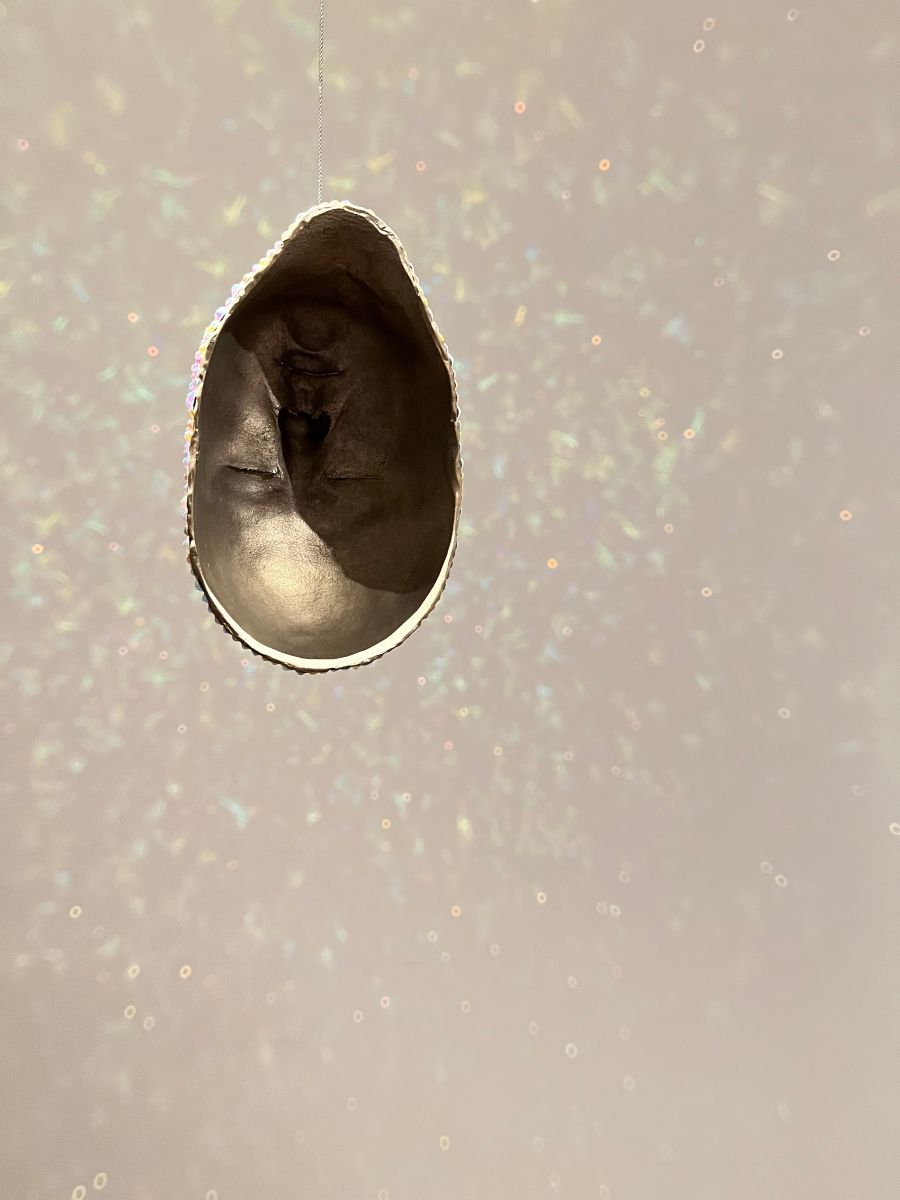
Young Joon Kwak's “Divine Ruin (My Face, Bronze),” photo by Sarah McCann
Installation view of Virgil Ortiz's “Pueblo Revolt 2180" (2018-2019) white bentonite clay with bee weed (spinach) paint, Smithsonian American Art Museum, museum purchase through the Kenneth R. Trapp Acquisition Fund, 2022.54, photo by Sarah McCann

Three pieces installed very close to the exit of the galleries look toward the future. Virgil Ortiz’s “Pueblo Revolt 2180” reminds us that many indigenous peoples have already overthrown their colonizers and in the future more will rise up. Young Joon Kwak’s “Divine Ruin (My Face, Bronze),” comprised a bedazzled bronze cast of the artist’s face. This piece states that the materials of the colonizers can be repurposed to illustrate an alternative use and reality that reflects beauty and joy far beyond all physical boundaries. Lastly, Rose B. Simpson’s “Dream Machine,” depicts a young girl who holds her head high in the midst of a militarized apocalypse, willing a future beyond destruction, one of healing the generations of trauma rooted in racism, hate, war, and greed.

The exhibition is dense and diverse with more content: artwork created for the home, work that expresses the beauty and challenge of different racial identities, sculptural pieces that may have been made in support of abolition, but continue messaging rooted in racial hierarchy, public art with questionable meaning, artists’ responses to historical violence. Together the works lay bare much of what has contributed to our arrival in the current political and social moment that—let’s be real—is frightening. Yet the The Shape of Power affirms art’s role in changing prevailing narratives and enabling people to see an alternative future. Shaped here too, are lessons about how to work together toward change, how to honor and celebrate difference, and how art is and will always be a part of the revolution. Exhibitions like these illustrate the vital importance of creative discourse, the need for critique of US history and myths, and are essential to preserving what freedoms we have left.

The Shape of Power: Stories of Race and American Sculpture is on view until Sept. 14, 2025 at The Smithsonian American Art Museum

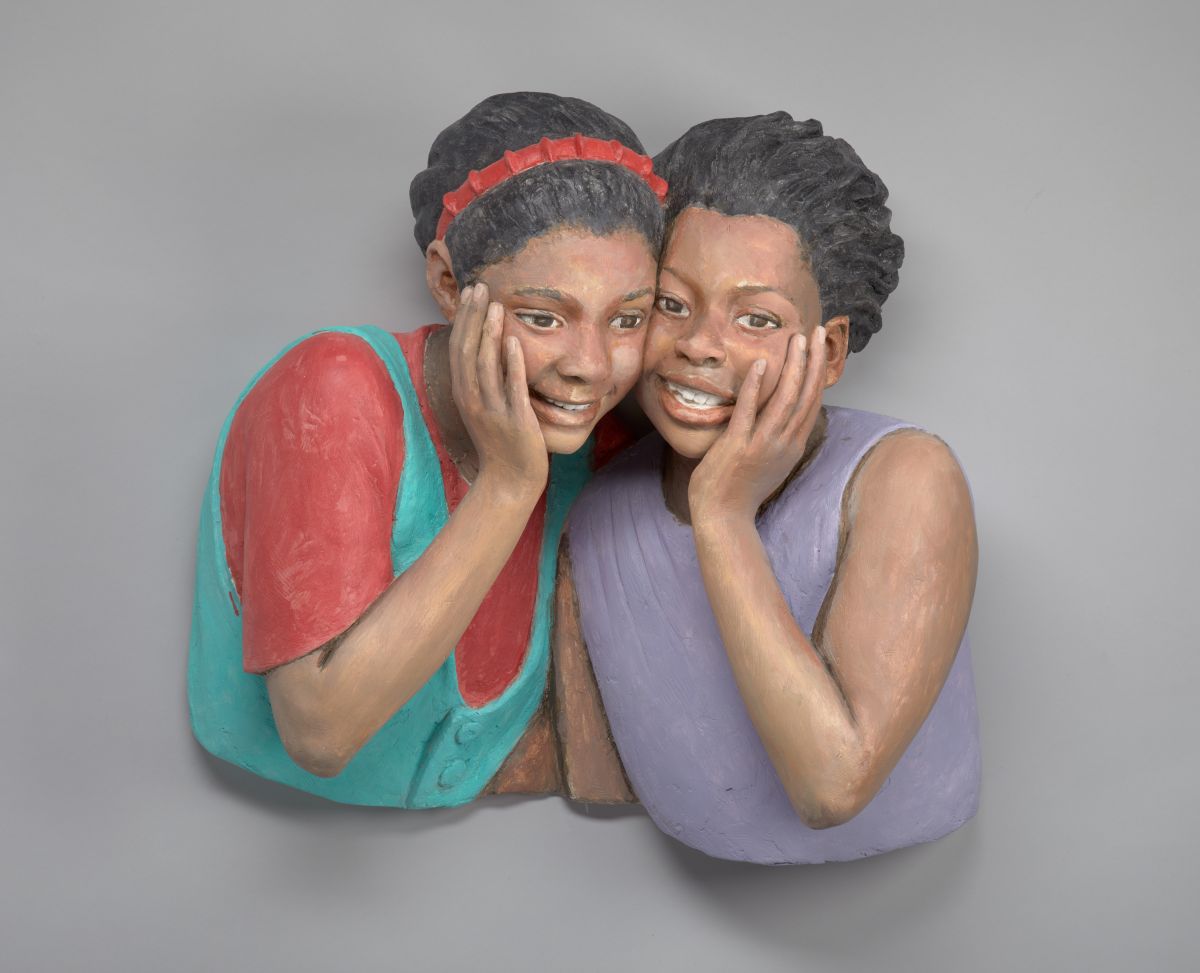
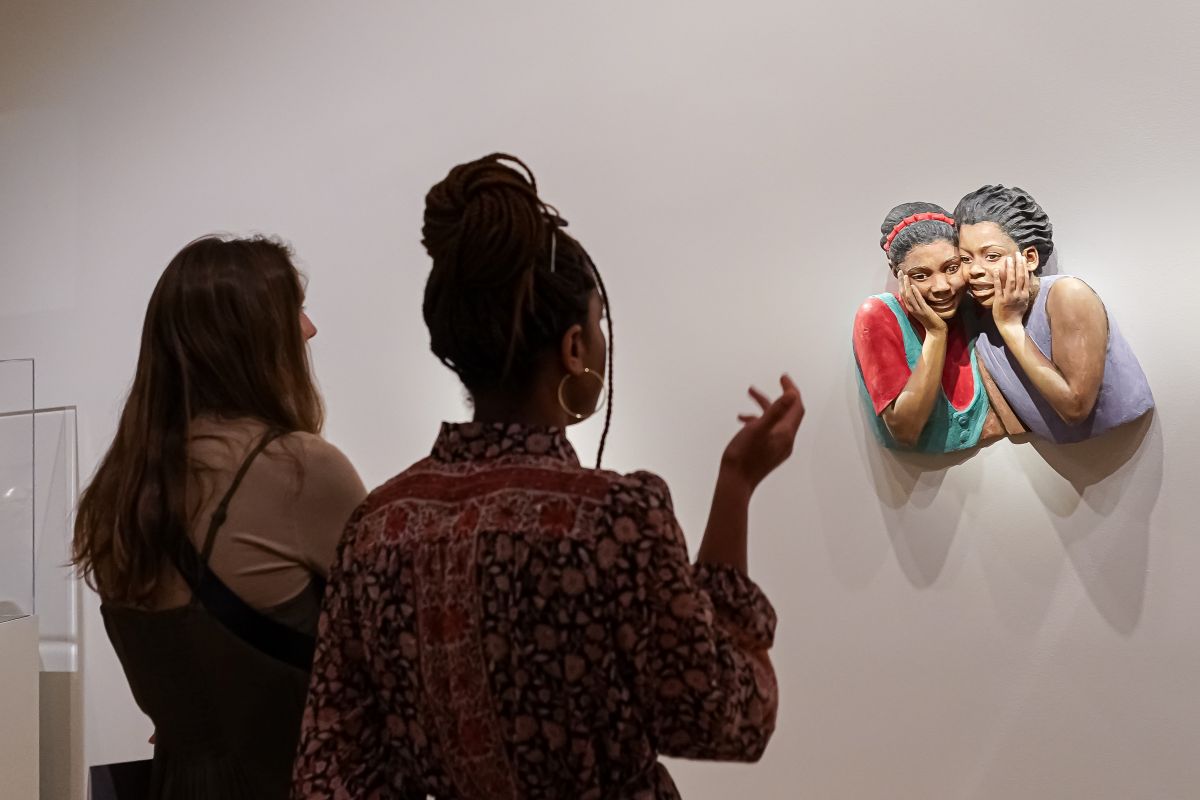
Header image: Installation view of John Ahearn and Rigoberto Torres, Jamese Jefferson and Gloria Bollock, 1992, exhibited at The Shape of Power: Stories of Race and American Sculpture, photo by Albert Ting.

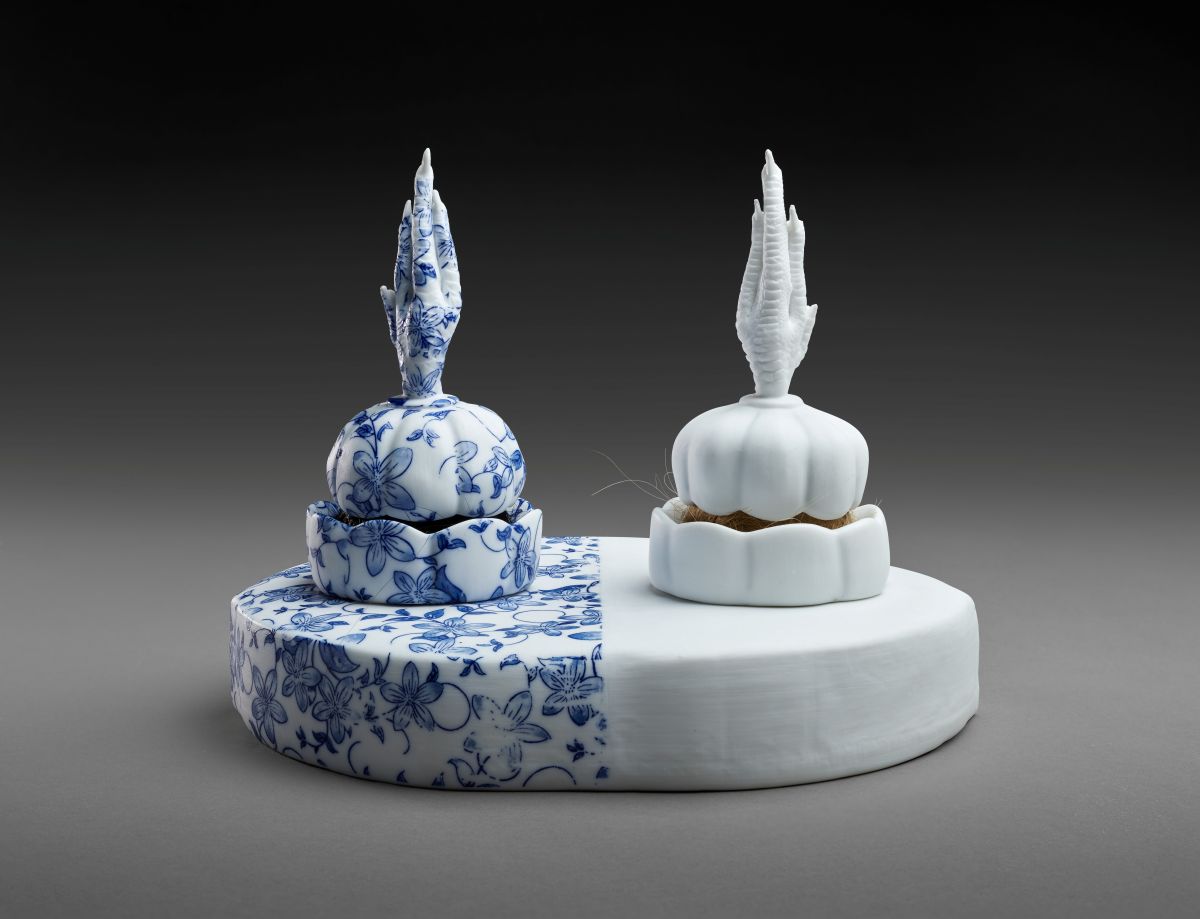
Jennifer Ling Datchuk, Half, 2014, porcelain and hair, The Museum of Fine Arts, Houston, Museum purchase funded by Michael W. Dale in honor of Anna Walker, 2018.398.A-E
John Ahearn and Rigoberto Torres, Jamese Jefferson and Gloria Bollock, 1992, acrylic on Hydrocal plaster life cast, Anacostia Community Museum, Smithsonian Institution, Gift of the artists, 2021.1.1
Maggie Thompson, Family Portrait, 2012, rayon, wool, and dye, Minneapolis Institute of Art, The Jane and James Emison Endowment for Native American Art

Images courtesy of The Smithsonian American Art Museum and Sarah McCann

Related Stories
Ikhide's "Tales From Future Past" is on View through November 22 at CPM

CPM Gallery recently announced that the run of Richard Ayodeji Ikhide's solo exhibition "Tales from Future Past" would be extended to November 22 by appointment. At the opening on September 27, the British-Nigerian artist was interviewed by luminary art historian, curator, and educator Lowery Sims.

In "Pandarayuhan: Home is a Memory" Divinagracia Explores Immigration and Identity at Creative Alliance

"One of my biggest intentions with this show was to really spotlight Filipino presence in Baltimore and specifically immigrant lives and journeys.”

Baltimore art news updates from independent & regional media

This week's news includes: Amy Sherald shines brightly in Baltimore, Hilton Carter makes his house a home, Inviting Light returns with a Wickerham & Lomax, John Akomfrah moving image + sound installation opens at the BMA, mayorial portraits unveiled at City Hall, Maryland Film Fest is here, and more

Swagger and Style at the BmoreArt Release Party for Issue 20

On Saturday, November 1, BmoreArt hosted 400+ guests at the Icons Ball & Benefit at the Lord Baltimore Hotel.