
Reading

Finding Epiphany: John Ruppert’s Vestiges of Time

Previous Story
Article Image

BmoreArt’s Picks: April 22-28

Next Story
Article Image

BmoreArt News: Ellen Owens, Amy Sherald, John Waters

When John Ruppert visited his friend’s home in Puglia, Italy in 2024, he had no idea that the journey would provide the subject for his next exhibition; he just knew that the connection he felt to the olive trees he saw there was significant. “I was totally enamored by the scale, the ancientness of them, the character, the positioning of the landscape… I just had this gut feeling that I needed to do these photographs,” he explains. “It wasn’t planned. We were driving around, and I was like, ‘Wow.’ One tree after the other after the other. I just got really kind of obsessed.” 

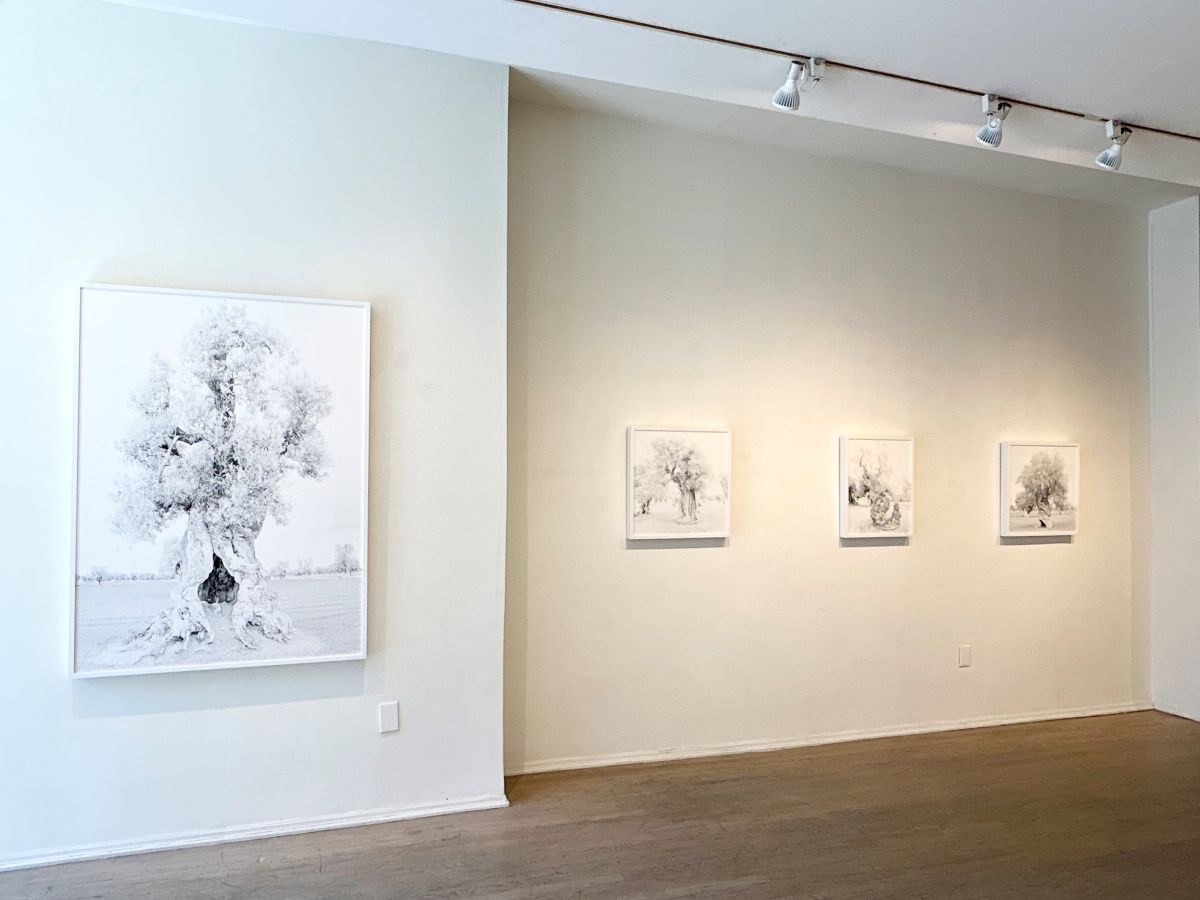
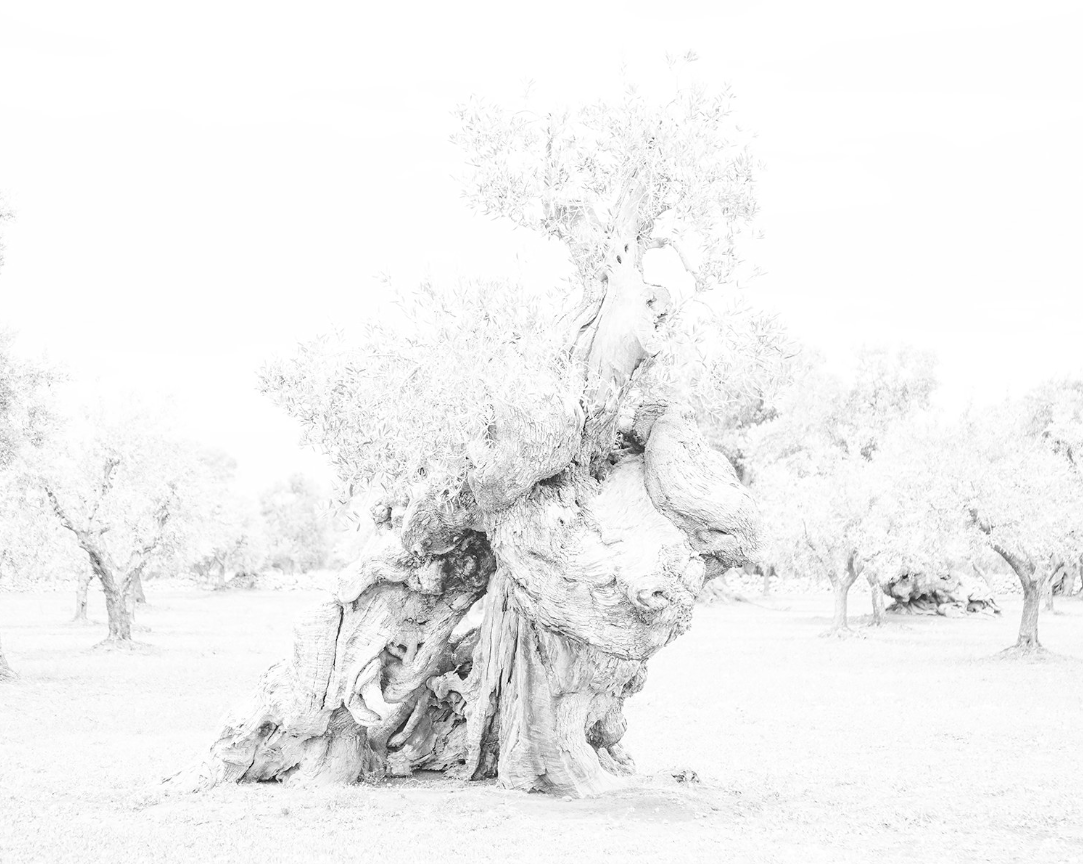
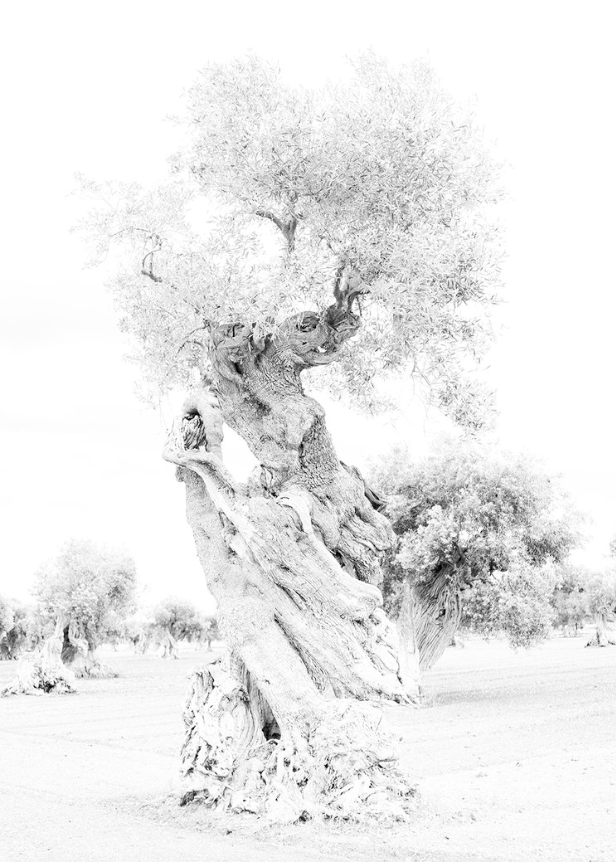
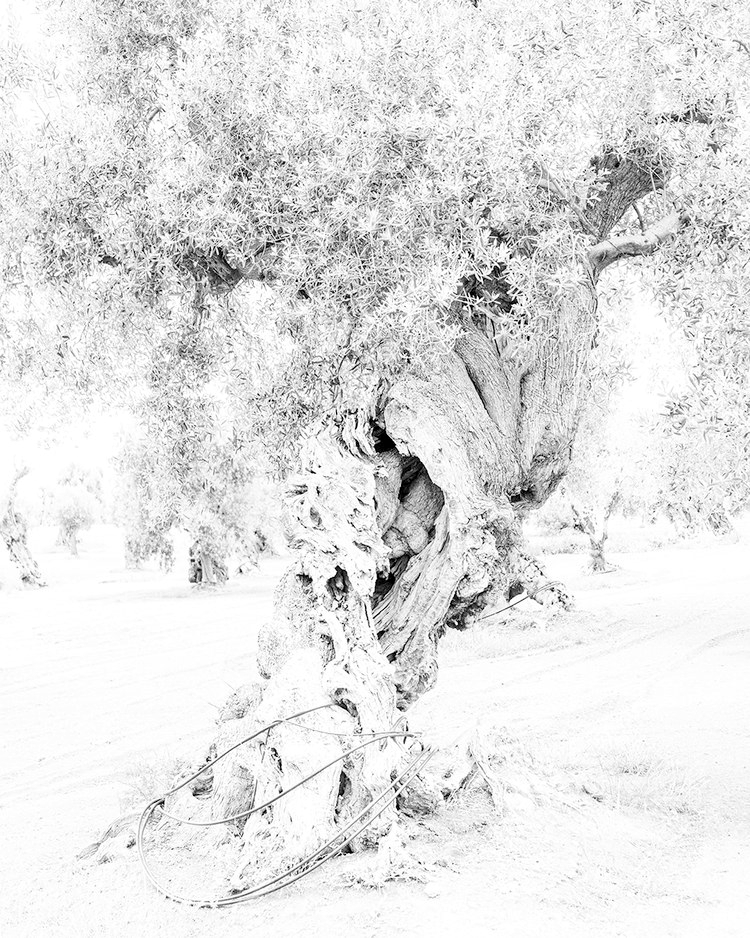
Ruppert’s Olea Europaea Portrait Series, on display as part of his Vestiges of Time exhibit at C. Grimaldis Gallery through May 17, captures the artist’s fascination, or what he calls the “biggest epiphany I’ve had for a while.” The images are both hyper-realistic and hauntingly ethereal, lining the walls of the show with whitewashed portraits of thick, twisted trunks and branches that give way to shimmering bursts of foliage. Despite the static nature of photography, there is movement in the pictures, a kind of vibration that fills the gallery space.

Olive trees are an apt subject for an artist who is deeply concerned with ecological time and the human connection to the natural world. “My interest in nature and human intervention began in my youth when my family was stationed in Amman, Jordan,” Ruppert explains. “I became fascinated by archeology, visiting ancient sites, and participating in digs. The interplay of material, human order and architecture, and the relentless effects of time made a lasting impression on me.”

Decades after his introduction to the symbiotic relationship between nature and civilization, Ruppert found the perfect emblem of this interplay in the olea europaea; for 2000 years, humans have cultivated and revered these trees.
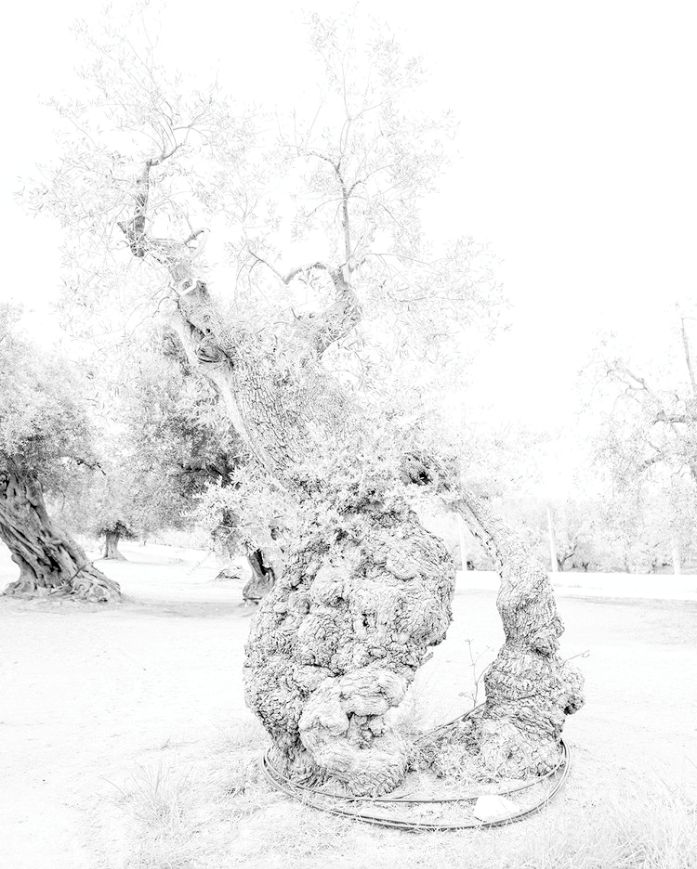
John Ruppert, Olea Europaea III, 2024, edition of 5, archival print on fine art paper, 22 x 17 inches
John Ruppert, Olea Europaea II, edition of 5, archival pigment print, 27 x 22 inches
The interplay of material, human order and architecture, and the relentless effects of time made a lasting impression on me.
John Ruppert

Indeed, close examination of the images in this exhibit reveals a lingering human presence, as ghostly as the trees themselves. In some pictures, a man-made stone wall stands in the background. Tidy orchard rows are evident in others.

Even the irrigation hoses wrapped around the base of a tree trunk, proof of human involvement, become objects of reverence: “the lyrical movement of them as well as this idea of life support… these are necessary for the tree to survive. It’s another layer of that engagement with culture. Not only the pruning but keeping them moist during the droughts.” As beautiful as the images are, they also serve as warnings about the fragility of natural systems, especially in the face of human interference. 

Experimentation and discovery is integral to Ruppert’s work. When he returned to the United States from his trip to Puglia, he had about 40 color pictures he had shot on the fly. They were “nice pictures of trees, but they weren’t doing anything for me,” he says, “so I flipped to black and white and started playing around.” 

The shift to black and white from color not only works aesthetically, but there is a literal precedent for the choice. The most ancient of the trees “are succumbing to a fungus introduced by coffee plants shipped from Costa Rica. The affected trees die and become bleached white figures in the landscape,” Ruppert says. “Experiencing these ghost figures definitely influenced my approach to this body of work.” Ultimately, the exhibit creates both a sense of awe in the observer and it serves, at least in part, as a cautionary tale about the impact humans have on the environment.

Much of the work Ruppert put into the creation of the images stemmed from a desire to portray this precarious relationship between humans and nature. The surreal quality of the photographs results at least in part from the fact that they are not single-image photos but instead are “built by stitching together several photographs taken successively during a pan of the subject.” 

It took time and experimentation with this digital compositing technique for Ruppert to create images that conveyed what he felt mattered most about the trees. This multi-image compositing allows for greater detail; places that might be blurry in a single image are sharpened when the images are combined, bringing “more presence” to the subject. 

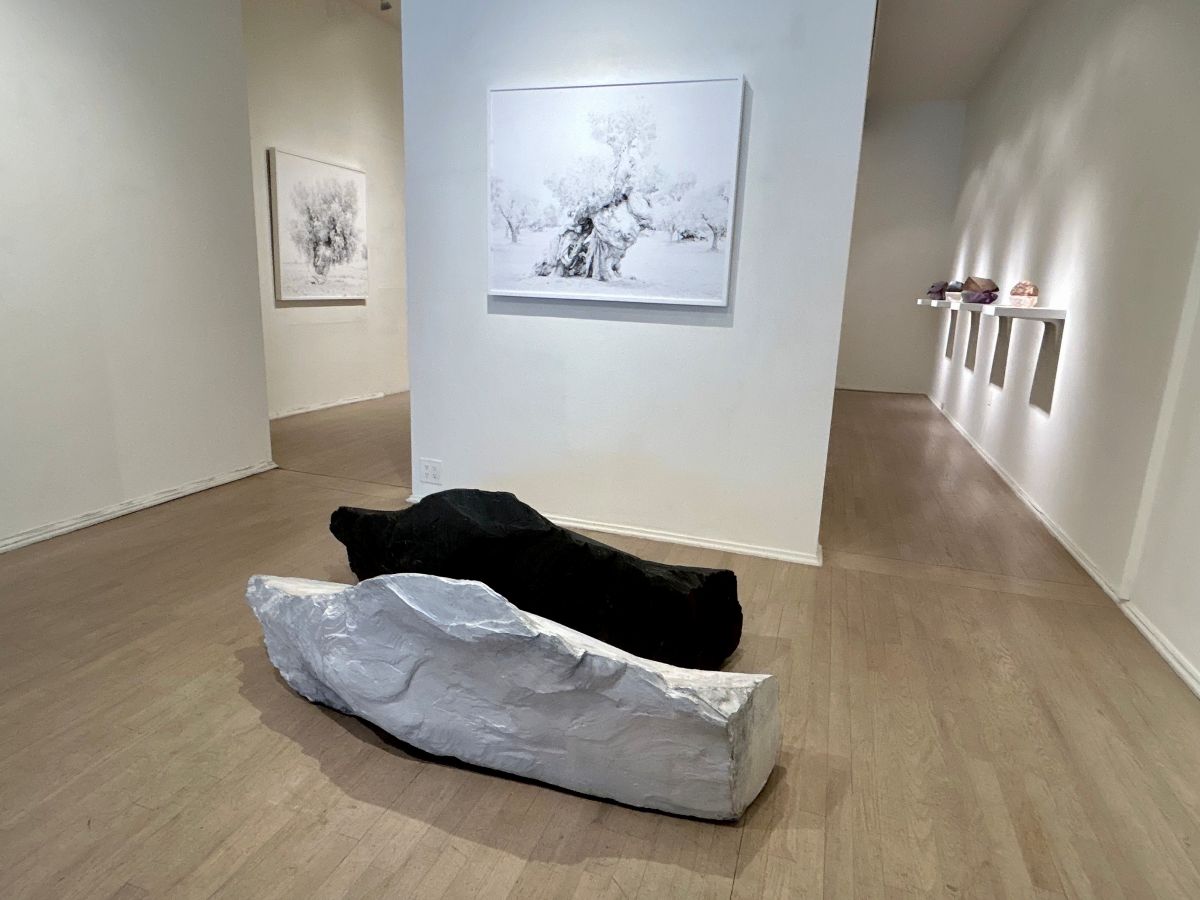
Installation view of Vestiges of Time: Traces in Light and Materials at C. Grimaldis Gallery
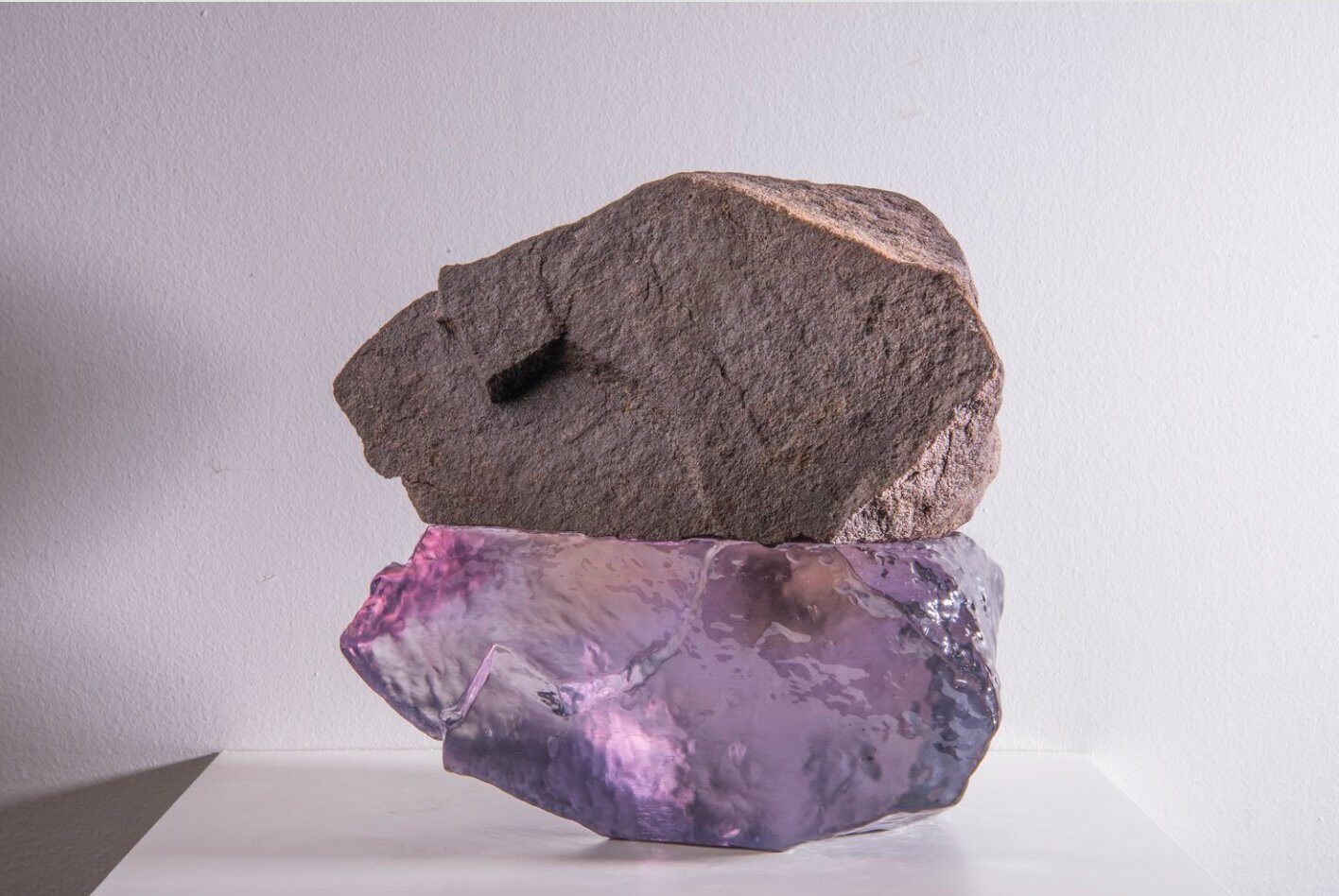
John Ruppert, Rock Reflection 4, 2024, 3D-printed resin and rock, 9 x 8 x 6 inches
Rock Reflections Series, Vestiges of Time: Traces in Light and Materials

As we look at one of the pictures together, Ruppert points to the foliage. “The leaves became painterly in the process of layering,” he says, seemingly surprised anew by this result. Furthermore, the act of manipulating the original images itself is a form of human interference, so the process becomes as significant as the product.

The tension between tradition and technology, between nature and civilization, is not only evident in the photographs on display, but also finds a powerful outlet in the sculptures that appear throughout the exhibit.

According to Ruppert, there is a natural connection between the two-dimensional pieces and the 3-D work. As he explains in the show’s catalog, “The cast forms echo ancient geological structures, while my photographs of gnarled olive trees—shaped by centuries of wind, water, and human cultivation—all speak to nature’s endurance. By bringing together earth and metal, image and form, this body of work meditates on the effect of time’s slow, persistent passage.”

Castings are not the only sculptures on display in Vestiges of Time. Toward the back of the gallery are a series of sculptures made from resin and rock. Just as technology played an important part in the creation of his photographs, so does it play a key part in his “Rock Reflections” series. First, Ruppert scanned granite rocks, then he inverted those scans and printed them on a 3-D printer. “They are all generated from the idea of reflection and water or ice,” he says. “What would happen if you solidified a reflection?”

The castings and printed sculptures complement Ruppert’s photographs and add complexity to the themes related to time and human interaction with nature; the fabricated elements of the works are difficult to distinguish from the natural elements. Ruppert gestures to the large sculpture at the front of the gallery, “Berg III,” saying, “People get confused about what’s real and what’s not because there’s an earthiness to how I cast. When I weld, I finish the weld in a way that references the way a river or waterfall goes through the landscape, kind of an accent. You can see how the texture seems almost more textured than the rock.” 

Similarly, the 3-D printed resin sculptures resemble quartz, leaving the viewer uncertain about what is natural and what is manufactured. Taken together, Vestiges of Time explores “both nature’s destiny and ongoing pattern of change, as well as human interference on a global scale.” 

Spending time with the pieces on display is humbling the way that great art so often is. Climate change, the relationship between man and nature, the vastness of geological time, and our relative insignificance are all conveyed through images and objects of great aesthetic beauty. “Art is a mirror of its time, reflecting and influenced by the attitudes and human condition of where it is made,” Ruppert says. “In my case, I hope that people will slow down, and become more perceptive, paying attention to the subtleties, differences, and similarities of experiences, and appreciating the natural world around them so that they will take care of it.”

Vestiges of Time: Traces in Light and Materials, a solo exhibition by John Ruppert, is on view at C. Grimaldis Gallery April 10-May 17, 2025.

Saturday, May 10th at 4:00 pm, the gallery will host an artist conversation with curator and scholar Kristen Hileman.

John Ruppert, Twin Strikes (44.19386°N, 68.66656° W), 2024, cast stainless steel, 117 x 60 x 60 inches
John Ruppert, Olea Europaea series, 2024, edition of 5, archival print on fine art paper, 22 x 17 inches
Installation view of Vestiges of Time: Traces in Light and Materials at C. Grimaldis Gallery

Images courtesy of C. Grimaldis Gallery

Related Stories
Ikhide's "Tales From Future Past" is on View through November 22 at CPM

CPM Gallery recently announced that the run of Richard Ayodeji Ikhide's solo exhibition "Tales from Future Past" would be extended to November 22 by appointment. At the opening on September 27, the British-Nigerian artist was interviewed by luminary art historian, curator, and educator Lowery Sims.

In "Pandarayuhan: Home is a Memory" Divinagracia Explores Immigration and Identity at Creative Alliance

"One of my biggest intentions with this show was to really spotlight Filipino presence in Baltimore and specifically immigrant lives and journeys.”

Baltimore art news updates from independent & regional media

This week's news includes: Amy Sherald shines brightly in Baltimore, Hilton Carter makes his house a home, Inviting Light returns with a Wickerham & Lomax, John Akomfrah moving image + sound installation opens at the BMA, mayorial portraits unveiled at City Hall, Maryland Film Fest is here, and more

Swagger and Style at the BmoreArt Release Party for Issue 20

On Saturday, November 1, BmoreArt hosted 400+ guests at the Icons Ball & Benefit at the Lord Baltimore Hotel.