Reading

Smoke, Fog, and Altered Visions: Air Quality at the BMA

Previous Story
Article Image

Finalists Announced for the 2025 Baker Artist Awards

Next Story
Article Image

BmoreArt News: ‘Strong, Bright, Useful  [...]

In an endearing 2008 video, the street artist Moose described the curious origins of what he called reverse graffiti. Working in a restaurant kitchen, he wiped away a dirty mark on the wall… only to notice that the resulting clean spot felt out of place in the generally grungy kitchen. 

After cleaning the entire wall, and wondering if he would have to wipe down the entire restaurant, he came to realize that cities as a whole are generally filthy—and that he could create effective works of art by cleaning patches of grime, exposing newly bright surfaces in provocative patterns. “The whole core of what I do,” he observed, “is based around drawing in pollution.” Pollution, in other words, can be dismayingly ubiquitous, but it can also be catalyzing, and full of expressive potential.

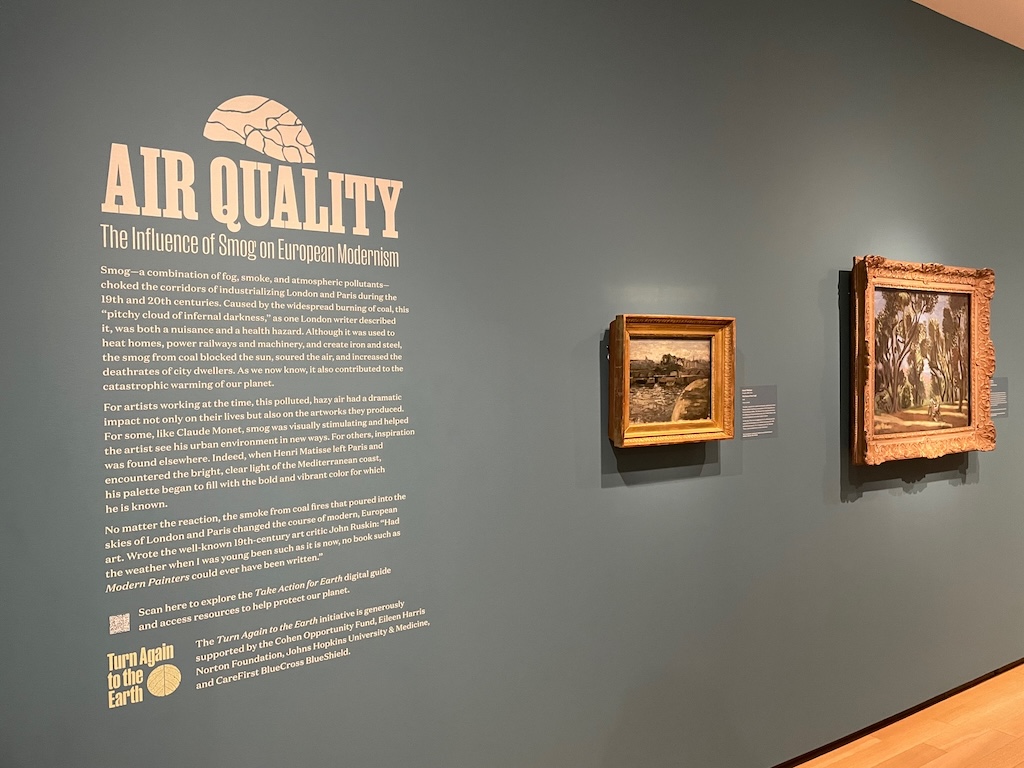
And that, really, is also the animating idea at the heart of Air Quality: The Influence of Smog on European Modernism, an affecting little show that opened at the Baltimore Museum of Art about a month ago, and that will be up through February of 2026. 

Curated by Kevin Tervala, and part of the BMA’s Turn Again to the Earth environmental initiative, it’s modest in scale: nine paintings and prints by European artists active in London and Paris in the late 1800s and early 1900s. But its core claim, that the smog that plagued those cities stimulated artists in distinct ways, is worth taking seriously—and opens onto important realizations about how we see our own world, as well.

Air Quality Installation photo at the BMA by Kerr Houston
The oppressive consequences of industry are depressingly apparent here.
Kerr Houston

Certainly, many of the urban centers of the Industrial Age were dismayingly polluted. The Thames and the Schuylkill were effectively open sewers, and the army of transport horses in New York City produced 2.5 million pounds of manure per day. Gradually, too, the very air changed. As coal-fired mills and factories multiplied, emitting huge quantities of soot and sulfur, many cities were shrouded in thick, acrid yellow-gray smog. 

Just how smoggy was it? A wall text in the show notes that climate scientists have estimated historical levels of air pollution, and determined that the air in London in 1888 bore 616 particulates of pollution per cubic meter. That’s 80 times the rate in Baltimore today, and it corresponds to an air quality index rating of more than 225, which is defined as hazardous. Or, often, fatal: for sustained “pea-soupers” could lead to more than 500 related deaths in London over the course of a week. 

Paris was not much better. Nauseating stenches emanated from the city’s sewers in the so-called Great Stink of 1880, and the corrosive gases released by factories that produced sulfuric acid devastated the fields surrounding the city. Artists, of course, were among the many who noticed, and two works in the show vividly convey the results of such intensive industrialization. 

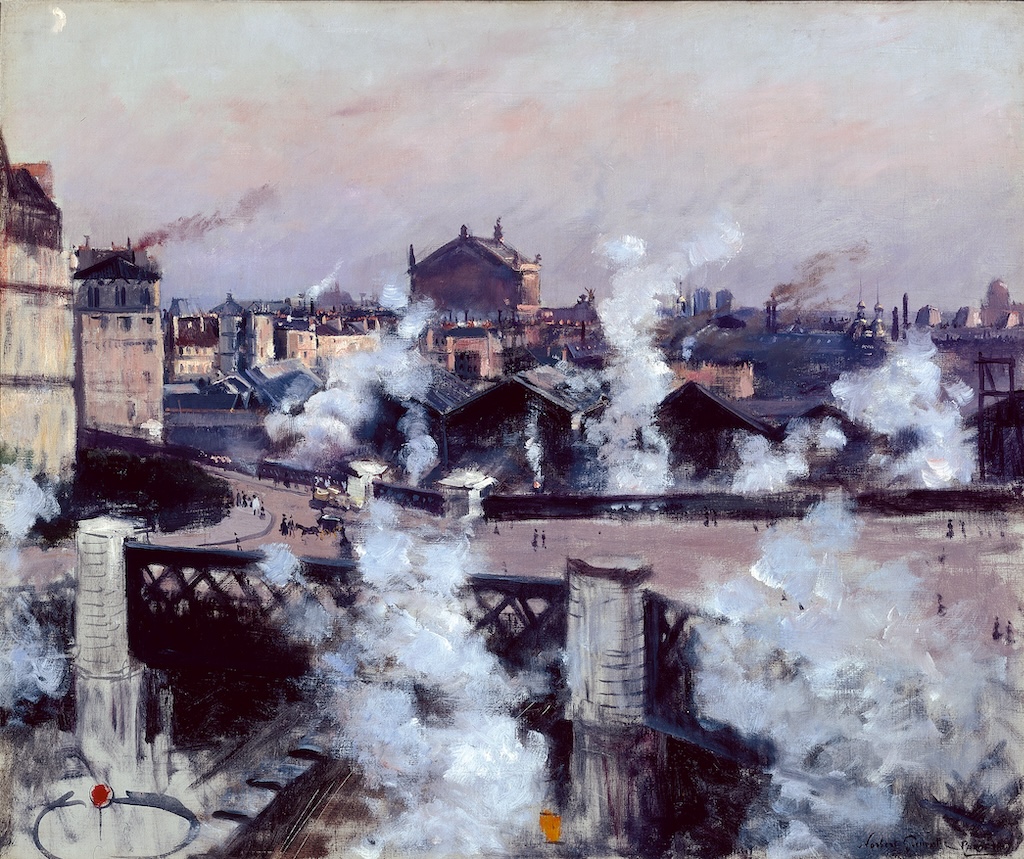
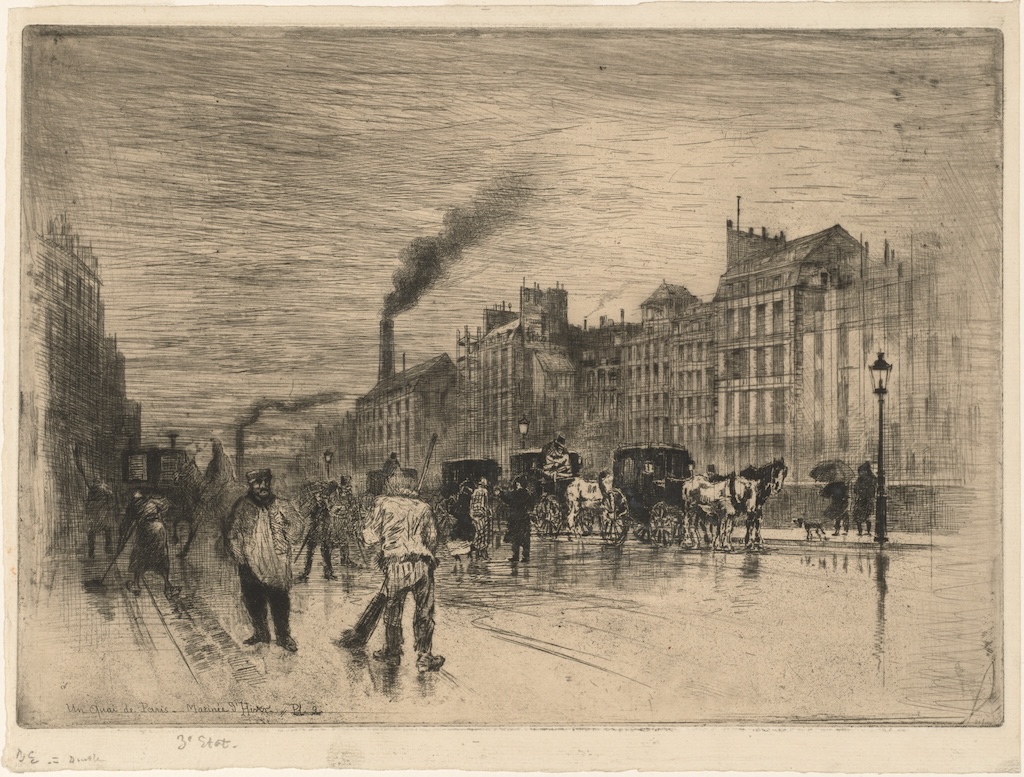
In an 1887 painting by Norbert Goeneutte, numerous plumes of steam and smoke rise from the dense metropolis; the tiny figures who make their way across a bridge are insubstantial in comparison with the city’s dynamic energy. By contrast, an adjacent 1883 etching by Félix Hilaire Buhot focuses largely on figures—but places them beneath a sky composed of slashing, ominous hatchings. The oppressive consequences of industry are depressingly apparent here.

Félix Hilaire Buhot, "A Quai in Paris, Winter Morning," etching and drypoint, 1883, BMA: George A. Lucas Collection
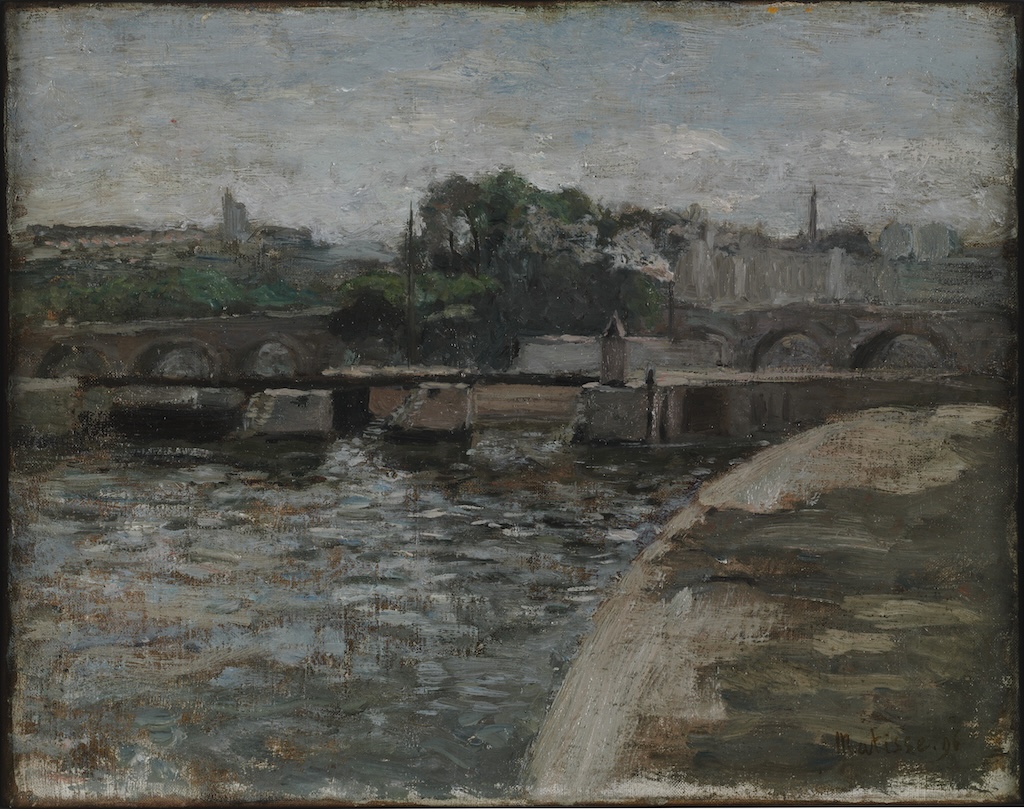
Henri Matisse, The Dam at Pont Neuf, oil on canvas, 1896, BMA: Cone Collection

Eventually, the city began to crack down on heavy and extended emissions—but not before Henri Matisse had registered the dreary sobriety of Paris in a restrained 1896 painting. True, the painting shows Matisse experimenting with a range of relatively novel Impressionist strategies. Working on a bank of the Seine, he relies on staccato brushwork to imply the dance of light on water, and the promenade in the foreground is as abstract as it is naturalistic. But the painting’s general mood is stolid and deliberately uninspiring: an echo of the thick, congested cityscape.

Small wonder, then, that Matisse would delight in the comparatively bright and more open skies of southern France. Indeed, a much larger canvas hung nearby communicates Matisse’s sense of joy and relief in a less polluted setting. Painted quickly and featuring an artist working in an olive grove against a backdrop of hills in lush periwinkle, aqua, and pink, it’s a work characterized by a sense of release and freedom. Evidently, the clotted, cloudy city could heighten one’s sensitivity to the lively visual appeal of a sparkling, sunlit day.

Strikingly, though, at least a few artists found the resulting visual effects of smog to be deeply interesting and even galvanizing. The Impressionist painter Claude Monet, who repeatedly visited London during the winter, was among them. As he wrote to the dealer René Gimpel, “I adore London… but what I love more than anything is the fog.” 

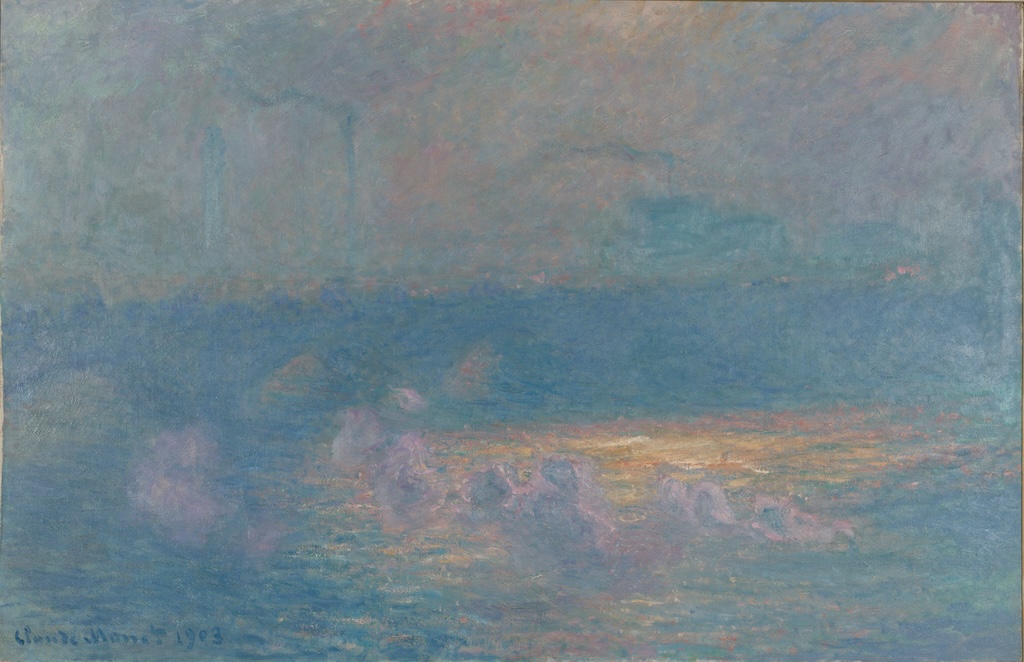
By fog, Monet meant the miasmic combination of vapor, smoke, pollutants that often settled over the Thames in winter months—and that yielded a range of shades, from rich amber to deep orange to a delicate gray. Monet’s 1903 oil painting “Waterloo Bridge, Sunlight Effect with Smoke” embodies his interest in soft colors and innuendo; the city seems to dissolve in a swirling, peach- and violet-hued cloud.

Look closely, though, and you can make out, just beyond the mass of Charing Cross Bridge, several towering smokestacks, trailing ribbons of emissions. To industrialists, these were symbols of progress and modernization. To Monet, they were indispensable elements in generating a uniquely painterly atmosphere. 

Indeed, he resented Sundays, when the city’s factories were closed, and in a letter to his wife Alice in 1900, Monet recounted his dismay when he woke up on a weekday to find surprisingly clear skies. “I was devastated,” he recalled, “and already imagined that all my canvases would be ruined, but little by little the fires were lit, and the smoke and fog returned.” The smog was back; all was well. Monet could paint again.

Claude Monet, Waterloo Bridge, Sunlight Effect with Smoke, oil on canvas, 1903, BMA: Helen and Abram Eisenberg Collection
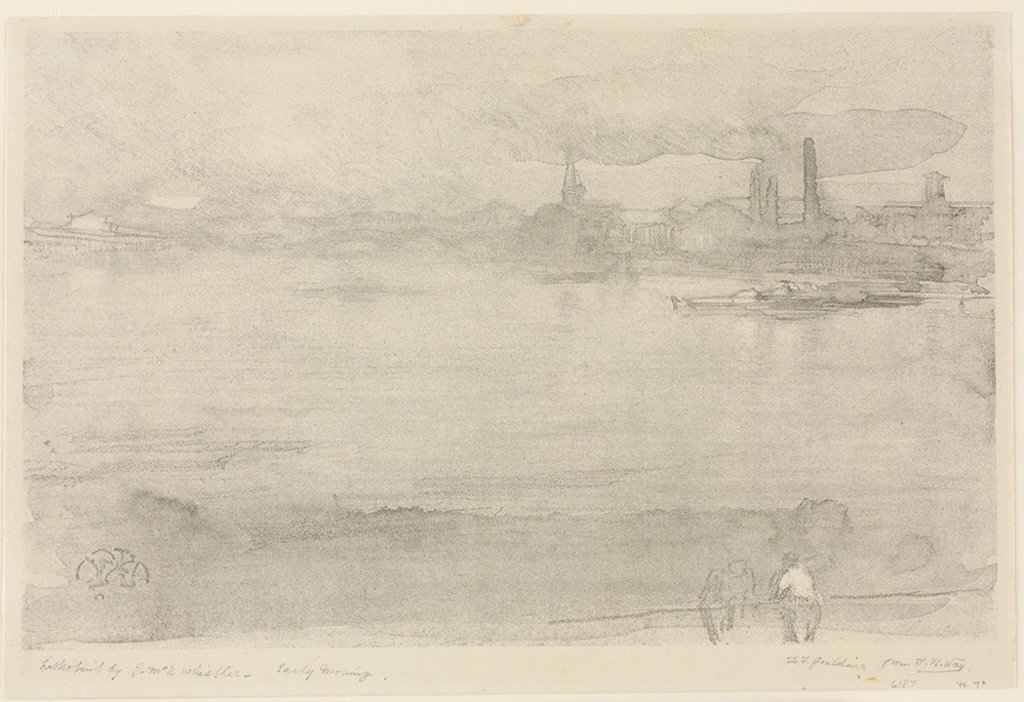
James McNeill Whistler, Early Morning, lithotint, 1878, BMA: gift of Mrs. Matthew H. Hirsh
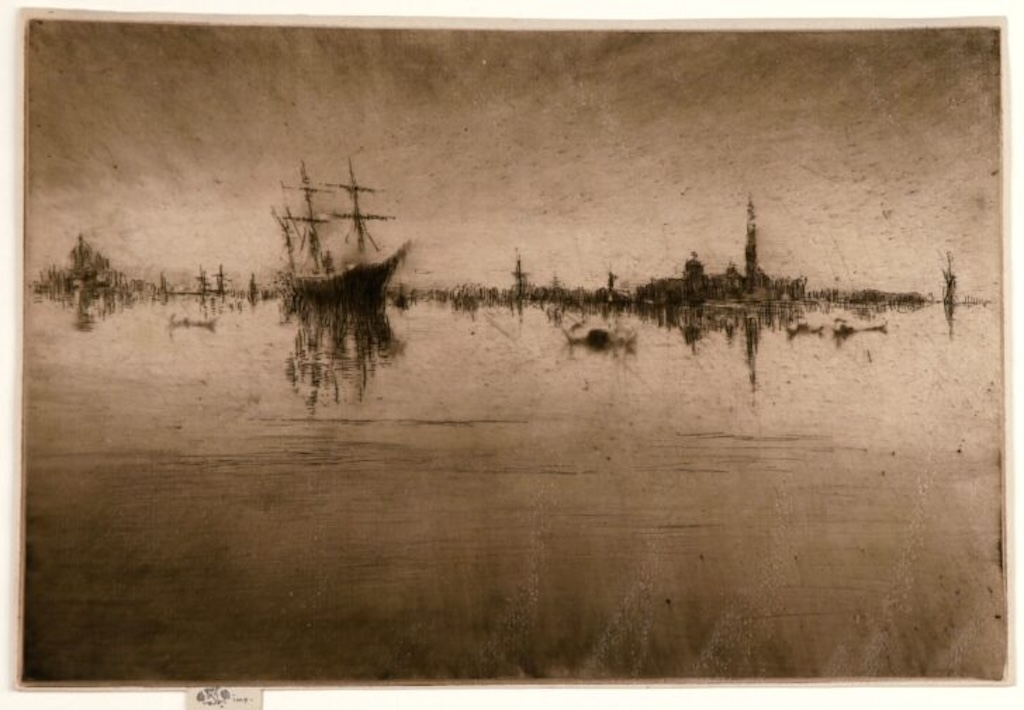
James McNeill Whistler, Nocturne, etching and drypoint, 1879-80, University of Michigan Museum of Art

The American artist James McNeill Whistler also found the fog to be visually fascinating. In “Early Morning,” Whistler relied on muted, gauzy tones to create a suggestive, indistinct image of the city. A large blot, a smear, spreads over several smokestacks and a steeple: religion and industry, cast as rough equivalents.

There are no hard contours in Whistler’s scene, and the foreground figures are indistinct—echoing the limited visibility in the city, and creating an exercise in implication. Clearly, the BMA is correct in its assertion that “for artists working at the time, this polluted, hazy air had a dramatic impact not only on their lives but also on the artworks they produced.” Air pollution could be visually generative.

Admittedly, that’s not really a novel idea. In an excellent 2004 essay, Jonathan Ribner noted that Whistler and Monet “each wrought enduring art from tainted air,” and Christine L. Corton’s 2015 London Fog: The Biography alludes to a number of creative souls who were deeply moved by the capital’s smoky haze.

Strikingly, moreover, many of them were foreigners. The American photographer Alvin Langon Coburn delighted in the mysterious sense of isolation created by the fog, while the Japanese painter Yoshio Markino compared the smog to a bride’s trousseau. There were a few exceptions: the British painter J.M.W. Turner, for instance, also rendered the haze with sensitivity. But it’s clear that Monet and Whistler were part of a larger corps of visitors enlivened by London’s tainted air.

And not just London’s—for in fact you could also put together a compelling show of works by artists who were similarly entranced by the smoky, hazy conditions in Venice. Granted, we don’t normally associate Venice with air pollution, but it was actually a lively center of industry.

In 1843, steam locomotives began to service the city and a French company was given permission to build a gasworks in the city; not long after, a campanile was converted into a steam-engine chimney. Given this, and the fingers of mist that curled through the city in the winter, it makes sense that Turner, Whistler and Monet all spent considerable time painting in Venice. The degraded air, you might say, was part of the draw.

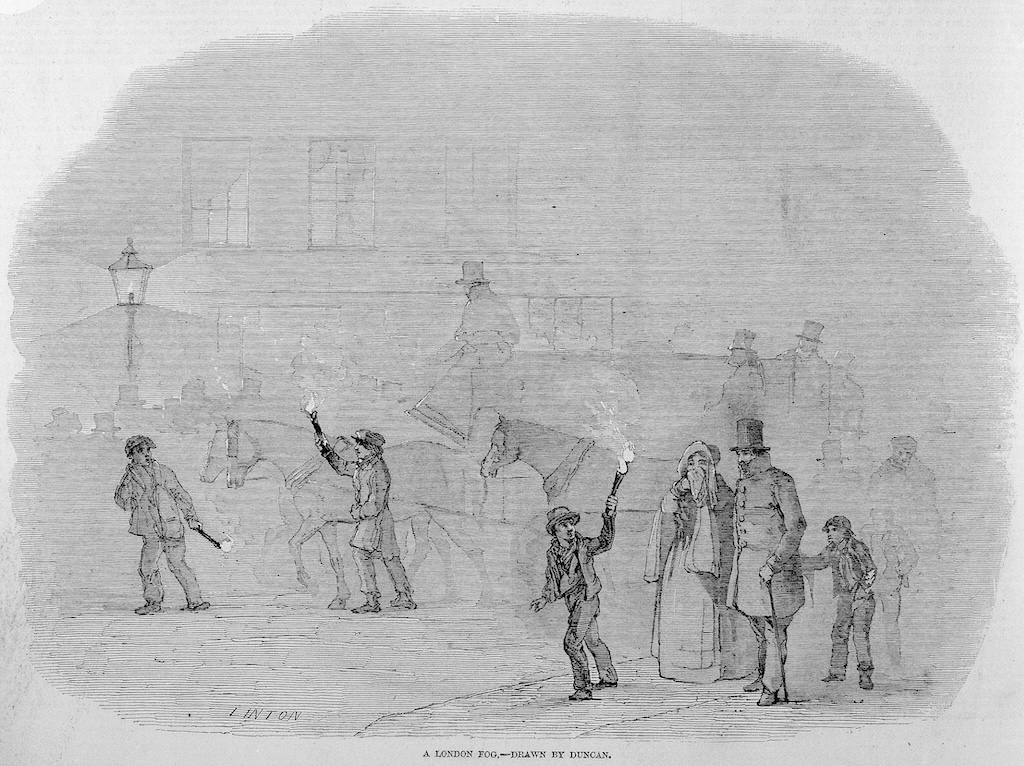
Edward Duncan, “A London Fog,”, engraving in The Illustrated London News, 1847, Wikimedia Commons
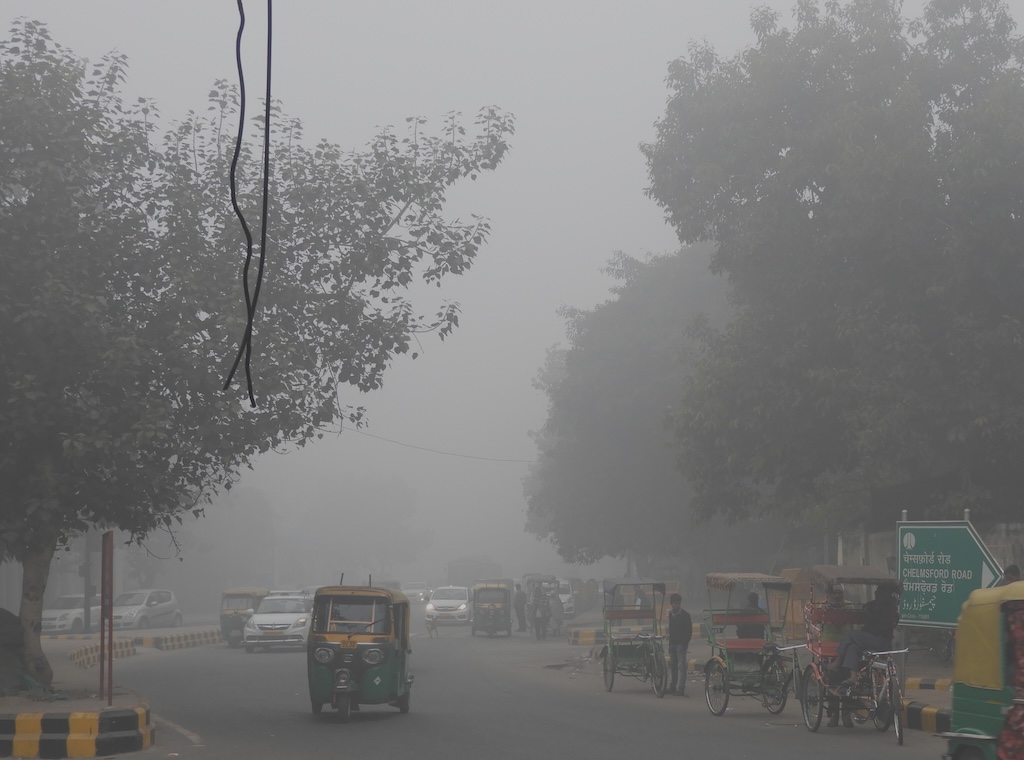
Sumita Roy Dutta, Low Visibility Due to Smog in Entry of Chelmsford Road, digital photograph, New Delhi, 2017, Wikimedia Commons
I love smoke with its vitality, its lovely fluidity, its elusiveness, then its disappearance!
Octave Mirbeau

Importantly, though, not everyone celebrated the resulting studies of smoke and haze. One critic, for instance, dismissed Whistler’s tendency to explore dirty side of Venice so frankly. “For who,” he asked, “wants to remember the degradation of what has been noble, and the foulness of what has been fair?” 

But Whistler, in turn, could point to the famous writings of John Ruskin, who had critiqued any painters who would “cleanse from their pollution those choked canals which are now the drains of hovels….” Such artists were, in Ruskin’s view, guilty of a failure to look closely and to paint what stood before them, with honesty. Or, as he put it: “instead of giving that refined, complex, delicate, but saddened and gloomy reflection in the polluted water, they clear it up with coarse flashes of yellow, and green, and blue, and spoil their own eyes, and hurt ours.”

In other words, this was a debate about realism, and the subjectivity of vision. Should one edit (or “read out,” as T.J. Clark once put it) distasteful signs of industrial modernity? Or should one aim at a sort of unaltered transcription of the visible world? To Monet and Whistler, this latter path was often the more rewarding. 

Significantly, such an approach also powered George Perkins Marsh’s 1864 “Man and Nature,” widely seen as the first modern environmental treatise. Comparing the observer of ecological change to poets, painters, and sculptors, Perkins concluded that “the power most important to cultivate, and, at the same time, hardest to acquire, is that of seeing what is before him. Sight is a faculty; seeing an art.”

In a sense, then, the artists behind the works on display were lessons in how to see the world that lay before them, with candor and commitment. Monet actually spoke honestly about cultivating such an ability. “My practiced eye,” he claimed, “has found that objects change in appearance in a London fog more and quicker than in any other atmosphere, and the difficulty is to get every change down on canvas.” 

In turn, his commitment to a close scrutiny of the world inspired those familiar with his work. In a 1904 essay on Monet’s paintings, Octave Mirbeau exclaimed that “I love smoke with its vitality, its lovely fluidity, its elusiveness, then its disappearance!” Art, it seems, was teaching others to see.

But can it do so today? For air pollution is not simply a thing of the past. While the levels of smog in London and Paris have abated, due to public pressure and responsible legislation, a number of cities around the world, from Hanoi to Milan, continue to struggle with dangerous levels of smog. Indeed, Air Quality includes a clever wall text that notes that the two limestone lions in front of the BMA have been noticeably darkened by airborne sulfur dioxide since they were last cleaned, in 2004. Removing that grime will cost, the museum estimates, $15,980.

It’s clear that change is possible: public health initiatives can work, and air pollution can be largely eliminated. But it’s also clear that, as Moose put it in speaking of his graffiti work, “the world is really, really dirty.” Ultimately, all of us—the painter who uses industrially produced paints; the curator who flies to Venice to see the Biennale; the critic whose words are stored on energy-consuming servers—bear partial responsibility for that fact. 

We may find, like Monet, inspiration in the resulting haze. Or we may seek out, like Matisse, a seemingly brighter alternative. In the end, though, we’re all in this together, and the lions in front of the museum act as a quiet measure of our ability to see what is before us, and an index of our resulting actions—or inaction.

Header Image: Norbert Goeneutte, View of St. Lazare Railway Station, Paris. 1887, The BMA, George A. Lucas Collection, purchased with funds from the State of MD

Related Stories
Ikhide's "Tales From Future Past" is on View through November 22 at CPM

CPM Gallery recently announced that the run of Richard Ayodeji Ikhide's solo exhibition "Tales from Future Past" would be extended to November 22 by appointment. At the opening on September 27, the British-Nigerian artist was interviewed by luminary art historian, curator, and educator Lowery Sims.

In "Pandarayuhan: Home is a Memory" Divinagracia Explores Immigration and Identity at Creative Alliance

"One of my biggest intentions with this show was to really spotlight Filipino presence in Baltimore and specifically immigrant lives and journeys.”

Baltimore art news updates from independent & regional media

This week's news includes: Amy Sherald shines brightly in Baltimore, Hilton Carter makes his house a home, Inviting Light returns with a Wickerham & Lomax, John Akomfrah moving image + sound installation opens at the BMA, mayorial portraits unveiled at City Hall, Maryland Film Fest is here, and more

Swagger and Style at the BmoreArt Release Party for Issue 20

On Saturday, November 1, BmoreArt hosted 400+ guests at the Icons Ball & Benefit at the Lord Baltimore Hotel.