Reading

Levester Williams: “all matters aside” Quarries the Local and Literary

Previous Story
Article Image

BmoreArt News: Craft in Baltimore, Maurice Berger [...]

Next Story
Article Image

At Untitled and NADA Miami, Hazy Painting and a B [...]

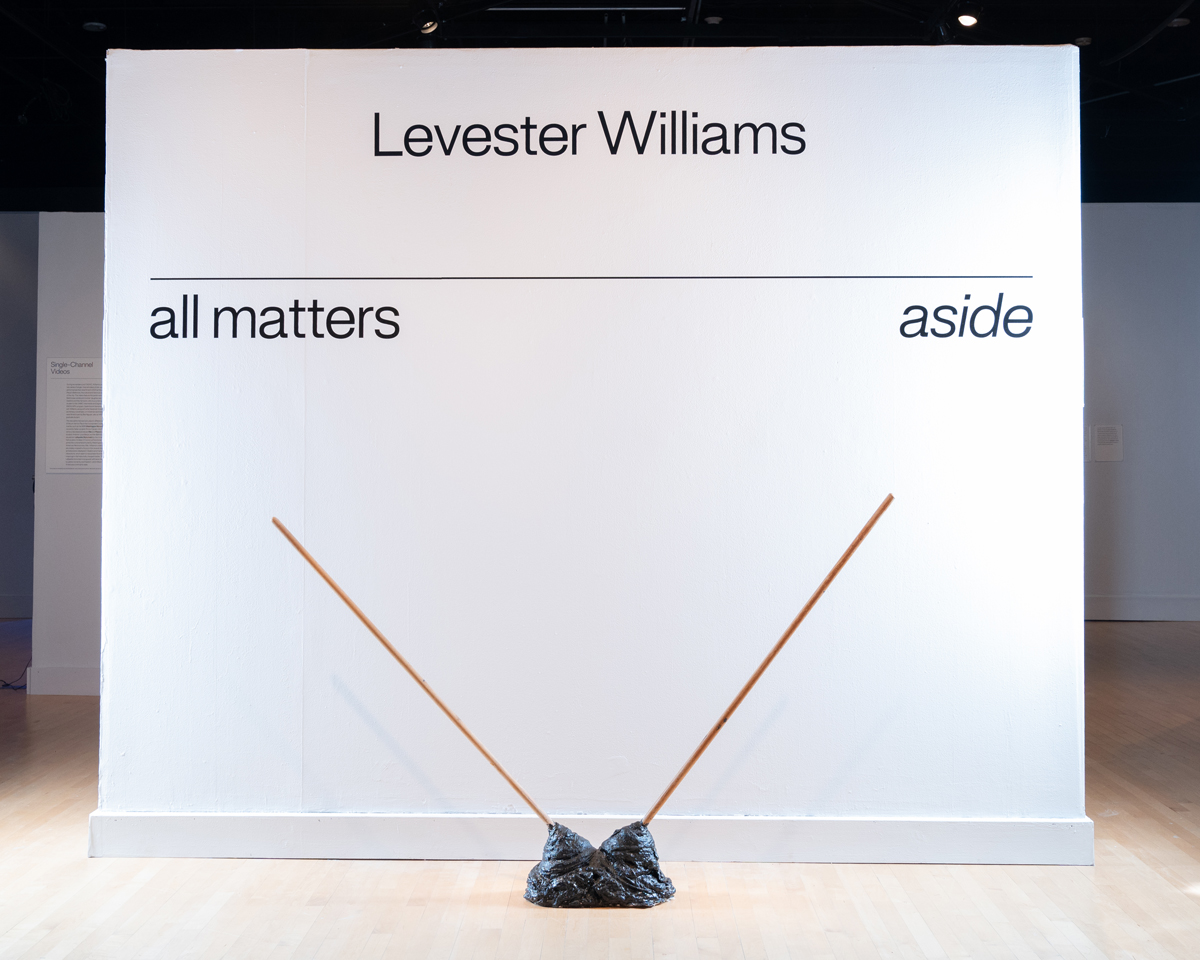
Walking into Levester Williams’ all matters aside—on view through December 14 at UMBC’s Center for Art, Design, and Visual Culture (CADVC)— viewers first encounter a wall with the exhibition’s title and an installation that functions as a microcosm of the show’s logic. “Double Up (Doubling),” is a pair of mop handles splayed apart: one points to the words, “all matters” and spaced widely to the right, the other to an elision in italics: “aside.” An invitation to the illusion of choice and the power of material narrative as an entry point.

To the left, just past the “all matters” figuration, its relativities are investigated, and to the right, “aside,” interiority, in-jokes, and the power of play take precedent. Referring to the “double consciousness” outlined in DuBois’ The Souls of Black Folk (1903), the titling also seems a dare: double the doubling, and so forth, until you reach infinity, or at least a multitude that cannot be contained. Identities ascribed by an inherently carceral system are both cemented and undone, unstable.

Twin bundles at the base of the piece, set in a matte black material, contain penitentiary sheets described in wall text as “unclean,” setting a tonal precedent that judgments made about moral and material purity are subject to critical review. These both-sides are also the same entire survey, and atop a large plinth directly behind the white wall, the monumental, stiffened rear legs of a bronze horse disrupts a central space with explicative curatorial text that could otherwise be considered a foyer for all matters aside.
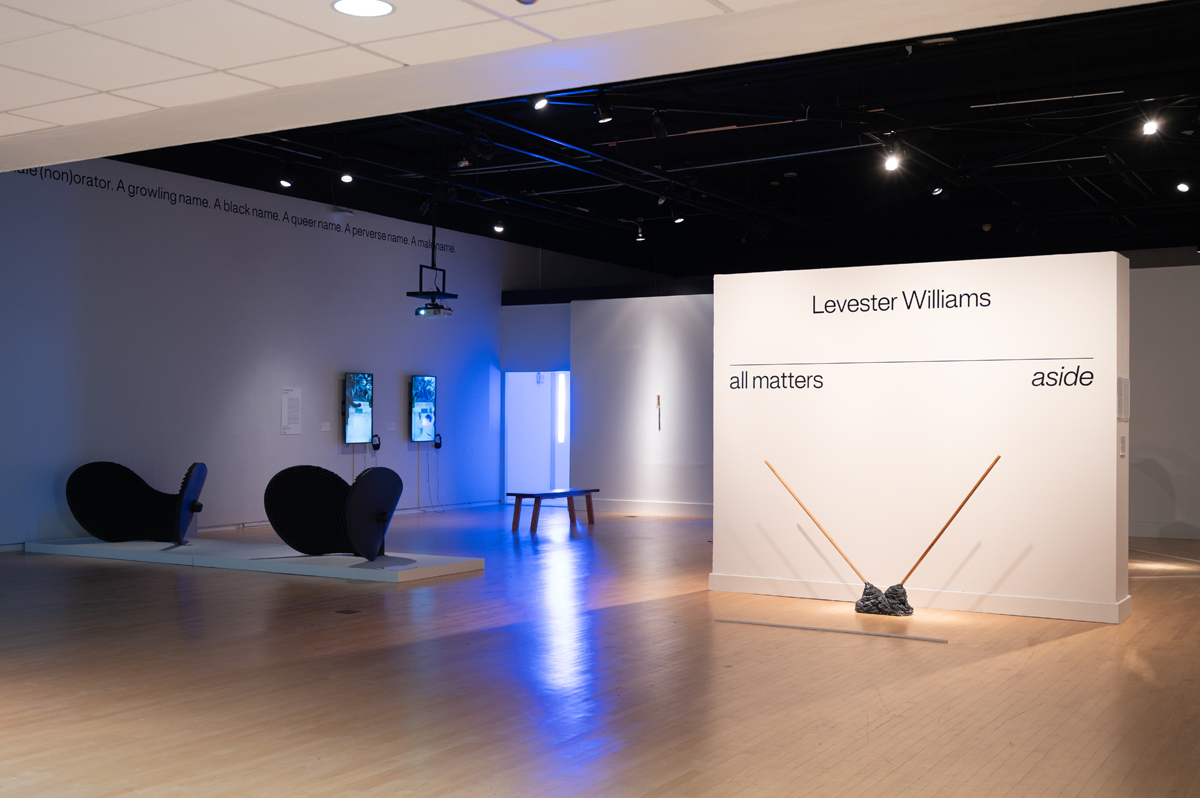
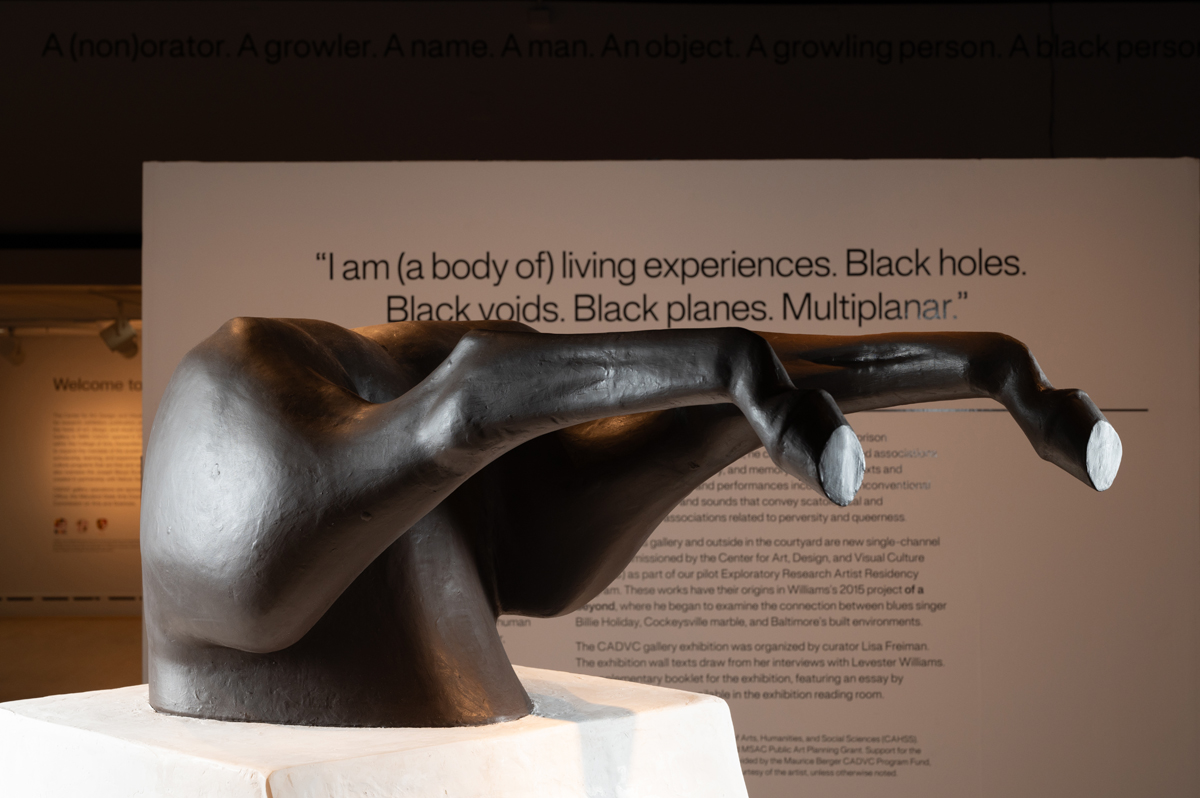
Photo: Tedd Henn. Courtesy of Center for Art, Design, and Visual Culture at UMBC (CADVC)
The monumental, stiffened rear legs of a bronze horse disrupts a central space...
Lexie Mountain

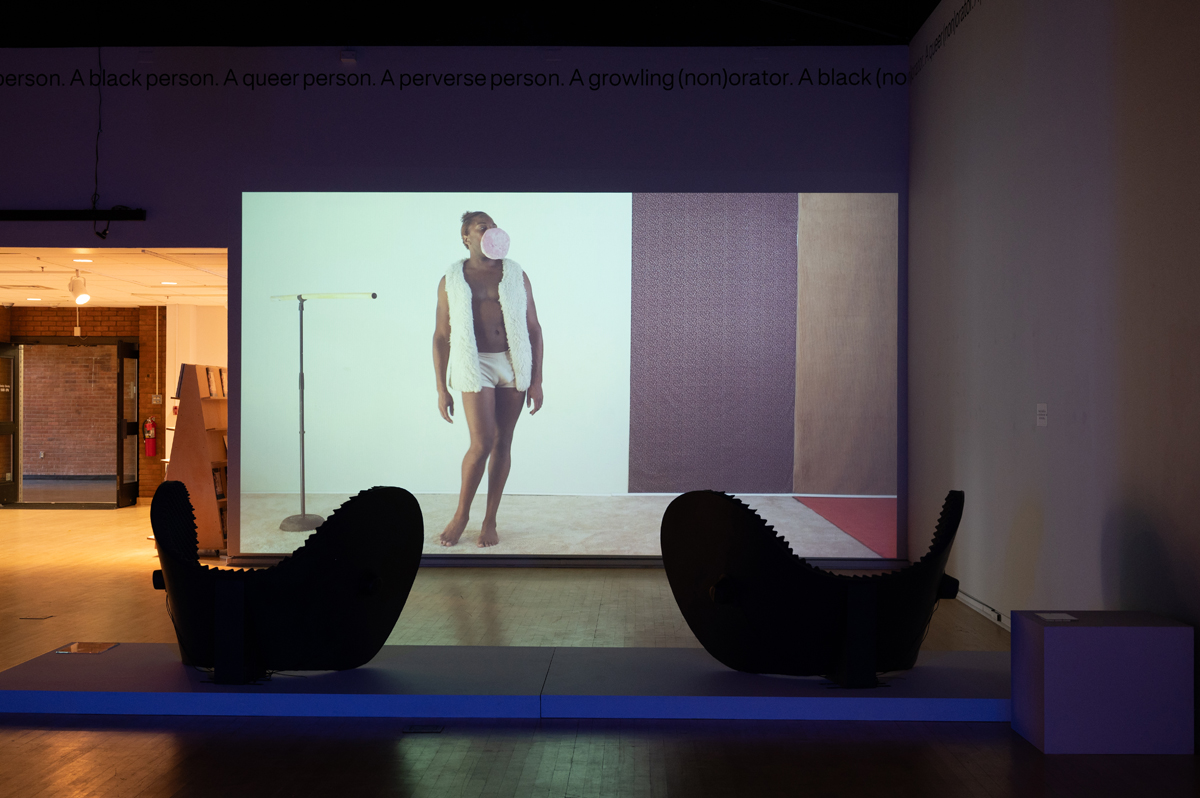
Adjacent to the exhibition’s primary entryway, small street-scene photographs outlining a site-specific series of radical sculptural pothole repairs invite close inspection. Bold, placarded quotes from Fanon, DuBois, Derrida, and more flank a desk piled with books. Text appears as a tool for performance, meditation, and mediation. The upper edges of the gallery sports a wreath of sans serif litany or incantation: “A man. An object. A growling person. A black person. A queer person. A perverse person.” This personhood dissolves, emerges, becomes a “(non) orator” containing and controlling the space, and the continuous phrasing changes slightly without arriving at any specific narrative finality.

Curated by Lisa D. Freiman, Levester Williams: all matters aside is an expansive survey of the Philadelphia-based artist’s works-to-date. While in residence at CADVC, Williams explored the social and cultural relevance of Cockeysville marble—engaging with historic narratives of Black Baltimore residents who quarried, shaped, placed, and nurtured the stone from its natural site to its current manifestations as front steps on iconic working-class rowhomes as well as canonical sculpture pieces along the streets of Mt. Vernon.

Natural materials shaped by labor, class, culture, and resistance is a point of near-infinite expansion, and Williams seeks to encapsulate these outwardly spiraling universes through a series of video pieces that are at once distanced and scientific, yet intimately personal.

"‘til we all foul (a new monument)," (detail) 2021, Black pepper, sand, and calcium carbonate mixed in gypsum cement; painted epoxy resin on milled extruded polystyrene. Photo: Tedd Henn. Courtesy of Center for Art, Design, and Visual Culture at UMBC (CADVC)
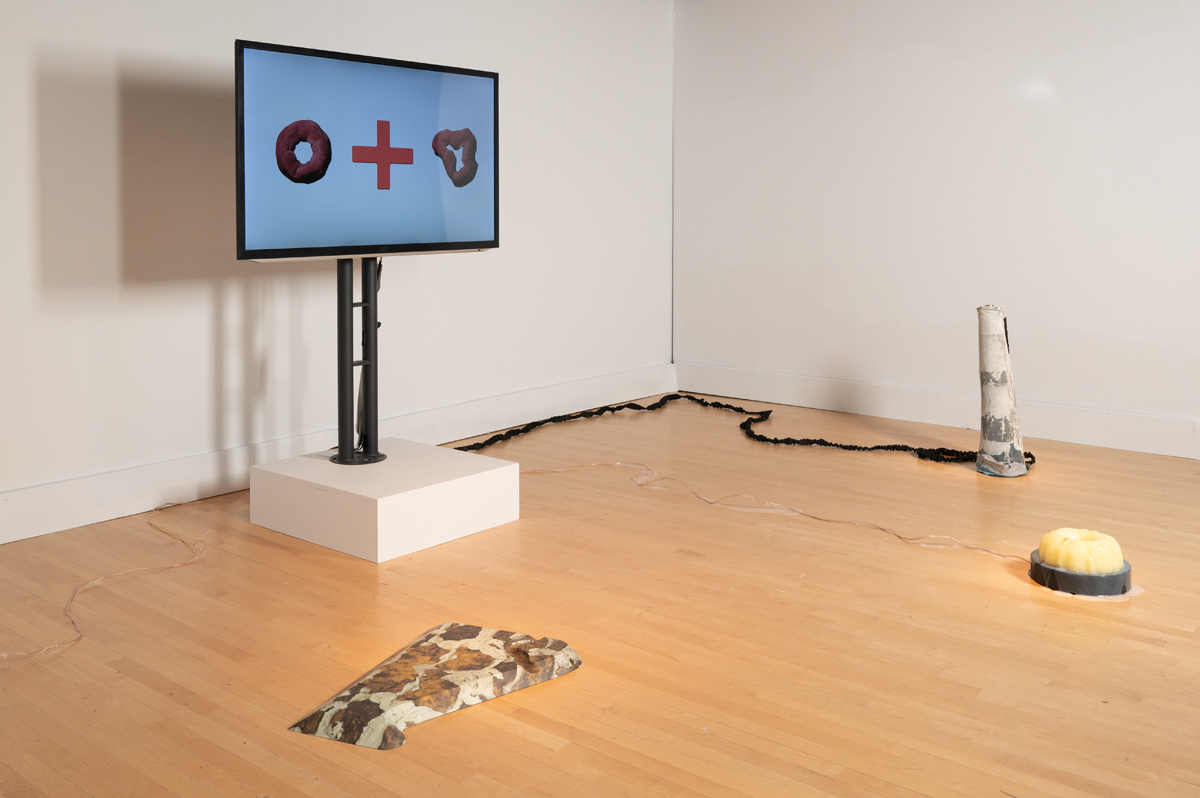
Installation with artworks including: "O + ~O 4K," animation, color, sound 4:00 2024; "Douglass’ study," vinyl on MDF 25” x 16” x 3”, 2016; and "hoist moist," silicone rubber cast of artist’s nipples, paint on wood, transducer, speaker wire, sound. Photo: Tedd Henn. Courtesy of Center for Art, Design, and Visual Culture at UMBC (CADVC)
Natural materials shaped by labor, class, culture, and resistance is a point of near-infinite expansion.
Lexie Mountain

all matters aside itself generates a sort of multiplicative effect: Williams’ processes point simultaneously at psychological and physical levels through a myriad of explorative forms. Toward the task of exposing the complications and often imperceptible yet seismic relativities of existing—as Black, queer, trans, male, female—Williams engages sculpture, video, sound, and subtle modes of installation.

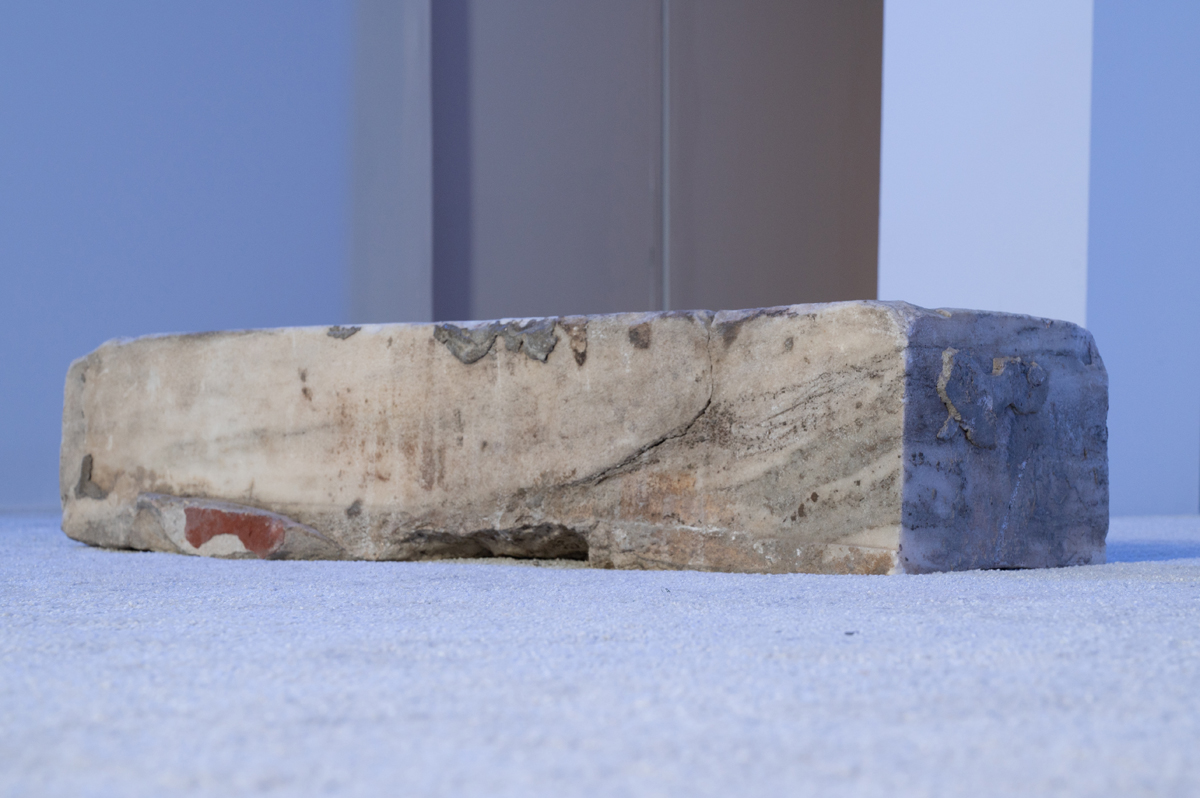
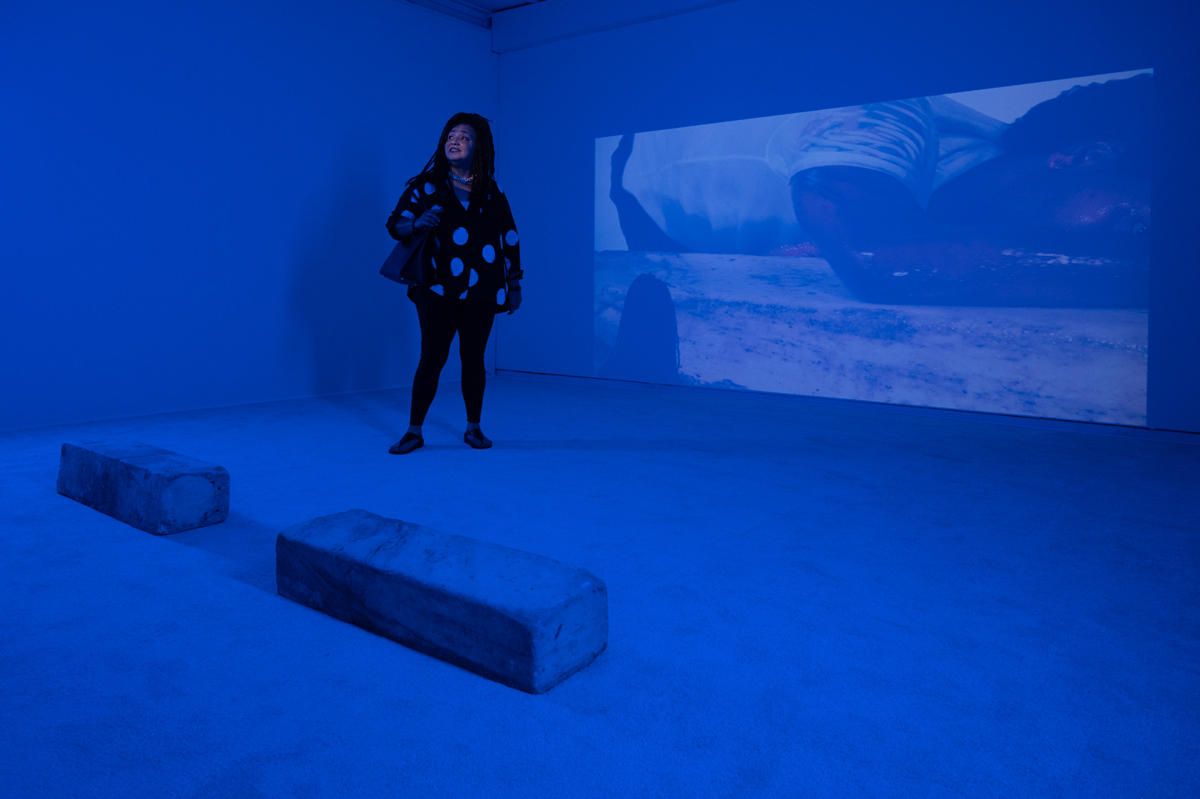
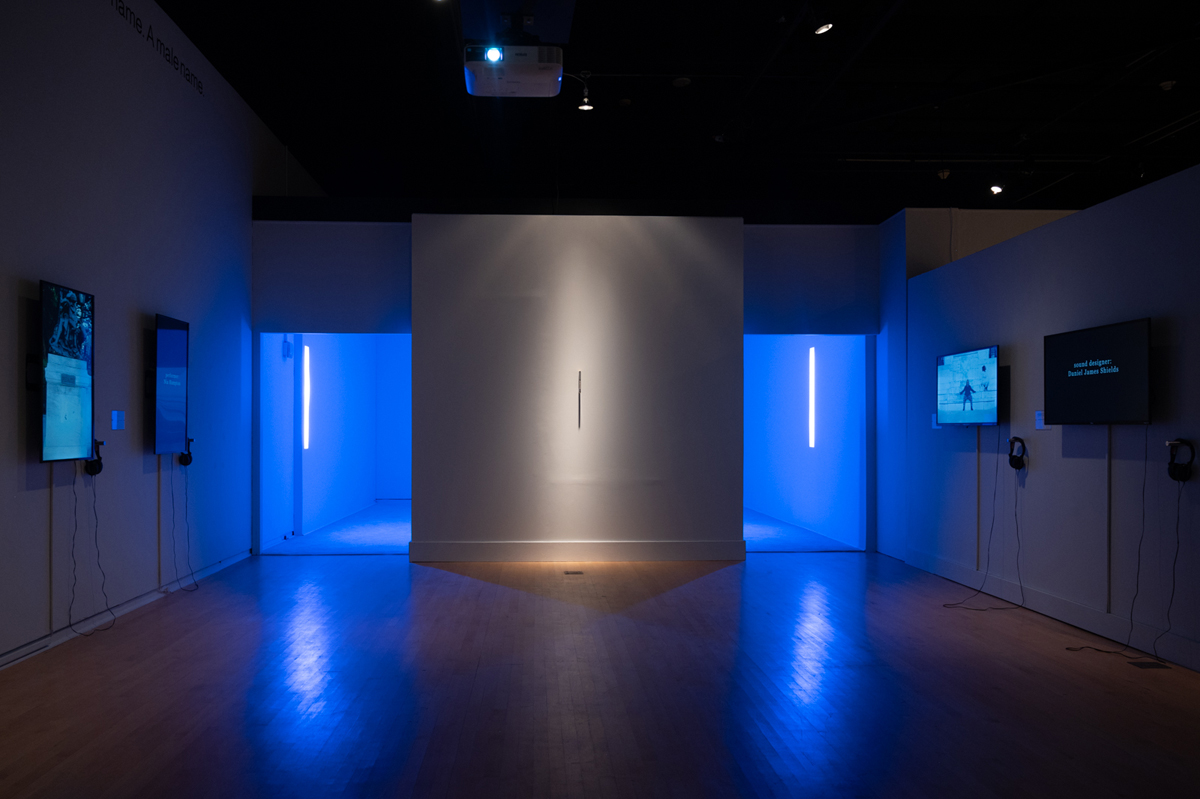
In some cases, the exposures are literal. Blue light panels in CADVC’s formerly black box room ensure the visibility of two long cuboid hunks of Cockeysville marble. It feels worn and carved by hand, positioned low to the ground in the space as sculptural gestures which could either function as seating or a reference to seating and human interplay.

These elements of removal and recapture thread throughout the exhibition, alongside the motif of the Torus, a three-dimensional tubular ring shape that differentiates itself from the humble donut by the parameters of its revolution.

Interiority and exteriority as simultaneous dimensions are made literal. Williams’ exploration of applied forces upon material entity is also multiplanar, and the idea of revolution as both a physical act and a place of existence can be felt in a field of a series of small sculptures that engage, variously: the facade of Frederick Douglass’ home, a groaning denim obelisk, and a bundt cake sparkling with gently opaque slime.

The boundary wall framing the “black” box ingress/ egresses contains a vintage paperback of Lady Sings the Blues and when I say contain, I mean the book is cleanly embedded in sheetrock, hovering at about 6’ up from the floor. On the cover, Lady Day seems to be emerging, maybe protected, by the wall itself. 

The relationship between Blackness and blue-ness is in action here—the intangibility of an unearthly glow referencing the physicality of the lives of Black artists whose work and humanity is subject to the voracity of popular culture at the service of white supremacy and imperialism.

It is no wonder that the video on a loop in this blue room—in which a closely-framed young man gliding a puck of solid coconut oil across a marble slab until it disappears and both the man and the marble are glistening—exhibits an eye-watering tenderness and determination. Here, also, shine and shimmer infer the labor required to hone a jagged block of stone to a scale fit for human use, while perhaps suggesting that labor towards distraction is also valid, referencing bodily fluid, pleasure, pain, exposure. The glisten disrupts the self-importance of the monumental. 

“a centerpiece (Lady Sings the Blues),” 2021, Lady Sings the Blues, Billie Holiday’s autobiography, inserted into a gallery wall, Dimensions variable. Photo: Tedd Henn. Courtesy of Center for Art, Design, and Visual Culture at UMBC (CADVC)
"of a beyond II," (detail) 2024, Hand-scoured and hand-washed Cockeysville marble stoops from Baltimore, Maryland; carpet; fluorescent lights; powder-coated steel; Plexiglas. Photo: Tedd Henn. Courtesy of Center for Art, Design, and Visual Culture at UMBC (CADVC)
"of a beyond II," 2024, Hand-scoured and hand-washed Cockeysville marble stoops from Baltimore, Maryland; carpet; fluorescent lights; powder-coated steel; Plexiglas. Photo: Tedd Henn. Courtesy of Center for Art, Design, and Visual Culture at UMBC (CADVC)

The physicality of outcome and the human relationship to the monumental is explored further in a series of videos featuring Baltimore artist Sheila Gaskins and her daughter Nia Hampton, an artist and performer presently enrolled in UMBC’s Intermedia and Digital Arts (IMDA) graduate program. [Full disclosure, the author of this review graduated from the UMBC IMDA program in 2014 and worked at the CADVC while enrolled].

IMDA graduate students populate the atmosphere: of the currently enrolled, Bao Nguyen assisted in video production for Williams, and Ahlam Khamis staffs the CADVC. Of the matriculated, large video works are projected onto a side of the CADVC building through the exhaustive efforts of alumna Rahne Alexander to activate the adjoining amphitheater. Williams’ effervescence and multifaceted passion for connection finds a fitting reflection in this space.

In “no duty more sacred” Hampton and Gaskins engage with Cockeysville marble accessible in Baltimore City’s Mount Vernon Place, adjacent to the Washington Monument. Layered, flowing black cloaks lend Gaskins—a proficient comedian and humorist—a monastic, mage-like energy while Hampton’s bone-white sherpa suit, similarly monochromatic, projects self-soothing comfort in a sci-fi uniform. As a pair, Gaskins and Hampton trace the tightly-fit steps of Mount Vernon place, as if waiting for something to happen and making something happen at the same time.

The tension of stray movements within a largely monochromatic field lend the import of ritual. In two portrait-framed screens, Hampton and Gaskins peruse one of the Antoine-Louis Barye “War and Peace” sculptures in Washington Place, generating similar forms of intimate suspense through caresses and embraces. Their actions, informed by intimacy coordinator Savannah Knoop, draw strength into the sculpture’s pedestals, not from. Here, and throughout Williams’ “all matters aside,” the power is returned to the source by the powerful. 

"Shift, Sift, Swoosh, Bods," 2018, HD video, color, four audio channels, 17:33. Photo: Tedd Henn. Courtesy of Center for Art, Design, and Visual Culture at UMBC (CADVC)
"Levester Williams: all matters aside" Exhibition overview with "of a beyond II," 2024, Hand-scoured and hand-washed Cockeysville marble stoops from Baltimore, Maryland; carpet; fluorescent lights; powder-coated steel; Plexiglas. Photo: Tedd Henn. Courtesy of Center for Art, Design, and Visual Culture at UMBC (CADVC)
Related Stories
Ikhide's "Tales From Future Past" is on View through November 22 at CPM

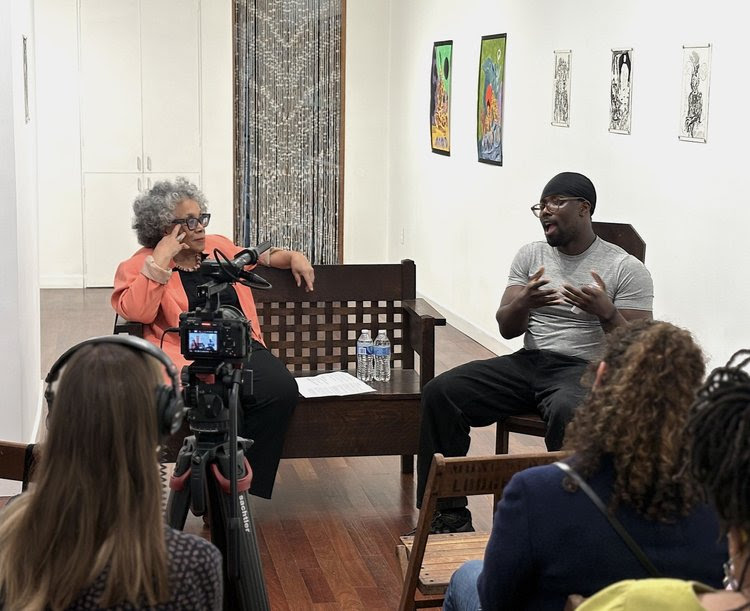
CPM Gallery recently announced that the run of Richard Ayodeji Ikhide's solo exhibition "Tales from Future Past" would be extended to November 22 by appointment. At the opening on September 27, the British-Nigerian artist was interviewed by luminary art historian, curator, and educator Lowery Sims.

In "Pandarayuhan: Home is a Memory" Divinagracia Explores Immigration and Identity at Creative Alliance

"One of my biggest intentions with this show was to really spotlight Filipino presence in Baltimore and specifically immigrant lives and journeys.”

Baltimore art news updates from independent & regional media

This week's news includes: Amy Sherald shines brightly in Baltimore, Hilton Carter makes his house a home, Inviting Light returns with a Wickerham & Lomax, John Akomfrah moving image + sound installation opens at the BMA, mayorial portraits unveiled at City Hall, Maryland Film Fest is here, and more

Swagger and Style at the BmoreArt Release Party for Issue 20

On Saturday, November 1, BmoreArt hosted 400+ guests at the Icons Ball & Benefit at the Lord Baltimore Hotel.