Reading

Timely and Timeless: Amy Sherald’s “American Sublime” at the BMA

Previous Story
Article Image

Fall Comes to Light: Garden Glow at Ladew

Next Story
Article Image

Iconically Yours: BmoreArt Icons Ball Party Photos

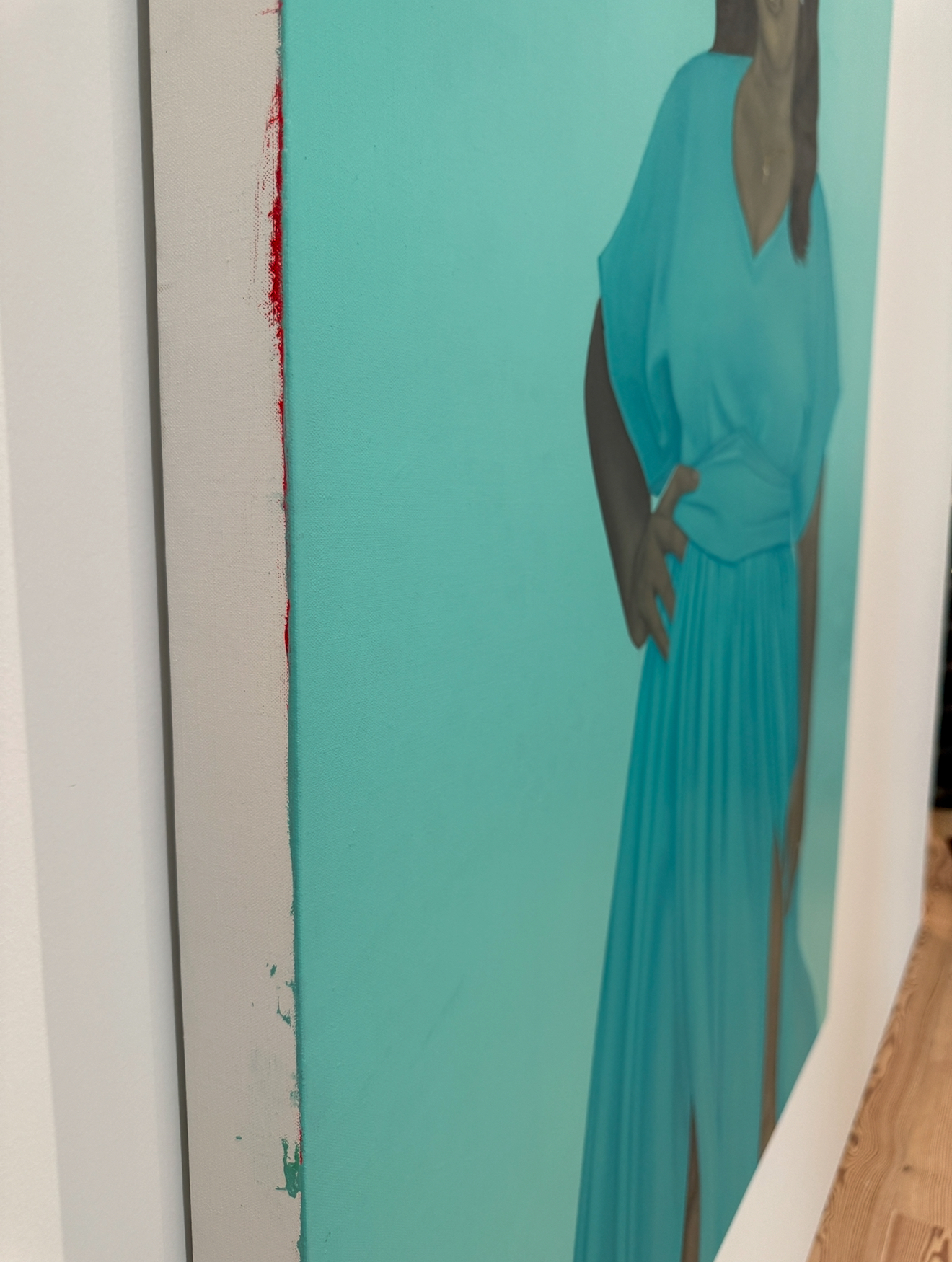
One tiny but important clue in Amy Sherald’s posthumous portrait of Breonna Taylor can be found on the raw canvas on the side of the painting: a scumbled slash of pure cadmium red, peeking out from under the Robins-egg blue background. Although you can’t see the red when looking directly at the painting, the layer adds warmth, subtly alluding to the blood pulsing under Taylor’s luminous skin, rendered in Grisaille, or grayscale. 

This strategy of red underpainting goes back to 16th century Venetian painters like Titian and Tintoretto, who used rusty pigments as a base layer to render cool hues more vibrant and fleshtones more lifelike. Coupled with Sherald’s signature Grisaille, a technique used since the Middle Ages to create the illusion of volume on a painted surface, the skin in her portraits of Black American subjects takes on a magical quality.

Now known as Sherald’s signature stylistic move, her rendering of skin in grayscale functions as a metaphor for race in America, evoking  Ralph Ellison’s “Invisible Man” and Toni Morrison’s “The Bluest Eye,” while also summoning the nostalgic elegance of antique black and white photos, transforming each sitter into a modern day icon. 

Sherald is a quintessentially contemporary figurative painter, perhaps the most important of our generation. The realization that she deliberately employs, and adjusts as needed, centuries-old painting techniques in order to arrive at images that belong in the art historical cannon is an Easter Egg for art nerds and historians; it speaks to the deliberate nature of her work. 
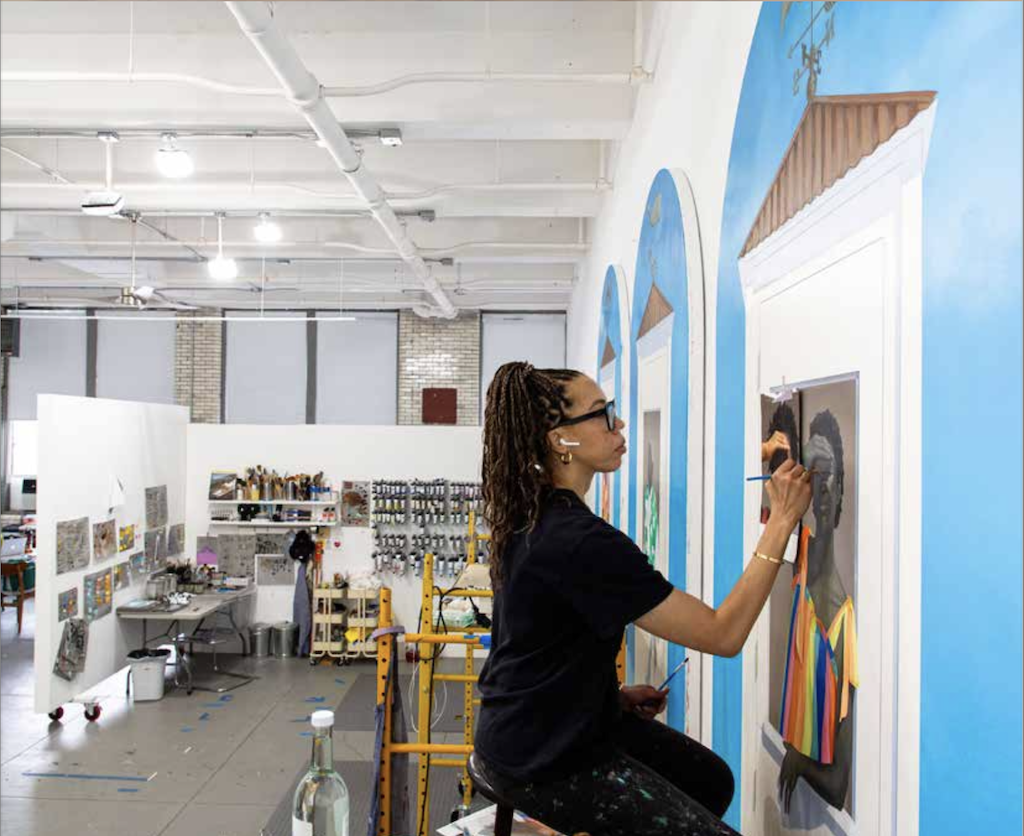
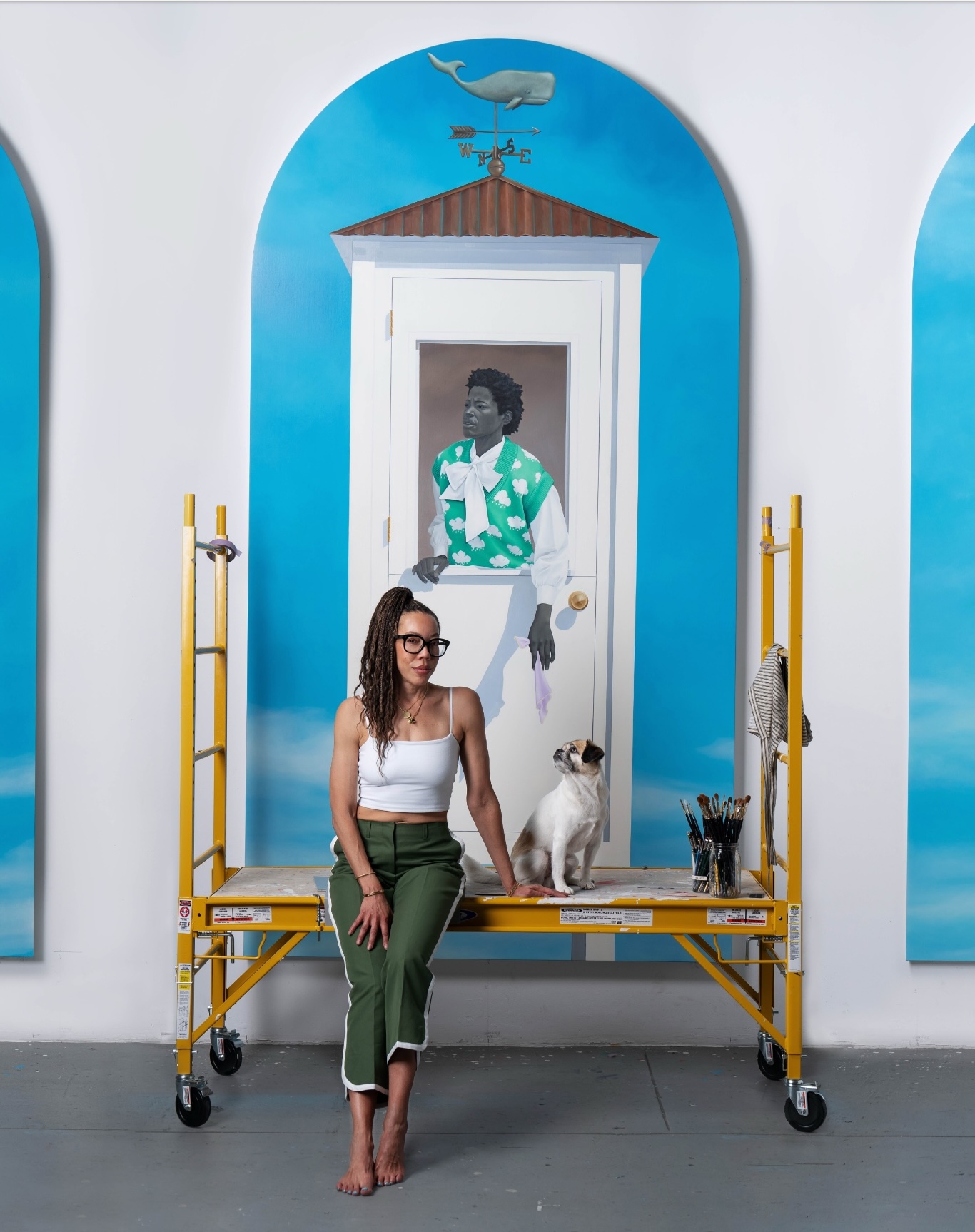
Amy Sherald in her studio, photo by Kelvin Bulluck

For decades, long before painting Michelle Obama’s official portrait and obtaining global representation at mega-gallery Hauser and Wirth, Sherald’s stated goal has been to challenge the status quo of art history through the inclusion of Black American subjects, depicting individuals in a way that inserts them seamlessly into the permanent collections of museums all over the world.

These works, for the most part, portray ordinary people the artist encounters in her daily life, harnessing the power and language of historical portraiture and minting new icons. Sherald presents each subject as an elevated version of themselves, giving them the nobility previously reserved for the depiction of a monarch or patron of the arts that, in the encyclopedic Western museums Sherald encountered as a child, is (almost) always white. 

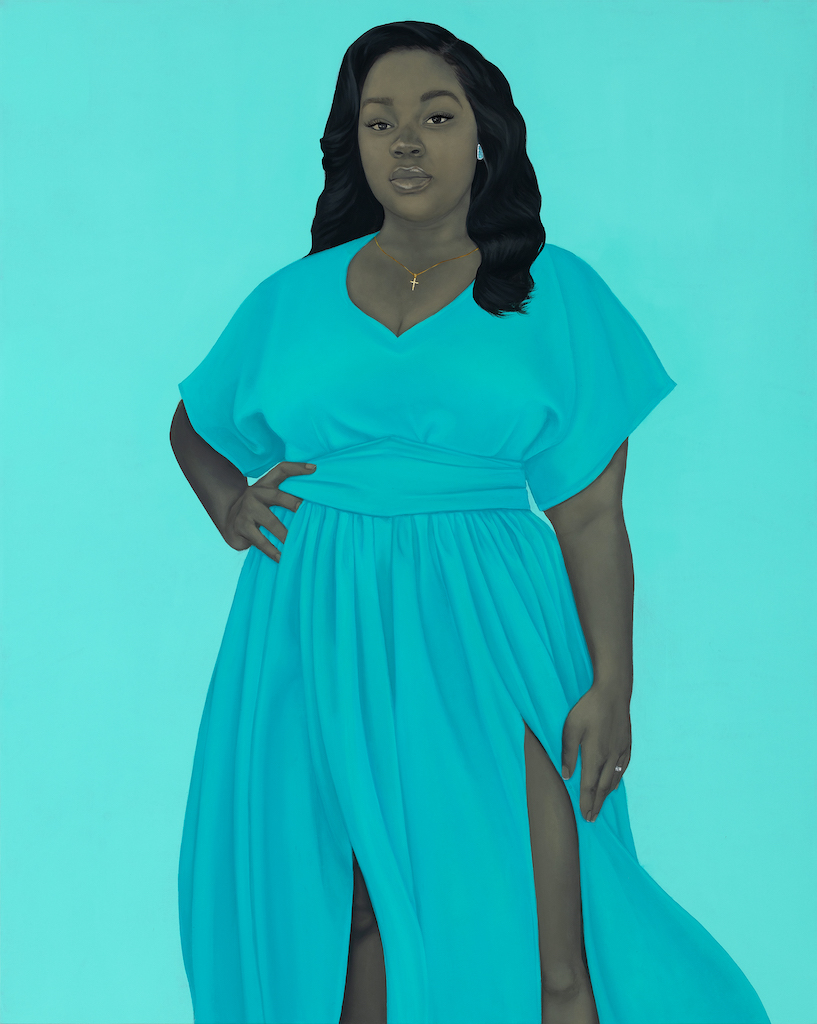
The best paintings reward you for slow and careful looking, with all manner of secrets revealed. Of all the paintings on display in Amy Sherald: American Sublime, a mid-career survey of approximately forty works across two decades now on view at the Baltimore Museum of Art (BMA) through April 5, 2025, Sherald’s portrait of 26-year-old Breonna Taylor commissioned for the cover of Vanity Fair has taken hold of me. 

Portrait of Breonna Taylor, photo by Joe Hyde
Breonna Taylor, detail, photo by the author

From a distance, the young woman is magnetic. Her solemn eyes beckon from across the roomseeing you clearly, glinting intimately. Her gaze is the visage of someone wise beyond their years, smoldering with the deep knowledge of life and death. Then you notice the subtle shimmer of her lips, a gold cross hanging from a chain around her neck reminding you that she was a woman of faith, and her hand on her hip with an engagement ring, a crisp French manicure on her short but tidy fingernails. The diagonal folds of her crepe dress, designed for the portrait by Jasmine Elder of JIBRI, direct your eyes back to her face, a vertical framing element that elongates her body slightly through gentle waves of aquamarine. 

This elegant, lone figurereminiscent of Ingres or Delacroixis both tragic and triumphant: a beautiful woman but also a sainted martyr of racial violence in modern America. The life-size portrait is expertly rendered to give Taylor the veneration she deservesattempting to replace, in some small way, what was stolen from her. 

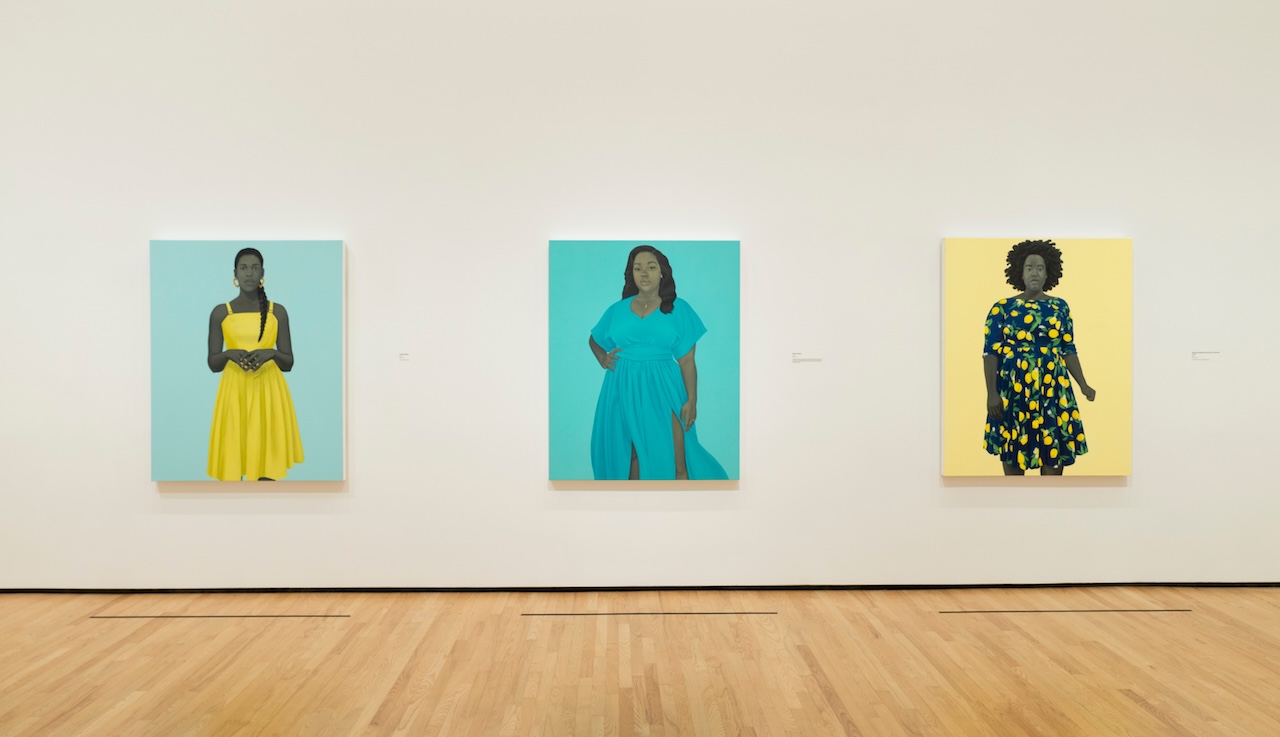
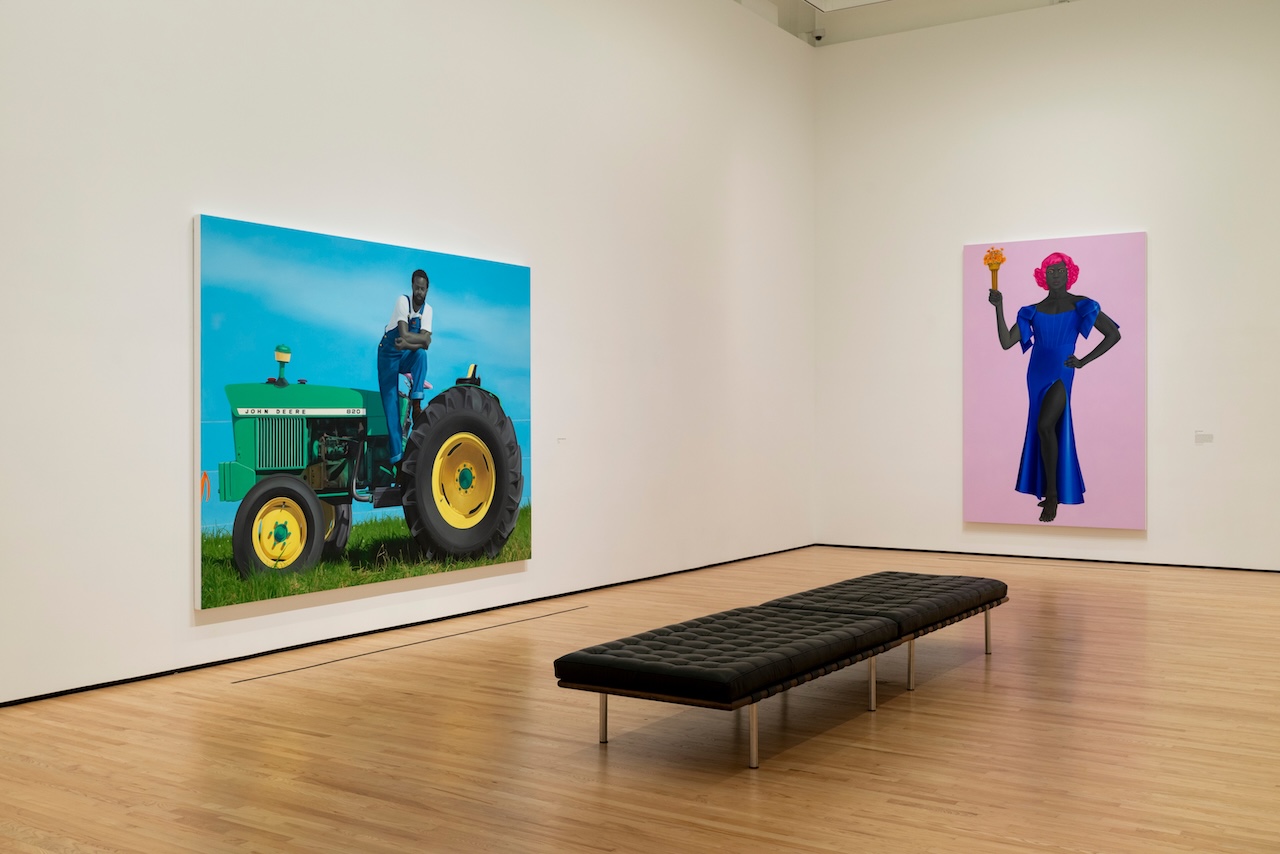
Within the larger context of American Sublime, the Taylor portrait feels at home, nestled between dozens of kindred depictions of young Black Americans. In the newest works of the show, Sherald has scaled her vision up, including larger than life-sized paintings that include elements of landscape and architecture, culminating in the monumental three-panel Ecclesia (The Meeting of Inheritance and Horizons).

Amy Sherald's portrait of Breonna Taylor in American Sublime at the BMA, photo by Mitro Hood
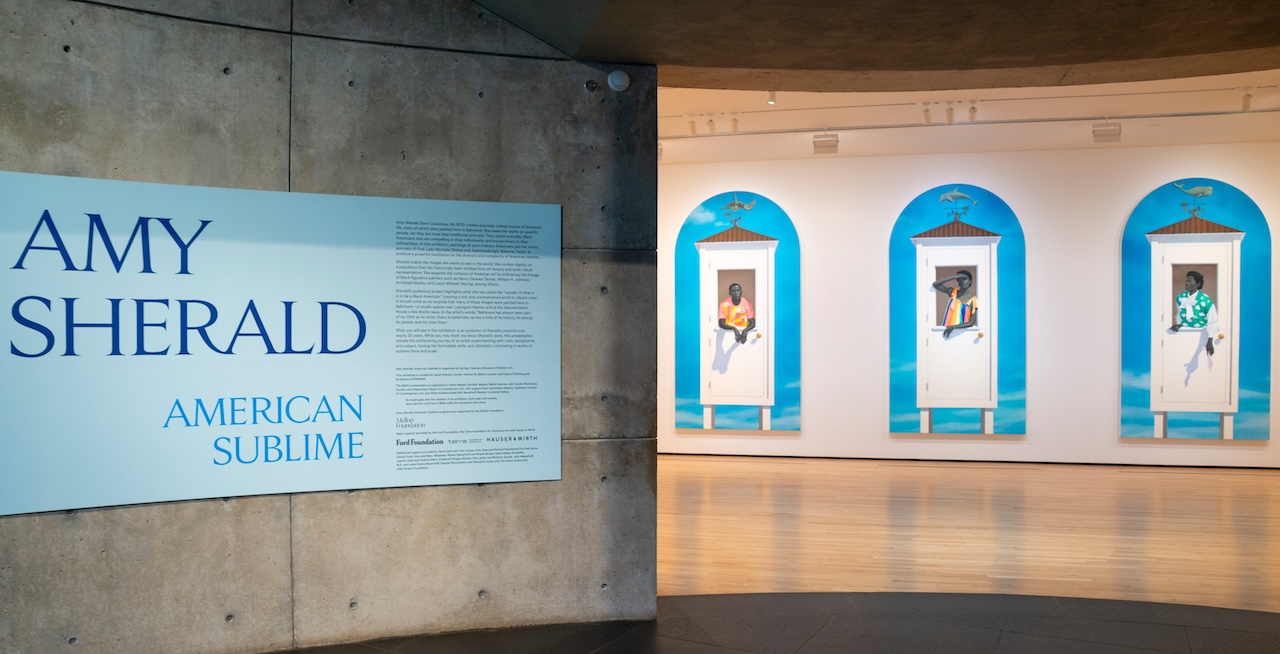
Amy Sherald: American Sublime at the BMA, Ecclesia, 2024, photo by Mitro Hood

Similar to Taylor’s portrait, a regal aquamarine blue grounds the figures in sky and tropical ocean hues, and the skin of each of the three subjects is rendered in grayscale, but not without a subtle warmth pulsing beneath the surface. However, this time Sherald employs a strict composition with architectural framing elements to reference Gothic cathedrals and religious altarpieces, where large rectangular compositions with rounded tops were once painted inside arches. In Ecclesia, three lifesize figures gaze into the distance from within stark white copper-roofed towers, high above the viewer’s eyeline but also shadowed by glaring midday sun. 

The ambiguous setting is referenced in the mysterious title of the piece; “ecclesia” coming from the Greek word ekklesia, meaning congregation or assembly, often translated as “church” in the New Testament. What’s curious about Sherald’s composition is that her three figures appear to be singular and unaware of each other, definitely not a collective gathering, despite their deliberate arrangement in a triptych. Rather than thinking they’re different people within the same repeated space, the artist has painted three unique weather vanes atop each white box, featuring different marine lifedolphin, whale, and turtleto show that each, while almost identical, is unique.

Since the term “ecclesia” alludes to a gathering, this forces the viewer to consider alternate ways that disparate individuals can come together around a shared goal, even if separated by geography, place, generation, or dogma. All three figures appear to be waiting, calmly, for someone or something to happen; their poise, elegant clothing, and elevated status surrounded by sky transforms each sitter into timeless versions of themselves: idealized, divine, and certainly allegorical.

Amy Sherald's American Sublime at the BMA, photo by Mitro Hood

Throughout the mid-career survey, the weight of its title, American Sublime, animates every single work with the artist’s desire to ennoble people who look like her, linking them indelibly to a shared art history, in order to make sure they are visibly present forever in public museum collections. Each figure is quintessentially American and uses specific props and clothing to place them in this time period. Each figure is also idealized and composed atop simple color-blocked backgrounds for a result that is sublime and worthy of admiration.

After successful runs at San Francisco MOMA and the Whitney Museum, Sublime was slated to open at the Smithsonian’s National Portrait Gallery in September 2025. However, once Sherald realized that one or more of the paintings from the show might be removed in order to bend towards the current political climate, she cancelled the exhibition, despite it being the museum’s first solo show of a contemporary African American artist and a landmark moment in history. In a lightning-speed decision, the BMA was able to decisively step up and provide an unfettered platform for Sherald’s vision to be realized.

“This country’s story has always been a contradiction,” wrote Sherald in an August 24 MSNBC opinion editorial. “Slavery alongside freedom. Erasure alongside invention. Art carries what is too heavy for language to hold. And museums, at their best, give us the full picture rather than the flattering one. That independence is not ornamental. It is as vital to democracy as the freedom of the press.”

Seeing these canonical works back in Baltimore, the city where Sherald attended MICA’s Hoffberger School of Painting and spent the first decade of her art career, is a cumulative, full circle moment. At least half of the models depicted in Sublime are from Baltimore. It gives the exhibition the feeling of an ecclesiastic gathering of old friends, a family reunion, a sacred circle. In Baltimore, American Sublime offers longtime Sherald fans and friends the opportunity to see ourselves reflected on her canvases, both timeless and timely.

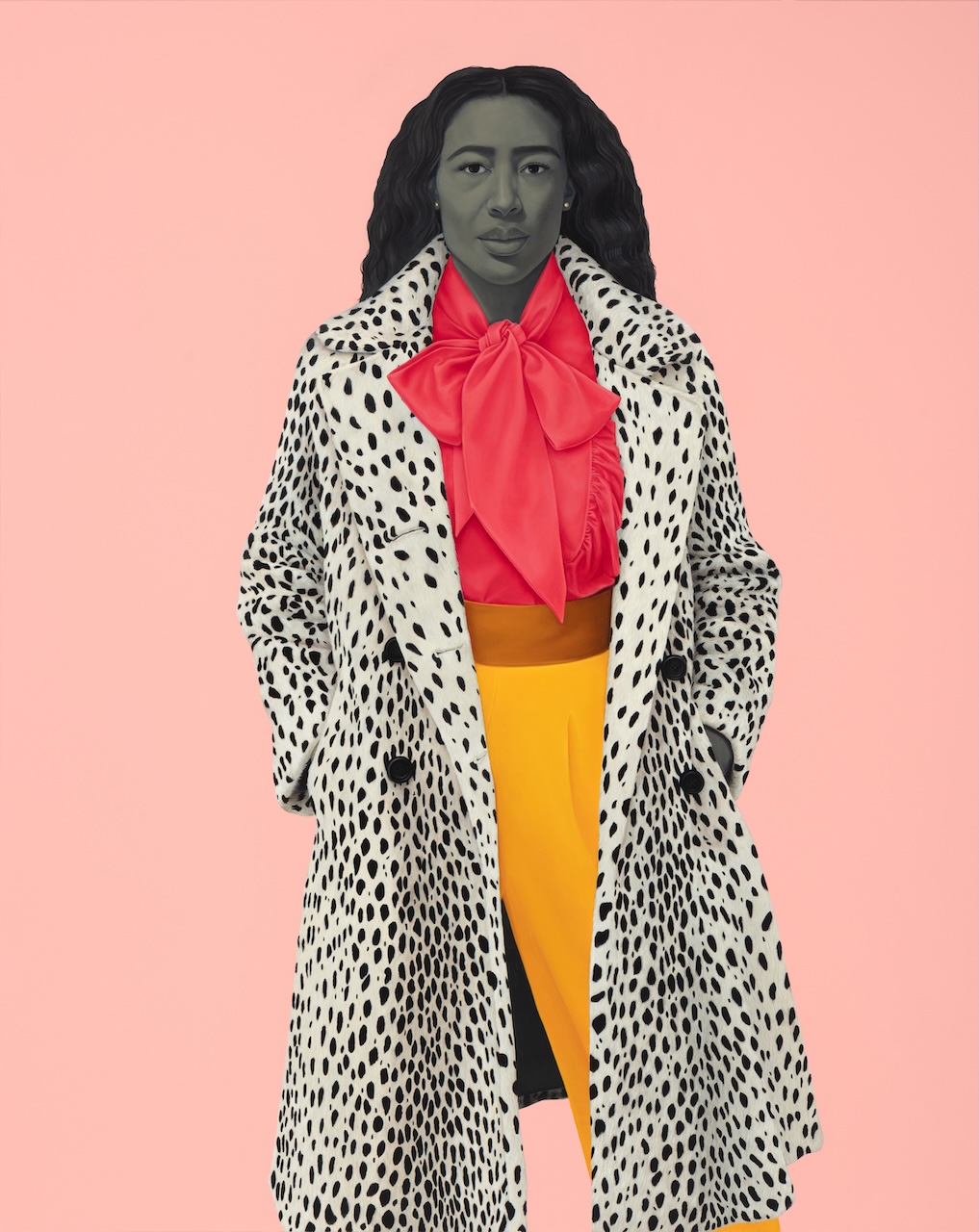
Amy Sherald, "As American as Apple Pie," 2020, at the BMA
Amy Sherald, "As Soft as She Is," 2022, at the BMA

Photos courtesy of Kelvin Bulluck and the Whitney Museum of Art

This story is from Issue 20: The Icons,

Related Stories
Ikhide's "Tales From Future Past" is on View through November 22 at CPM

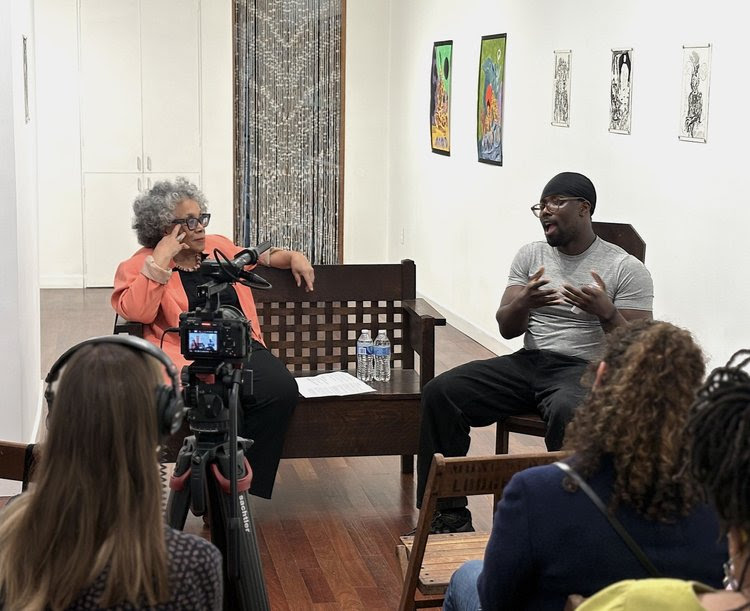
CPM Gallery recently announced that the run of Richard Ayodeji Ikhide's solo exhibition "Tales from Future Past" would be extended to November 22 by appointment. At the opening on September 27, the British-Nigerian artist was interviewed by luminary art historian, curator, and educator Lowery Sims.

In "Pandarayuhan: Home is a Memory" Divinagracia Explores Immigration and Identity at Creative Alliance

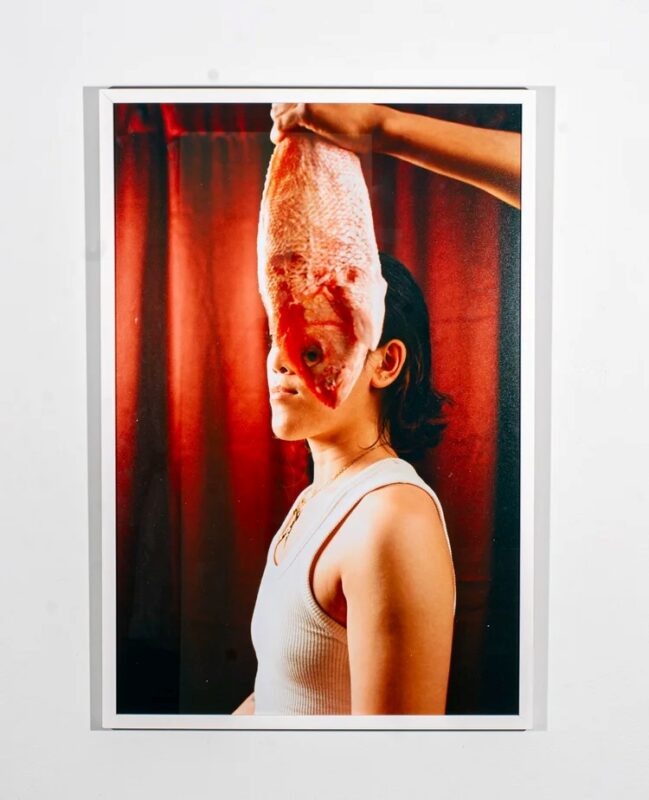
"One of my biggest intentions with this show was to really spotlight Filipino presence in Baltimore and specifically immigrant lives and journeys.”

Baltimore art news updates from independent & regional media

This week's news includes: Amy Sherald shines brightly in Baltimore, Hilton Carter makes his house a home, Inviting Light returns with a Wickerham & Lomax, John Akomfrah moving image + sound installation opens at the BMA, mayorial portraits unveiled at City Hall, Maryland Film Fest is here, and more

Swagger and Style at the BmoreArt Release Party for Issue 20

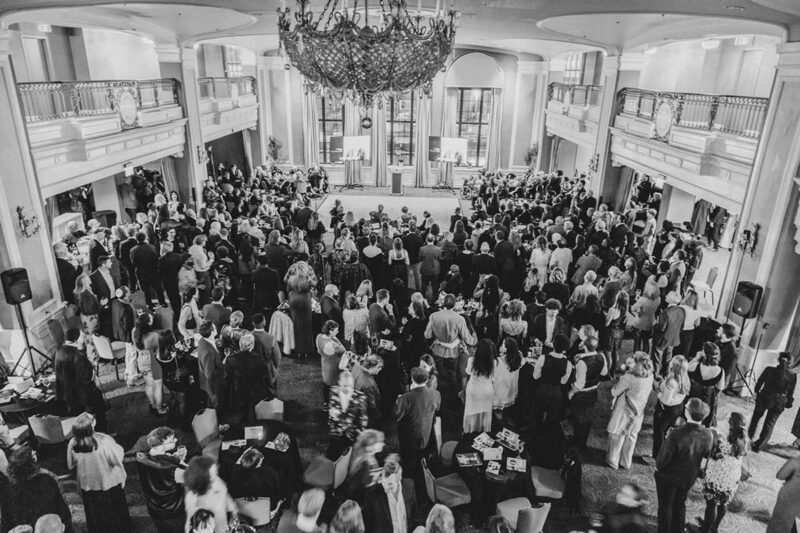
On Saturday, November 1, BmoreArt hosted 400+ guests at the Icons Ball & Benefit at the Lord Baltimore Hotel.